
Subscriber Benefit
As a subscriber you can listen to articles at work, in the car, or while you work out. Subscribe Now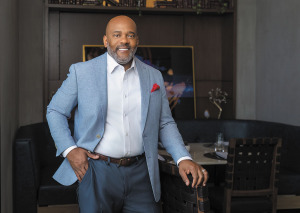
The Indianapolis Recorder Newspaper this summer celebrates 130 years covering the Black community, and its current CEO says the media organization is just as relevant now as it was when it started as a two-page church bulletin in 1895.
Founding publishers George P. Stewart and Will Porter launched the publication specifically for the church community, but by 1897, it had evolved into a newspaper focused on news and opinion for and about marginalized communities.
Parent Recorder Media Group launched the Indiana Minority Business Magazine to cover minority business issues statewide and created the Champions of Diversity event.
Robert Shegog became CEO of Recorder Media Group in 2018 and has focused on building the news organization’s multimedia platforms and strengthening partnerships with civic, nonprofit and corporate organizations across the city and state.
He told IBJ that in an age of misinformation and media consolidation, independent journalism remains crucial for all communities. This interview has been edited for clarity and length.
Why does Indianapolis need a newspaper focused on the Black community?
The Recorder is more than just a newspaper. It was 130 years ago—in 1895—[that] the Recorder started, and we documented our community’s victories, struggles and contributions, often when no one else would. It’s so important to have a cultural institution, a trusted voice for the African American community.
And now, we are in an age of so much misinformation, disinformation and media consolidation, and we’re still an independent, Black-owned publication that is vital for accurate storytelling.
It’s hard for any media business to survive these days. How do you think the Recorder has been able to endure 130 years?
I think it is the love that the community has for us. Our two founding members wanted us to be a voice for the community. We love the community, and the community loves us. But a part of that also is that you have to be a trusted source.
You’re right: 130 years is a long time to survive for any business, especially a Black-owned media. So to me, it’s because of our forefathers, it’s our community, it’s our partners, it’s our unique collaborations and partnerships. It’s people and organizations believing in the Recorder.
Are there other Black-owned media companies in the United States that have such a long history?
Yes. We’re the third-oldest African American newspaper in the United States.
What are the challenges today for The Indianapolis Recorder?
I think the challenges are not just for the Recorder but for journalism—period. One of the big challenges for all local media is sustainability.
Journalism is under threat. There’s a decline in advertising revenue and not a lot of investment in media. A challenge is trying to diversify our revenue stream and grow our digital presence. There are people who are bloggers and people who are talking on YouTube or social media. They’re just blogging, blogging, blogging. People think they are media. But they are not. The Recorder, IBJ, The Star are trusted media sources who do things differently than these bloggers and who are accountable for what we do.
How is the Recorder attacking those problems that you just described?
I think the big opportunities are in being a multimedia storyteller, in leveraging our digital platforms to better serve our audience—our digital platforms meaning our two websites, our social media. But we also are building our strategic partnerships with the community, with civic organizations, with business leaders. That’s how you have to attack bringing in different revenue.
Also, we have two events a year, which helps us to diversify our revenue and make sure that we are alive and doing well for the next 130 years.
Why are events important?
Our Champions of Diversity event started about 20 years ago. It’s important to recognize people who are doing great things across the whole state of Indiana. This event has grown from a 400-person event to 1,200 over just the past 10 years.
You also have the Indiana Minority Business Magazine, which has its own website. Why have a magazine?
The Minority Business Magazine covers the whole state of Indiana. It started under the last president and CEO and covers topics that help keep the whole state engaged and informed about what’s going on.
One of my focuses is, how do we engage people, educate people and empower people? It’s important that we have a publication that does that for the entire state.
 Your weekly newspaper has a lot of contributions from the community in terms of columns and stories. Why is that important?
It’s important for me, for us to have diverse representation in voice—meaning Black, white, green or brown. We have to have different voices so we can understand everything that’s going on and hear about different topics—not just from our reporters, but from an Andre Carson, from a Sen. Young, from a Larry Smith. These are people who are trusted inside of their communities.
One challenge we have at IBJ and that is a challenge across the industry is finding reporters. Is that a challenge for you, especially finding diverse reporters?
Yes. I remember when I first started, I was trying to hire people within the community. But we just couldn’t find qualified people for certain positions. But I’m a big believer in hiring the right person who can get the job done.
In this day and age, it’s getting harder and harder to find certain reporters, which is why it’s really important to add the voices of some of these trusted leaders who can be columnists or someone from a school of business who can talk about business issues.
Journalism as we knew it, maybe 20 years ago, has changed. Being a journalist has always been a true passion. Today, for some people, it’s not about passion; it’s about money or about well-being. But it is a passion. You have to live it.
What do you see as the next opportunities and the next challenges for the Recorder?
The next opportunity is further expanding our multimedia platforms—even, how can we start dabbling with AI in the newsroom? We came from New York about a month ago where Google put on an event about AI in the newsroom. We need to figure out how we use some of these AI platforms to help us better streamline things and make us more efficient.
And moving forward, we’re going to double down on issues related to civic engagement, health, equity, economic justice and preserving our history while also mentoring young journalists. This summer, we have three interns—and one of the interns is in the 12th grade, in high school. We’re bringing him in three days a week, showing him the roles of journalism. That’s very important.
How did you come to work at the Recorder?
I’m not a journalist per se. My background is business and finance. But I love history. And I love putting systems in place. So I started at the Recorder part time about eight years ago, putting systems in place and helping them with their subscription model and helping diversify revenue.
But I love stories. I read a lot. I read the IBJ. I read The Star. I love all of it. News is more than news. It’s about telling the story of someone, and we need to keep that tradition going on and on.
Did you think when you started your career that you would ever be CEO of a newspaper?
No! I’m retired military, and I’ve had my own business. I tell people now that I never envisioned myself being the CEO of the Recorder newspaper. It was all in God’s hands. It was never my vision or my intent.
But I think sometimes we end up in certain jobs, certain positions to challenge us and to also challenge other people to do more and do better.•
Please enable JavaScript to view this content.
Editor's note: You can comment on IBJ stories by signing in to your IBJ account. If you have not registered, please sign up for a free account now. Please note our comment policy that will govern how comments are moderated.