
Subscriber Benefit
As a subscriber you can listen to articles at work, in the car, or while you work out. Subscribe Now
Carmel-based Republic Airways Holdings Inc. is on track to accomplish something that’s been on its “to-do” list for several years: Go public.
Republic’s planned takeover of Phoenix-based Mesa Air Group Inc., which was announced last week, achieves this goal. The all-stock deal between the two regional airlines is expected to close by the end of the year.
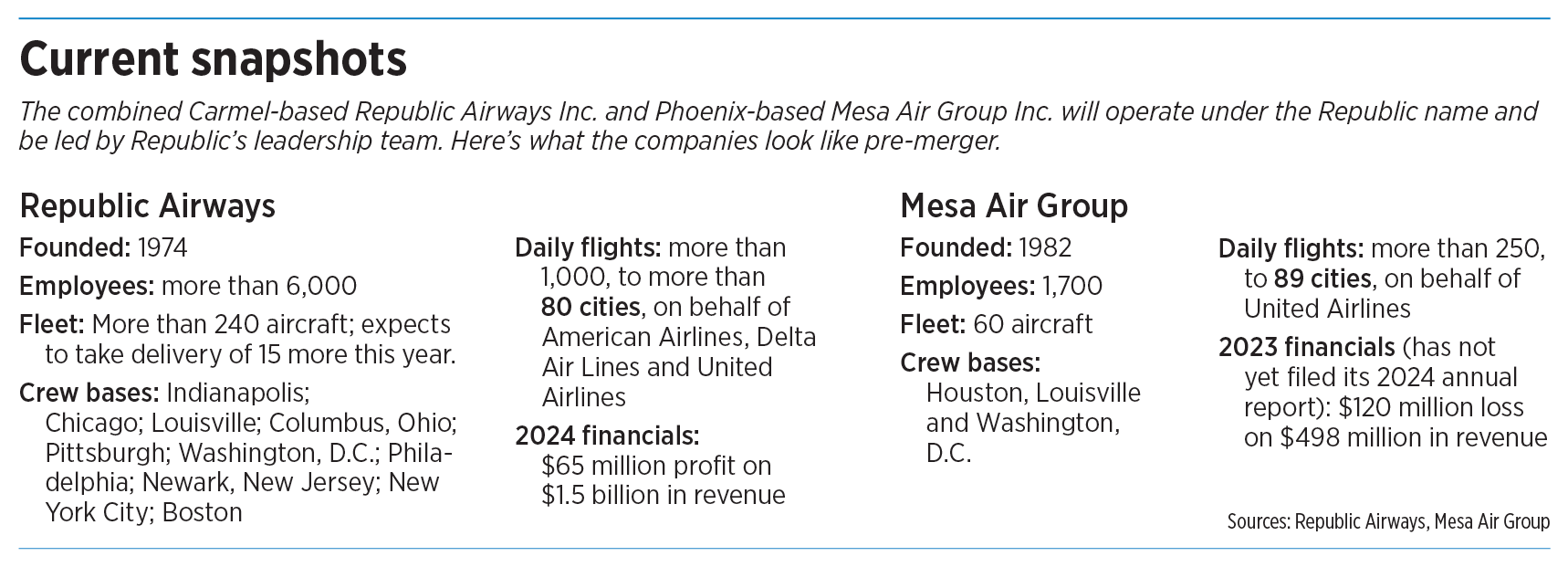
With about 1,700 employees and 250 daily flights, Mesa is a quarter of the size of Republic, which has more than 6,000 employees and operates more than 1,000 daily flights. But Mesa is publicly traded, and once the deal closes, the combined company will change its ticker symbol from MESA to RJET, continuing to trade on the Nasdaq market.

Republic had been a publicly traded company until April 2017, when it emerged from Chapter 11 bankruptcy as a privately held company whose majority owners were its pre-bankruptcy creditors American Airlines Group Inc., Delta Air Lines Inc., United Airlines Inc. and aircraft maker Embraer.
At the time of the company’s emergence from bankruptcy, Republic executive Matt Koscal told IBJ the company wanted to once again be publicly traded at some point, though it had not set a timetable.
In June 2021, Bloomberg reported that Republic was planning to go public again via an initial public offering. Those plans did not materialize. That September, Airline Weekly reported that Republic CEO Bryan Bedford said an IPO was “not a priority” even though some of the company’s shareholders wanted the airline to go public.
Republic did not respond to IBJ’s request for an interview, but aviation industry consultants say they see multiple ways Republic will benefit from the Mesa transaction.


The deal makes a lot of sense to aviation industry analyst Adam Thompson, president of Arlington, Texas-based Lagniappe Aviation. The traditional route toward an IPO is laborious and involves filing lengthy registration statements with the U.S. Securities and Exchange Commission, engaging with underwriters and other tasks.
“It’s an elegant solution for Republic,” Thompson said of the Mesa takeover. “It gets Republic what they need—they need to go back to the market—without the pain of an IPO.”
John Celigoy, president of Scottsdale, Arizona-based Core Aviation Services, said the Mesa acquisition also offers a way for Republic to grow—something that will be especially important once it rejoins the ranks of publicly held companies.
“The market respects growth quarter-over-quarter, period,” Celigoy said.
Deal details
In announcing the deal last week, Republic and Mesa said they expect to retain all flight crews, technicians and other operational staff post-merger, operating more than 1,250 daily departures across both airlines’ existing routes.
Republic’s route map covers the eastern third of the United States, while Mesa’s routes are more focused on the West.
Another advantage to Republic, Thompson and Celigoy said, is that the two airlines have some key operational similarities.
As regional airlines, both Republic and Mesa fly routes on behalf of major carriers with which they have capacity purchase agreements. Republic flies for American, Delta and United. Mesa flies for United.
As part of the expected Republic/Mesa deal, United will enter into a new 10-year capacity purchase agreement with Mesa, while Republic will continue to serve America, Delta and United under its existing agreements with those airlines.
That new 10-year agreement gives Republic assurance of Mesa’s value as a company, Thompson said.
“I think it’ll be a fairly easy integration, especially with United already on board to keep Mesa flying for United as part of the Republic deal,” he said.
Mesa operates a fleet of 60 Embraer 175 aircraft. Republic has more than 240 Embraer 170s and Embraer 175s.
The Embraer 170 has 66 to 78 seats, depending on how the seating is configured. The Embraer 175 has 76 to 88 seats.
The similarity between the fleets, Celigoy said, means Republic can more quickly integrate Mesa’s pilots, flight attendants and mechanics.
“It really cuts those transition costs,” he said.
A lifeline for Mesa
The deal also solves a problem for Mesa, which has been facing significant financial challenges.
For the nine-month period ending June 30, 2024, Mesa reported revenue of $361.2 million and a loss of $66.1 million, or $1.61 per share. During the comparable period a year earlier, the airline reported revenue of $383.7 million and a loss of $91.8 million, or $2.35 per share.
Mesa has not filed a quarterly financial report since October, when it reported its performance for the quarter endingJune 30. The company also has not filed its 2024 annual report for its fiscal year that ended Sept. 30.
Because of the delays in filing those reports, Mesa reported in February, the company was not in compliance with the Nasdaq rule for stocks listed on its exchange.
In that report, Mesa said it had $366.4 million in debt and $16.3 million in cash as of June 30.
The Republic/Mesa deal announcement said Mesa will not bring any of its current debt to the combined company. The announcement did not specify what will happen to that debt.
Mesa’s stock, while still in “penny stock” territory, has seen a price bump since the deal was announced April 7.
On that day, Mesa’s stock closed at $1.10 per share, up from 71 cents per share at the close of the previous trading day. That increase was mostly intact by the end of the week—Mesa’s shares opened at $1.07 on Monday.
Since Republic is privately held, it’s difficult for outsiders to get a full picture of the company’s financial performance. But the deal announcement did include some financial details that indicate Republic is on sound financial footing.
In 2024, the company said, it made a profit of $65 million on revenue of $1.5 billion. As of Dec. 31, the company had $323 million in cash and $1 billion in debt.
The combined company will be 88% owned by Republic’s shareholders and will be led by Republic’s executive team. The board of directors will consist of six existing Republic board members and one member of Mesa’s current board.
“With this combination, we are establishing a single, well-capitalized, public company that will benefit from the deep expertise of Republic and Mesa associates, creating value for all stakeholders well into the future,” Bedford said in the April 7 announcement.
The fact that Republic’s executives will lead the combined company could also be good news for the Indianapolis area, Thompson said.
Though the announcement did not specify this, Thompson said it seems likely that Mesa’s Phoenix headquarters will close and its dispatching and scheduling functions will shift to Indianapolis.
“It may ultimately bring a couple of hundred jobs out of Phoenix and into Indianapolis,” he predicted.
Republic is in the midst of building out its new $200 million aviation campus in Carmel, between U.S. 31 and North Pennsylvania Street. A 105,000-square-foot training center, along with a hotel and parking garage, opened in 2023. A 122,000-square-foot headquarters building is scheduled to open in January, replacing the company’s current headquarters near The Pyramids office park in northwest Indianapolis.
One factor Thompson said he is wondering about is who will succeed Bedford, Republic’s longtime CEO. In March, President Donald Trump announced that he had nominated Bedford to lead the Federal Aviation Administration. Bedford still must be confirmed by the U.S. Senate.
Regarding the Republic/Mesa deal, Thompson said, “The only thing that really surprised me was that [Bedford is] slated to continue leading the company. There’s no announcement of a plan for a successor, even though it’s pretty much a guarantee that the Senate’s going to confirm him.”•
Please enable JavaScript to view this content.
Great that they are progressing and grouwing. Just sad to nite that I lost all of my prior investment in Republic whan they filed bankruptcy. Dont think I am interested in investing again .