
Subscriber Benefit
As a subscriber you can listen to articles at work, in the car, or while you work out. Subscribe Now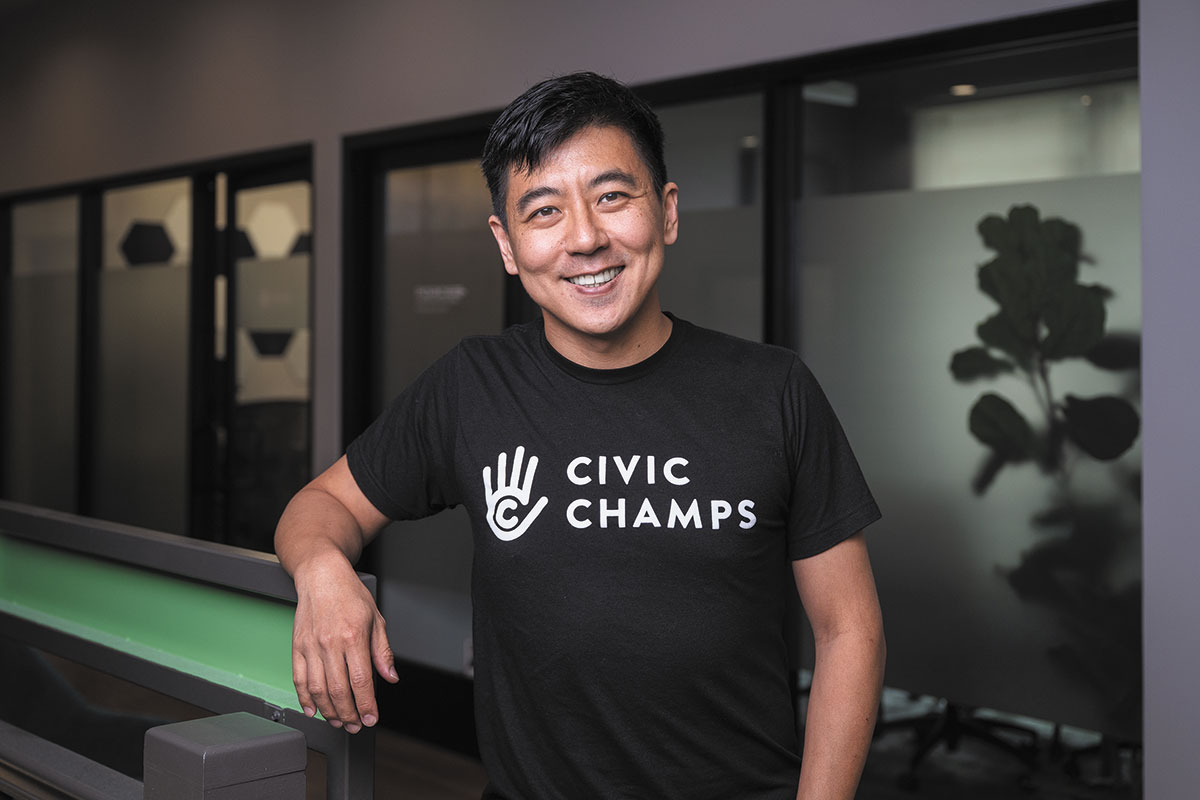
Geng Wang has volunteered for much of his life. Now a company he started helps organizations provide services to others.
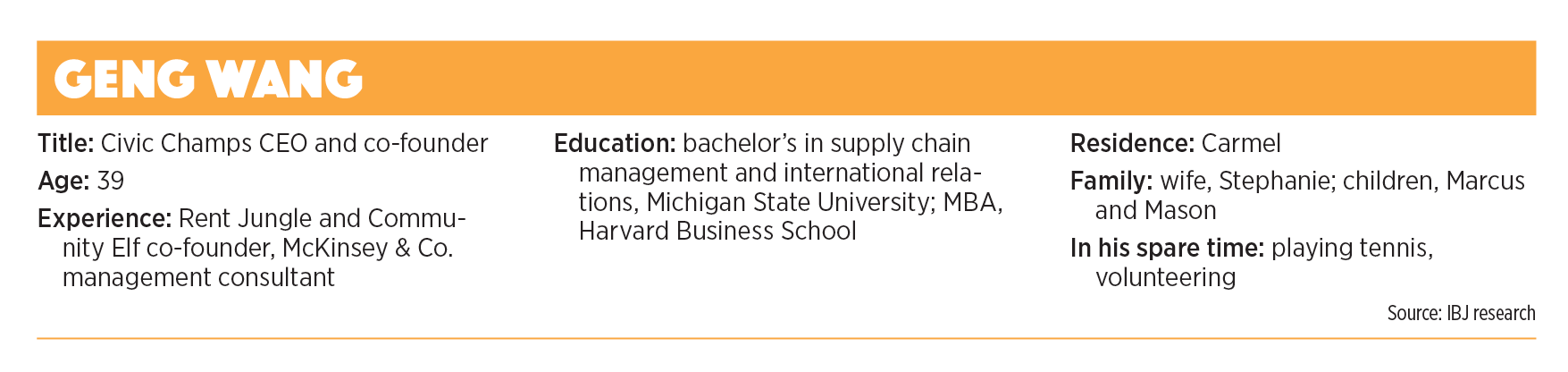
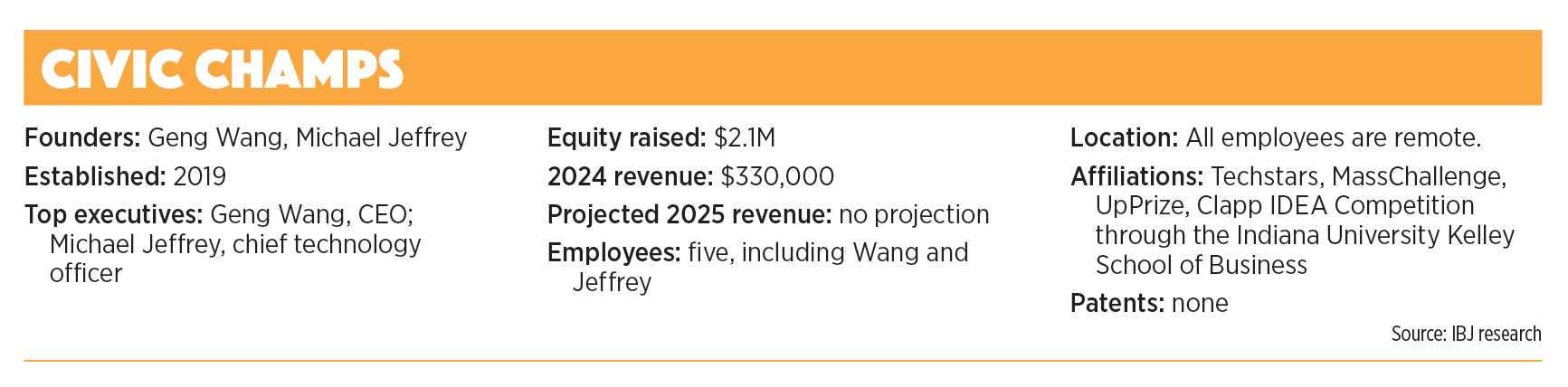
Wang and co-founder Michael Jeffrey launched the startup Civic Champs in 2019. Civic Champs helps connect volunteer organizations to volunteers through a mobile and desktop app.
Despite early challenges when volunteer organizations were limited in their activities due to the pandemic, Civic Champs now serves more than 200 nonprofits in the United States and Canada and has drawn recognition from the Gates Foundation. Civic Champs also has won a Gold Award from MassChallenge, been selected as a TechCrunch Startup Battlefield company and been named a Nasdaq Milestone Maker.
Civic Champs is Wang’s third startup. He previously co-founded and sold two startups, Rent Jungle and Community Elf. After college, he got his professional start as a management consultant at McKinsey & Co.
Wang sat down with IBJ to discuss what led him to the world of startups and the advantages startup founders have in central Indiana. This conversation has been edited for length and clarity.
What was your original objective with Civic Champs, and how have your goals changed over the past six years?
We changed very early. The initial vision was, actually, we wanted to make a mobile game for volunteering. If you think about Pokemon GO, it helps people explore the community and meet new friends while catching a little Pokemon on your phone. We thought we could do something similar but with small acts of service.
But then that’s how we got to learn from our nonprofits that we were connecting with. We asked them, “How do you engage? How do you recruit? How do you retain these volunteers of yours?” For a lot of these nonprofits, [they used] pen and paper, spreadsheets, and we were like, “Hey, does that take a lot of time? Do you like doing that?” And when we got the answers of, “No, it’s my least favorite part. It’s super annoying. It takes a lot of time,” that’s when we decided to change course and serve them. We thought this could be a faster way to have a more direct impact because, by helping the helpers, so to speak, you can help them have even more impact.
What made Civic Champs an important project for you?
I wanted to do something that had a bit more social impact than my previous couple of ventures. I just thought, hey, if we were doing something that created more societal value, that could be something that I personally from a mental standpoint could lean on. If things got a little tougher or you’re not having a great day, you could say, “Well, look at all the good that we’re able to help people with.”
What motivates you to launch startups?
Having an impact and making things better are all things that excite me right now. I like new things, and that’s why I think startups fit me well. You’re always working on something new. There’s always a new challenge. At every stage, it’s a little different, and you can always optimize something to be better.
What stage is Civic Champs right now?
We’re just getting to the early stages of growth where we found product market fit in terms of, here’s a consistent core of folks who are quite happy with what we deliver for them, and we know how to reach a segment of them pretty consistently.
What are the next steps that you want to see?
For us this year, we’re focused on two things. One is further increasing our retention of existing customers. Ideally, we exceed 100% in terms of revenue from existing customers. That means that they’re actually paying us more next year than they are this year, which shows that we’re really adding value to them, and they’re adding add-ons and other things. The second thing is getting cash flow to break even. We’ve raised some funding, but we have no plans to fundraise more. Knock on wood, next month or in June, we should be sort of operationally cash-flow break-even, which allows us to control our own destiny.
What do you want Civic Champs to be in five years?
I hope that we have a platform that serves thousands of nonprofits and really helps them in their day-to-day. If we’re big enough, then it becomes a network of its own that can facilitate the recruitment of volunteers and help build community.
What have you seen that makes central Indiana’s startup environment unique?
If you compare us to Detroit and Pittsburgh, that’s kind of our peer group. Where Indy shines, I think, is on the marketing and sales side, probably because of the Exact Target sale to Salesforce. Even today in Pittsburgh, there’s a lot of technical talent because Carnegie Mellon [University] is based there. Google moved out there. Facebook moved out there. They’ve got autonomous vehicle research.
That’s all really exciting stuff, but it was always hard to find a VP of marketing, a VP of sales, somebody on the business side that knows software that can help you grow that company. That still continues to be a talent shortage in that market, even though in many ways it’s boomed from a startup standpoint. Whereas Indy actually has its unfair share of that kind of talent. I think that makes Indy unique and probably positions Indy startups to be relatively successful because you can have the best product, but if you can’t sell, it doesn’t matter.
What role has volunteering had in your life?
I’ve always volunteered and benefited from volunteers. I moved to the U.S. when I was 5, and my parents were already here. I was not allowed to immigrate [with them] because the Chinese government thought my parents would … not go back.
[The government was] right. They stayed here. My dad was a professor, and he did his PhD, and I wasn’t allowed until I was 5 to leave [China]. When I came through, I had kind of a classic immigrant story in some ways. My parents didn’t have a ton of money, so I really benefited from a number of services, like going to the Boys and Girls Club. I do remember, even from very young, being the beneficiary. I always volunteered as a kid. I think I enjoyed helping people. It felt good.
How did starting your career at McKinsey help set you on your path?
I think McKinsey was super important in terms of my formative years. They really teach you how to analyze problems to break down any problem into component parts, the assumptions that you have to test and the analytical skills to test those assumptions. And then to have the confidence to present that information to people that are way more knowledgeable in their field but maybe don’t have the time capacity to analyze the thing that you’re looking at.
What advice do you like to give people about launching startups?
Whenever I talk to students, the first thing [I say] is, you have to talk to the people you’re trying to sell to and try to make the sale. What happens is, people don’t intend to do this, but they end up lying to you. They’re like, “Oh, fantastic idea. Awesome. That’s amazing. Good for you. I think people are going to love this.”
And then you’re like, “Oh, great. People like you are actually in my target demographic. Would you buy this?” And then the truth comes out. It’s hard to know if you really have something or if people are just blowing smoke in your face until they swipe that credit card. The first thing is to get out there, really talk to people and get them to buy the thing you’re selling.•
—Daniel Bradley
Please enable JavaScript to view this content.
Editor's note: You can comment on IBJ stories by signing in to your IBJ account. If you have not registered, please sign up for a free account now. Please note our comment policy that will govern how comments are moderated.