
Subscriber Benefit
As a subscriber you can listen to articles at work, in the car, or while you work out. Subscribe Now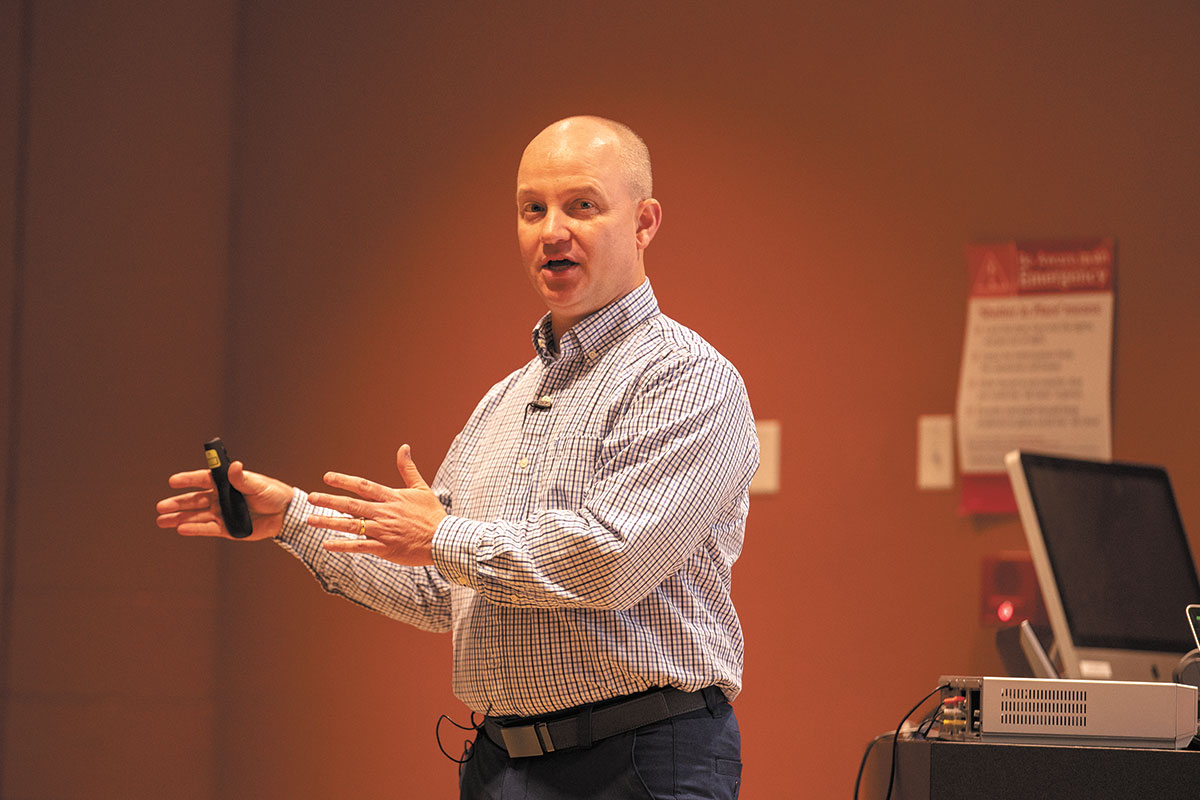
Entrepreneurship Center. (Courtesy of Ball State University)
Rob Mathews, executive director of Ball State University’s Entrepreneurship Center, views leadership and innovation as inseparable attributes for a startup.
“My personal motto is, ‘Great leadership equals innovation, and innovation equals great leadership,’” Mathews said. “If you’re doing the things that encourage ongoing innovation and creativity in your company, that’s what good leadership looks like.”
The benefit: Engaged team members who express beliefs such as, “My opinion is valued,” “My role has a purpose,” and “I’m cared about as a person.”
Mathews, who co-authored the 2018 book “Entrepreneurship the Disney Way” with former Ball State faculty member Michael Goldsby, said leadership isn’t restricted to executive roles.
“You can lead from any position,” he said.
At Ball State’s Entrepreneurship Center, which launched in the school’s Department of Management in 1983, students are encouraged to be problem-solvers, Mathews said.
“If you’re a good problem-finder and -solver, then you’re entrepreneurial,” he said.
During a startup-themed interview with IBJ, Mathews spoke about interpersonal skills, financial literacy and trends in entrepreneurship. This conversation has been edited for length and clarity.
What advice would you give to a budding entrepreneur who’s paralyzed by the thought of, “I have an idea. Now what?”
The first thing to know is, “Do I have an interest in this field, and am I passionate about it?” If the answer is “no,” then really you need to find something else because the perseverance probably won’t be there when it gets tough. The second thing would be to get experience in your industry. Learn from business owners, sales reps and people who understand that industry really well.
And from a business-planning standpoint, test it. Let’s say you want to start a catering business. Are you going to go from zero to 1,000 customers in a month? Are you suddenly going to be a multimillion-dollar company? No. Your best bet is to test it. Start with one customer and see how it works. See how you handle the money, see how you handle bills and payments, and see how you handle the staff or people who are going to help you. I think people jump in, and they haven’t piloted what they want to do on a small scale.
Is “handling the money” a hurdle for startups?
We see financial literacy as such a weakness in entrepreneurs, especially among younger entrepreneurs. You should understand the financials so you can have an intelligent conversation with your accountant. You don’t have to be a financial expert, but understand the basic numbers.
We work hard to demystify this and say, “This is the language of business. This is how you survive. This is how you pay your bills. This is how you pay your people. This is how you reinvest in your community as a business owner.”
What else is overlooked in this process?’
Entrepreneurs often forget to hone their leadership skills. What motivates employees? How do you get them engaged? How do you create a healthy work culture? A lot of entrepreneurs only think about their product or service. Then they get in business, and they need to rely on people. But they haven’t really honed those skills.
What can an entrepreneur do to develop interpersonal skills? Are we talking about role-playing and mentorship?
Having a mentoring network is important. We have a speaker series at Ball State that brings in about eight speakers a semester. They all say that you need to build a strong network of experienced leaders and people in the industry you can lean on. You want them to give you feedback, and you want them to challenge you. That’s really critical, because they’re going to ask you the tough questions. “Are you caring for your employees?” “Are you showing them that you care about them as a person?”
We do a lot of training, too, and we see a need for training in the area of moving people from frontline positions to supervisory positions. As a culture, we haven’t done a great job of developing a leadership pipeline in organizations. That would be the next step: OK, you’ve established your business, and you’re a good leader. But how do you develop a pipeline of people who are on the bench and ready to get in the game?
What are some trends in entrepreneurship?
Franchising has become extremely popular. People get really good at building a business model, and you end up with these franchise opportunities—really on both sides. The franchisee buys into an individual unit or multiple units. On the franchisor side, if you get really good at something and you can systematize it, there’s franchising opportunities for you as the owner. I think we live somewhat programmed lives, so franchising makes a lot of sense for people on the independent startup side.
As a society, we’re busy people. People have a lot of challenges, and enterprising people are seeing those challenges as opportunities to be addressed. One challenge is time management, so a business based on a personal chef or a family chef can help when time is scarce.
Tech is obviously hot and becoming more hot in Indiana. Let’s say you develop a really good system for tech repair. Or maybe someone is skilled at tech, but they don’t have the business side of things. You could provide the business structure, and the tech person could come in and work within your system.•
Please enable JavaScript to view this content.
Editor's note: You can comment on IBJ stories by signing in to your IBJ account. If you have not registered, please sign up for a free account now. Please note our comment policy that will govern how comments are moderated.