
Subscriber Benefit
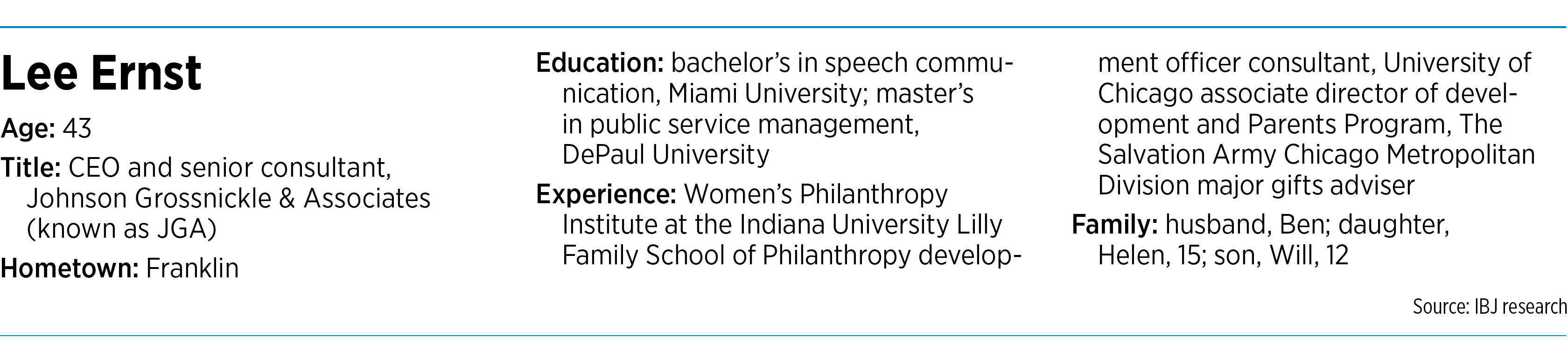
As a subscriber you can listen to articles at work, in the car, or while you work out. Subscribe NowFranklin native Lee Ernst joined nonprofit consulting firm Johnson Grossnickle & Associates in 2013 as an associate after fundraising positions with the University of Chicago and The Salvation Army, jobs that gave her the skills to help other organizations succeed.
She worked her way up at the Greenwood-based firm to become a consultant, then senior consultant, and last July was named the firm’s CEO.
The company—known as JGA—helps as many as 65 nonprofit clients each year boost their relationships with donors and raise the money they need to achieve their missions. Ernst said the team is successful because it incorporates authenticity as a core tenet.
“I firmly believe that when we are asked to partner with a client, it does no good to tell them what they want to hear. We have to tell them what they need to hear,” Ernst told IBJ. “We are hired to be truthful. We’re hired to be partners with them. To do that, we must build trust and a relationship with them.”
IBJ talked with Ernst about her career and the challenges facing the nonprofit sector today. This conversation has been edited for length and clarity.

What drew you into working in the nonprofit sector?
I wanted to make an impact. That might sound cliche, but I think our lives are too short to not love what you do, and I found the ability to truly love what I do. When I get to work with nonprofits and help support their missions, that’s awesome.
Did you know early on that this was the way to make an impact?
I did not know early on. I always enjoyed the study of relationships, what motivates people. I ended up majoring in interpersonal communication, so I knew enough to choose that major.
But it was not until I graduated college and had my first job—actually in corporate America—that I realized that a back-of-my-mind thought about nonprofit work was something that I should not ignore. So then I went to graduate school to study nonprofit management.
You worked at several nonprofits before joining JGA. What did you learn from those positions that helps you?
I was fortunate to work both in the higher education and in the social service sector. I was at the Salvation Army in Chicago. I was at the University of Chicago, among others. Not by design, but I ended up in each position being responsible for really starting a program, engineering a new process or a program. … For example, at the University of Chicago, it was a $2 billion campaign, and I was charged with helping to start fundraising from parents. Having that experience has really helped now not only as a consultant to nonprofits but as the CEO of JGA.
That’s because at JGA, we’re most often brought in to really help transform the way an organization works with donors in new ways, in different ways, to help accelerate fundraising. In order to do that, we’re always asking questions and listening well. And the work that I was doing with those nonprofits, I think translates well—the need to ask good, thoughtful questions, and just as importantly, to listen well. At JGA, we do our best job when we ask good questions and when we listen.
Some people think that they’re hiring a consultant to tell them what to do, but I think they’re really looking for a partner.
What do you mean by that?
For us at JGA, the best way we can do our work is when we are able to partner alongside a nonprofit, rather than sit across the table and be viewed just as the expert. … If we can learn from them as well, ask good questions and listen, we get deeper to the root of the issues that then allow us to help them achieve their fundraising goals.
Tell us about JGA.
We are headquartered here, just south of Indianapolis, in Greenwood. And we are a full-time team of about 15 people, including adjuncts. We’ve had the opportunity to be a part of transformational campaigns with our nonprofits. Our work centers around really helping our nonprofits prepare to engage in new forms of philanthropy. How do they build deeper, more meaningful relationships with donors to achieve the fundraising success?
And I think at the end of the day, the more we can engage with nonprofits, it allows them to do good for the world.
What are you doing to help nonprofits now that maybe they weren’t doing 10 years ago?
Increasingly, we are seeing the use of data. Nonprofits have more data, more information on donors, on potential donors, prospective donors.
In the past, organizations could put together a list maybe of top individuals that had given them support in the past based on gifts. But now, with the data, we’re able to better understand how donors want to be communicated with, what motivates a donor, what demotivates a donor.
So increasingly over the years, a lot of our work has been centered around not only helping [organizations] achieve fundraising success, driving impact toward their mission, but also, how are we using predictive analytics to have more or to have smarter philanthropy or precision philanthropy as part of that?
What’s also different is that when I think about our firm, JGA, we are a national company. We’re in about 20 states. We’re headquartered here in Indianapolis, and I would say we’re deeply committed to our region. We are able to look across the nation and the work we do with our clients and bring it back to [Indianapolis].
And I think we’re so lucky to be in the city we’re in. Indy is a nexus of the nation’s giving community. You think of the strong nonprofit community we have, the tremendous work the nonprofits themselves are doing, but then you think of the support that they have with the Lilly Family School of Philanthropy [at Indiana University], institutional funders. You’ve got the Lilly Endowment, Central Indiana Community Foundation, so many wonderful institutional founders. You have family foundations; you have individual donors.
I think we’re really lucky as a firm to be located in this city with so much philanthropy going on.
What are the major challenges nonprofits are facing now?
One is that donors are changing. Today’s nonprofits face incredible competition for donor attention. How do I connect with this donor so that I, as a nonprofit, am their top priority? Also, we have so many different generations of donors, and the communication styles are different.
I think the other piece facing nonprofits is retention of staff and of teams. The average fundraiser, gift officer, major gift officer, stays in a position at a nonprofit less than 24 months. The heart of fundraising is building relationships. That can be very hard to do if staff turnover is occurring every 18-24 months.
Then the third challenge or issue is nonprofits facing the adoption of technology. How can nonprofits adopt technology to help support their fundraising efforts, to help build relationships with donors, to help communicate their message, to help better understand how to use the staff time that they have in the most strategic way possible?
How have the actions of the Trump administration impacted nonprofits?
It’s a challenging time for many nonprofits as they work through changes at the federal level. That’s why we say it’s so important that nonprofits stay in touch, stay close to their donors, stay in communication, thinking about how they diversify funding streams and how nonprofits can share and work together as they’re trying to achieve their missions.
How many nonprofits does the firm work with each year?
We’ve been privileged over our 31 years to have served over 500 clients, and at any given time, we are serving 50 to 65.
We’re in about 20 states at any given time. We’ve always had a presence here—not only in Indianapolis but in the state of Indiana—and that’s very important for us. The clients that we serve are very diverse across sectors, ranging from education, higher education, including pre-K through 12, and social services, arts and culture, faith-based, as well.
What have you learned in your first year as CEO?
It’s all about the people. That’s what I’ve learned. It’s about the team members at JGA. We have an exceptional team. We are all so committed and grounded to our values and our mission.
We have a 45-year-plus age difference among our team members—and to be grounded in our mission and our values and to see the intergenerational work is inspiring. It’s exciting. It’s empowering.
Were there any unexpected challenges you found as CEO?
To embrace change. It allows for more expansive thinking, and it allows for opportunities you never thought were there. I have been blown away by our team and our team’s commitment and care for each other. And I think when the team cares for each other, it shows to the client, and I think that’s really important because it’s authentic.
At the end of the day, JGA is about thought leadership and innovation, and we’re authentic in the way that we deliver our client work.•
Correction: The photo caption in this story has been corrected to reflect that Lee Ernst became CEO of JGA in July. See additional IBJ corrections here.
Please enable JavaScript to view this content.
Editor's note: You can comment on IBJ stories by signing in to your IBJ account. If you have not registered, please sign up for a free account now. Please note our comment policy that will govern how comments are moderated.