
Subscriber Benefit
As a subscriber you can listen to articles at work, in the car, or while you work out. Subscribe Now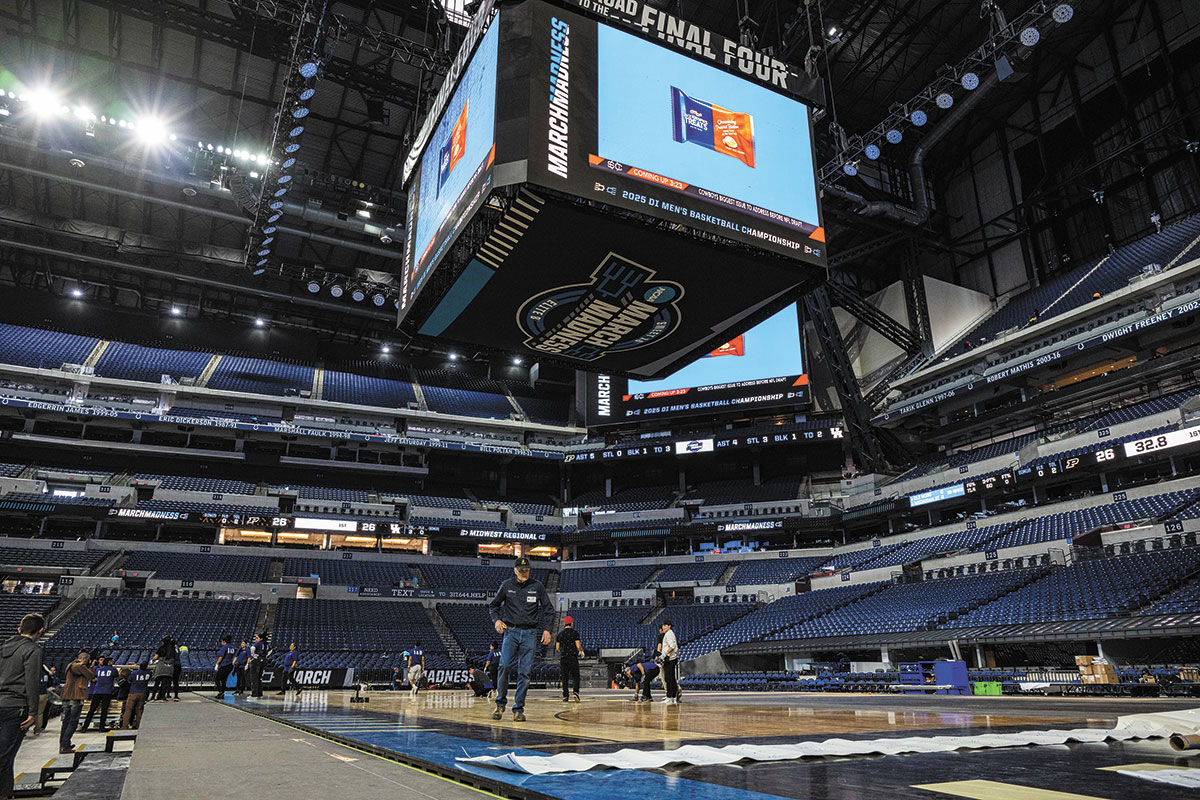
There’s a method to the madness that is the NCAA Division I men’s basketball tournament—and it relies wholly on the collective involvement of thousands of NCAA and university staffers, contractors, local organizers, venue workers and volunteers.
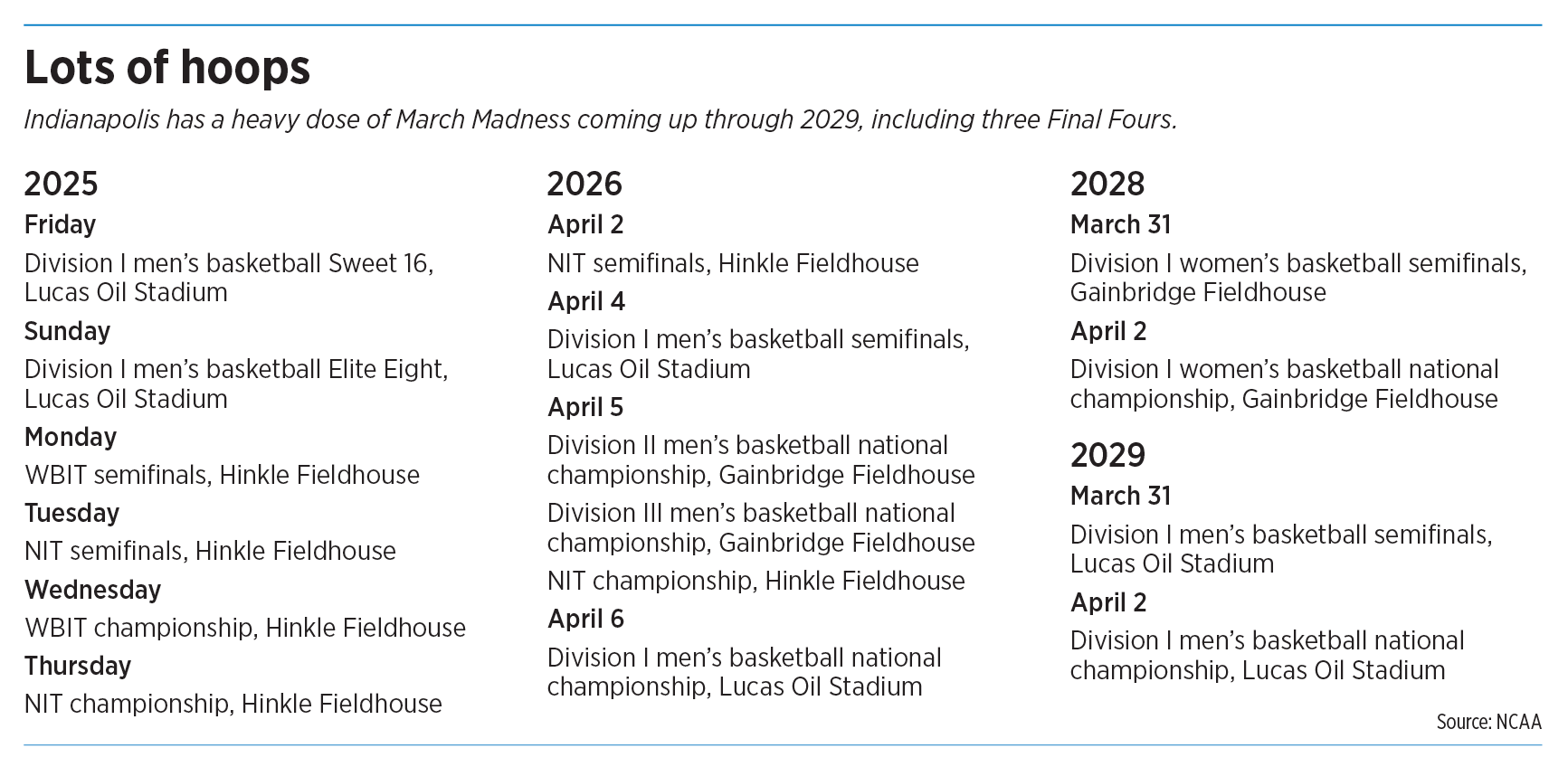
For sports officials in Indianapolis, which already has under its belt more than 150 men’s tournament games (including the entire 2021 tournament), hosting any portion of the 2-1/2-week event is a welcome challenge. This year, the city is set to host the Midwest Regional on Friday and Sunday at Lucas Oil Stadium; the Final Four is on tap for 2026.
But whether it’s Indianapolis or any of the other dozen cities the NCAA uses as a host for games, executing the event takes a lot of people and even more time. Planning for the tournament starts years in advance with the selection of the host cities, then picks up steam at the one-year mark.
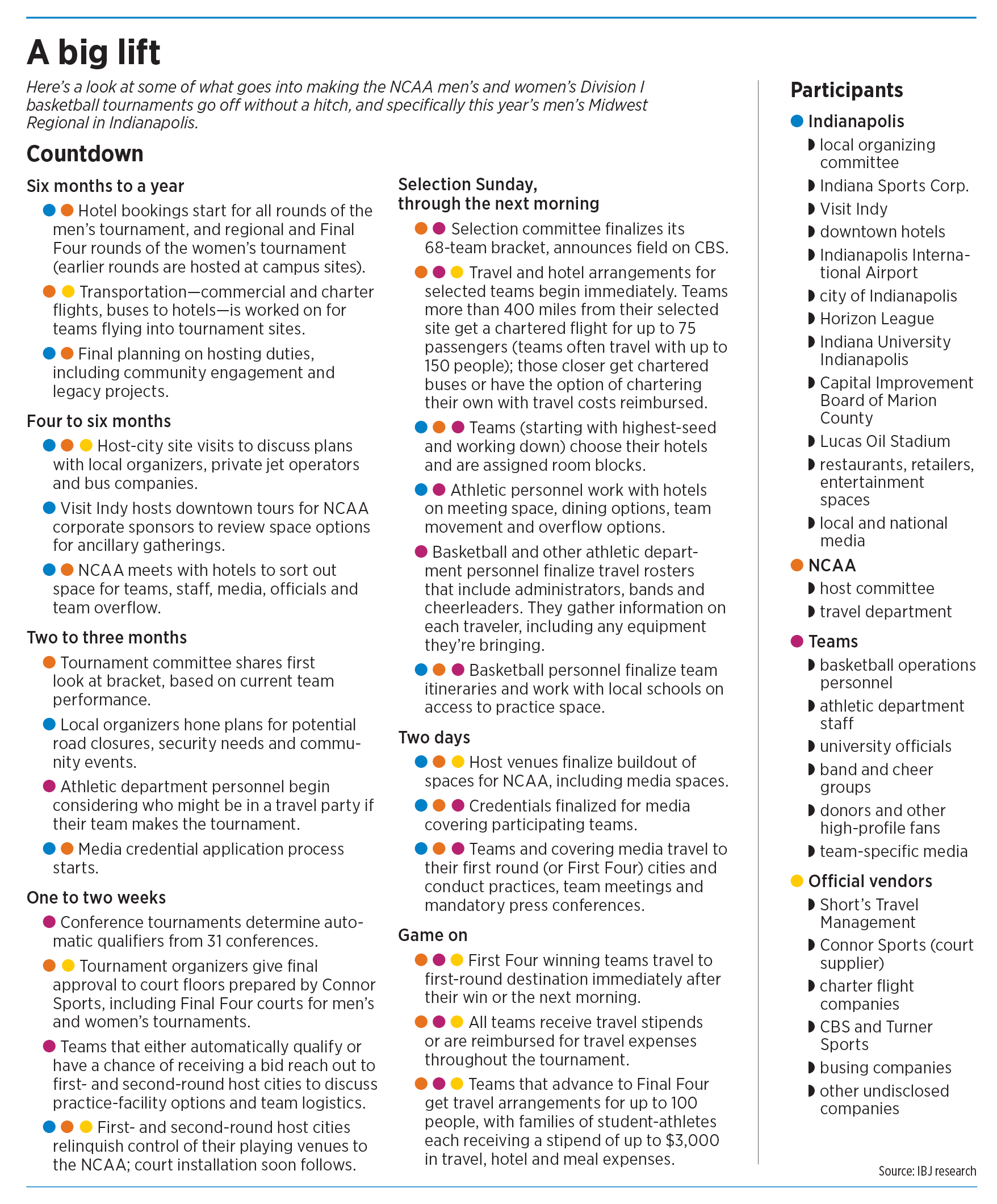
Experts told IBJ that some components are locked in about that time, then later honed—hotel-room blocks and travel contracts, for example. The pace ramps up further at the six-month mark and even more so in the run-up to Selection Sunday, when tournament hopefuls learn whether they’ve made the field of 68 teams and, if so, where they’re headed for their first game.
Once the field has been set, the NCAA works directly with teams to help them craft a travel plan and secure flights, depending on where they’ll be traveling. Teams within 400 miles are required to take a bus. The NCAA generally allows teams to book their own buses, as they often like to use their usual providers when possible, but the organization offers help for teams that need it.

Melissa Piening, director of travel management for the NCAA, said teams can have flights booked for as early as 11 a.m. Eastern time the day after Selection Sunday, which makes communication and organization imperative for not only coaches and players but also the rest of the team’s travel party.
She said the NCAA’s biggest challenges are typically in timing the flights, the volume of total flights being booked, making sure the planes being used can accommodate the team they’re carrying and making sure flight crews are available.
Certainly, travel details have presented challenges over the years. During the First Four games this year, the University of North Carolina missed its media availability on Monday in Dayton after encountering unspecified travel problems.
Planning ahead
Andy Farrell, director of basketball operations for Vanderbilt University, said he and other team and athletic department personnel had been planning for several weeks based on different tournament scenarios. That included researching the host cities and gathering travel information from administrators, band and cheer team directors, and other prospective travelers.
He said Vanderbilt officials started making calls to hotels and other contacts in host cities for the First Four and first- and second-round games shortly after the team was eliminated from the Southeastern Conference Tournament the Wednesday before Selection Sunday.
Those calls, he said, were to determine where Vanderbilt might stay in each city and to discuss factors like dining options, meeting space availability and travel-party size. Farrell also contacted various colleges and high schools to determine what practice facilities would be available.
“From an operation standpoint, I just wanted to make sure that we were ready to go as soon as our name was called,” he said, adding that it’s the responsibility of each school to set its own schedule outside of one open practice, a required media availability and the game itself.
“Every college has to reach out … to schedule its gym times and establish the points of contact it needs to build out its itinerary,” he said.
While many teams in the tournament begin coordination weeks or even months ahead of time, the 24 hours after the selection show is when things go into overdrive for all 68 athletic department staffs.
Al Kidd, a longtime sports event management expert and consultant, said Vanderbilt’s approach allows it to get out ahead of what he called “a mad scramble” that generally includes compiling media credential information, travel itineraries, family-member information for inclusion in the travel party and a litany of other responsibilities placed on teams.
“There’s a lot of sleepless nights in those three days between the selection show and the tournament’s first game,” he said.
Farrell said by preparing for the tournament as much as possible ahead of time, Vanderbilt officials managed to connect quickly with the NCAA to finalize hotel and departure plans. It also allowed him to be on the phone with the team’s hotel within a couple of hours of the team’s selection, as well as finalize team practice times and shore up the university’s travel-party list.
“You’re talking about hours and hours and hours and a couple [of] sleepless nights leading up to the tournament in preparation,” he said. “So a lot of work goes into it, but it’s great to be able to line all that stuff up and to ease that burden … so our coaches can focus on the game plan, and our players can focus on their preparation.”
Vanderbilt was sent to Cleveland, and its season ended with a 59-56 loss to St. Mary’s College in the first round.
Purdue, which is one of four teams competing in this weekend’s Midwest Regional in Indianapolis, took a similar tack to prepare for its first- and second-round games, said Chris Peludat, assistant athletics director for marketing and ticketing.
“Once you get in, it’s somewhat laid out as to what would come next,” he said before the team’s second-round game. “So we’ve already started making plans and checking through a list of who would go to Indianapolis, should we be fortunate enough to advance. Once you know where you’re going from the first site, it makes things a little easier. And with Indy, we already have the manuals.”
Local roles

From 2002 to 2012, Michelle Perry led management and execution of the NCAA Division I Women’s Championship as director of women’s basketball. The women’s tournament generally operates in a manner similar to the men’s, except it has only two regional sites instead of four, and the first and second rounds are played at campus sites.
She said in addition to having to juggle both of those events, the NCAA is also overseeing numerous other championships that require teams to travel across the country, such as wrestling, swimming and diving, and track and field across all three of its divisions. Those, too, run through the organization’s travel office, as well as Short’s Travel Management, an Iowa-based travel agency that has assisted the NCAA since 2004.
“They don’t call it March Madness for nothing,” said Perry, who is now CEO of Indianapolis firm Gamechangers Consulting. “It is full on, pedal to the metal for four weeks, where you’re working 20 hours a day because you’ve got to get it right. It’s not an easy job.”
For many services, the NCAA relies on local partners and contractors, including security, venue, labor and media credentialing.
Using vendors can be more practical and frees up NCAA officials to tackle other logistical challenges. Even so, the NCAA is kept in the loop throughout every step.
In the case of the playing courts, Michigan-based Connor Sports meets regularly with the NCAA in the run-up to the tournament, with championship officials conducting in-person inspections of the floors before they are shipped to the host cities for installation.
In Indianapolis, Connor Sports installed the regional round court on Tuesday, with Lucas Oil Stadium staff completing final inspections Wednesday afternoon before turning the building over to the NCAA for Friday’s matchups. Hundreds of people were involved in preparing the stadium, from operating forklifts and other equipment to lay the court and hang banners to janitorial services that involve cleaning every seat in the southern portion of the stadium’s seating bowl.
The NCAA relies heavily on its relationship with local communities to organize tournaments. That’s especially true in Indianapolis, which the NCAA calls home and where it has hosted tournament games for decades.
That relationship played a major role when the city hosted the 2021 tournament in Indianapolis, West Lafayette and Bloomington during the pandemic.
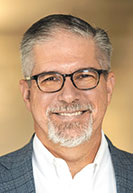
Patrick Talty, president of the Indiana Sports Corp., said the bond between the city and the NCAA is something local leaders recognize as an advantage and one they continue to nurture. That will be important in coming years as the city hosts next year’s men’s Final Four, the women’s Final Four in 2028 and the men’s Final Four again in 2029.
“We love having them headquartered here, because it allows us more chances to interface with them, to communicate with them,” Talty said. “They’ve gotten to know the city, and they’ve gotten to know other people in the city. Having worked elsewhere, I can say that having the NCAA here is an advantage, and it is one that we do not take for granted. I think the whole community realizes how impactful the NCAA being headquartered here is.”
Piening, the NCAA’s travel director, said host cities and their organizing committees are “vital to the execution of any NCAA event,” as they play a major role in its planning and execution.
“They accomplish everything from organizing all the volunteers that help with these events to serving as liaisons to the hotels and airport and other events,” she said. “Our local organizing committees and host schools and conferences, in this case the Horizon League, are absolutely vital to the success of any event. … It is always nice to be in Indianapolis and work with our local partners.”
(Editor’s note: IBJ owner and Publisher Nate Feltman is co-chair of the Local Organizing Committee for the 2026 Men’s Final Four.)
Kidd, the event management consultant, said most observers don’t understand the number of people who have a hand in making the NCAA Tournament happen.
Without that collective work, the tournament would be a lesser event—and even with it, he said, it’s still surprising that an event as complex as the NCAA Tournament comes together so well every year.
“You have countless aspects that have to be perfect, flawless for an event like the NCAA Tournament,” he said. “Indianapolis has a special group of people that can put an event like this on. They’re experienced; they’re equipped. They know how to do it, and it’s not a bunch of new people coming in. It’s pretty spectacular how the city is able to stage events like this.”•
__________
IBJ reporter Daniel Bradley contributed to this story.
Please enable JavaScript to view this content.
Editor's note: You can comment on IBJ stories by signing in to your IBJ account. If you have not registered, please sign up for a free account now. Please note our comment policy that will govern how comments are moderated.