
Subscriber Benefit
As a subscriber you can listen to articles at work, in the car, or while you work out. Subscribe Now
Before hitting publish for an internship callout on LinkedIn and other job boards, employers have a bevy of decisions to make about just what kind of experience they want their student interns to have.

One major consideration is whether an employer plans to pay students for their work—a choice that involves more than simply weighing the cost.
Industry experts told IBJ that employers should consider legal guardrails, equity concerns, workload and external financial support when deciding whether an internship program will be compensated.
“We definitely do find that the paid experiences provide a much greater incentive for students to persist,” said Jenny Berry, career technical education director at Indianapolis Public Schools.
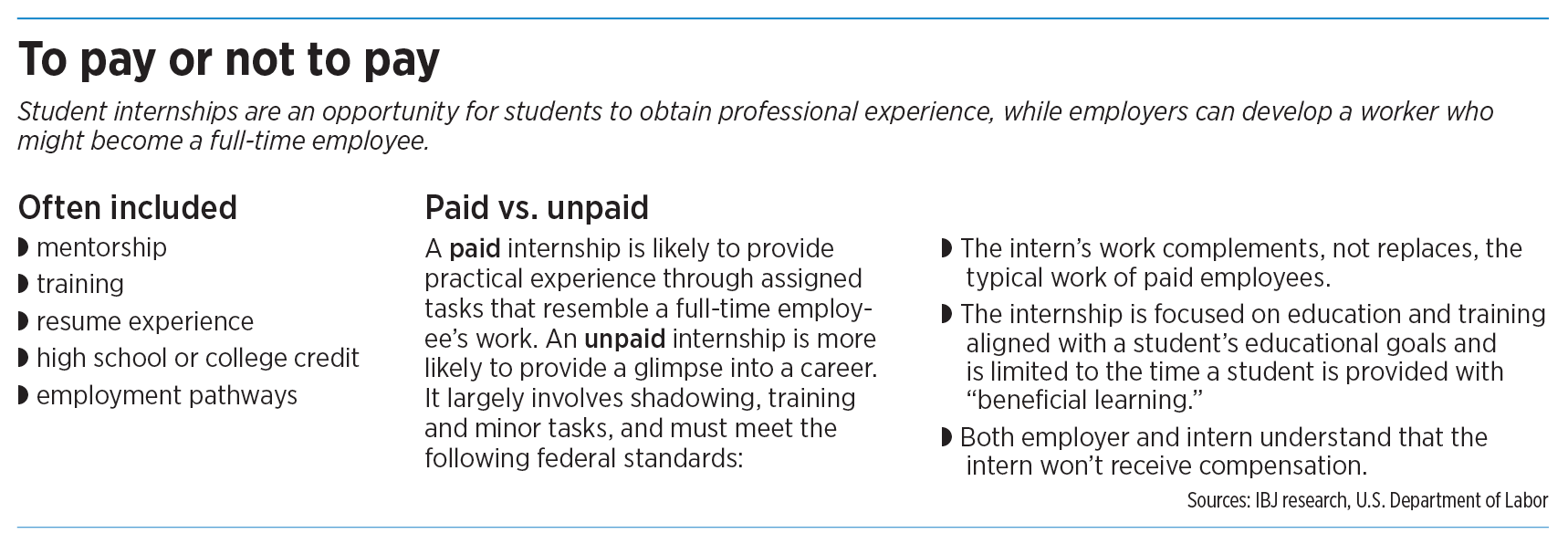
Unpaid internships tend to be more educational, with student interns largely shadowing employees and completing small tasks. Paid internships usually mean a student is completing tasks that full-time employees would otherwise do. However, not all internships follow those guidelines.

Overall, about 60% of internships are paid, said Laura Love, Strada Education Foundation’s senior vice president of work-based learning. Those that aren’t, she said in an email, are usually in the liberal arts, social sciences, teaching and nursing. Nonprofits, too, are known for unpaid internships.
But those numbers are falling as companies and organizations have felt pressure to pay, thanks in part to lawsuits related to uncompensated work and studies that show internships are more equitable and more satisfying if the students receive a paycheck.
Unpaid internships have “fallen dramatically over the last few years,” said Gary Beaulieu, Butler University’s senior director of career and professional success. “There’s more of a fight for talent. Employers of all sorts know that they need to pay interns in order to get the best talent.”

In fact, EmployIndy President and CEO Marie Mackintosh said internship programs are among the best ways to develop and recruit a future workforce. Employers can “test drive” a student worker, she said, and find future employees that mesh with an organization’s work and culture.
“Having an internship is a low-risk, high-reward strategy for businesses,” she said. “They have early access to emerging talent, they’re shaping skill development that meets their needs, and they can build a more diverse pipeline.”
Studies from the National Association of Colleges and Employers, a nonprofit employer research and advocacy organization, show that interns become employees more often than not.
And internships are productive for students, as well. A study by LinkedIn’s Economic Graph team found that students who’ve had internships are 22.9% more likely to start a full-time position within six months of their graduation than their classmates who didn’t.
Barrier to entry
But many students can’t afford to participate in a full-time, unpaid internship, especially one that’s in another community or includes built-in costs such as parking fees.
That’s why the National Association of Colleges and Employers argues that unpaid internships are “problematic” and allow employers to unfairly benefit at the expense of disadvantaged students.
The group argues that historically underrepresented demographics—including female, Black and Hispanic students—are particularly impacted.
EmployIndy, a nonprofit that provides workforce training and talent connection services in Marion County, has several programs aimed at high school students from a wide range of socioeconomic backgrounds. Therefore, EmployIndy primarily works with employers who will pay students for their work. That allows all students to take advantage of the available opportunities.

“We hear it constantly that students want to be paid,” Beaulieu said. “We hear all the time that a student needs it for financial reasons. … They’re doing some pretty serious work, and they want to be compensated for that—and I understand that.”
If a company is struggling to pay its interns, Beaulieu puts it simply: “Find the money. They’re doing real work for a real organization. … They deserve to be paid for their work. They deserve to be compensated.”
One option for financial support is through a partnership between the Commission for Higher Education and internship-matching marketplace Work and Learn Indiana. The Employment Aid Readiness Network, or EARN, can support eligible employers by reimbursing half of an intern’s wages.
Under the program, eligible student interns must file the federal student aid application and demonstrate a certain level of need. Employers need to apply and ensure their internship program meets certain activity and hour requirements.
“That [program] has created more of a culture in Indiana that allows for internships to be paid and makes that more of a norm than what it might have been a decade or so ago,” Mackintosh said.
Sally Saydshoev, executive director of the Institute for Workforce Excellence, an Indiana Chamber of Commerce program, said not all organizations have the means to offer a paid internship. But she said in a statement that the EARN program “has been helping Indiana businesses build talent pipelines—supporting industry with the ability to hire more interns or increase intern wages.”
Federal work study and programs through the Workforce Innovation and Opportunity Act can also support paid internships.
Federal hurdles
Beyond fairness issues, there are legal factors employers need to consider when deciding whether to compensate interns.
In interpreting the federal Fair Labor Standards Act, courts have used what’s called the “primary beneficiary test” to determine whether an internship should be paid. “In short, this test allows courts to examine the ‘economic reality’ of the intern-employer relationship to determine which party is the ‘primary beneficiary’ of the relationship,” the U.S. Department of Labor says.
An unpaid internship should be largely educational, and an employer should not assign an unpaid intern duties that paid employees typically complete, according to the Labor Department. Instead, students must be the primary beneficiary of an unpaid arrangement, meaning they are receiving training similar to what they would receive in a classroom and completing tasks complementary to the already-established workload.
Interns who are essentially doing the same work as full-time employees should receive both minimum wage and overtime pay, the Labor Department said.
But unpaid interns are not considered employees, which means they go without protections compensated workers receive. For example, unpaid interns are not legally protected from discrimination or harassment in the workplace.
Over the years, Congress has considered various bills—including one called the Federal Intern Protection Act—that would provide protections to interns. However, the legislation has not gained traction in the U.S. Senate.
Employer advice
Whether the internship is paid or not, work-based learning experts recommended employers do a heavy dose of planning before an intern’s first day.
Employers should know in advance who will supervise the intern and plan out the projects and other activities the student will work on, Beaulieu said. Immersing an intern in a company’s culture through social events is critical, he said.
For high school interns, IPS’ Berry said, employers should establish a liaison or mentor who will keep in touch with the school and the student. Schools often have training plans and other materials that could make setting up a program easier, she said.
Mackintosh said employers should take advantage of the services offered by partner organizations.
“Take the time and make the investment in building a high-quality internship or apprenticeship program,” she said. “The return that you will have will manifest in many different ways. … It’s also this intangible kind of jump-start to your culture, because you’re investing in that next generation of talent.”•
Please enable JavaScript to view this content.
Pay interns and expect them to do real work. That’s a win-win.
My student applied for dozens of internships this summer and probably less than 10% of them were paid despite asking for 24 – 40 hours/wk of time commitment. The very least they could do is pay minimum wage. The company I used to work for offered internships. Most of those went to the kids of the executives or their relatives. Not surprising, those were paid.