
Welcome to IBJ's 2026 “Business Cares: Corporate Social Responsibility” microsite.
Corporate Social Responsibility is a business model that encourages companies to operate in ways that benefit their communities. That’s often defined by how much money and volunteer time an organization commits to a worthy nonprofit. But that misses the bigger picture. The benefits of a partnership flow both ways. On page 25A of this issue of IBJ, you’ll find our annual “Business Cares: Corporate Social Responsibility” section and within it a discussion of what a true partnership should look like.
We start with an introduction by social-impact consultant Erin Hedges, who discusses the importance of companies and nonprofits evaluating their partnerships not by measuring activities but by considering the true impact their partnerships are having. Hedges offers a list of questions company leaders can ask to evaluate the quality of their partnerships.
Hedges' column is followed by two great examples of partnerships that are having a positive impact on our city’s youth while also benefitting the organizations involved.
- Providence Cristo Rey High School has an astounding 99 corporate partners. The benefits of those partnerships for the school and its students is apparent, but a few of its key corporate partners weigh in on the impact the students have on their companies and employees.
- JD Sports, formerly Finish Line, asked its employees what they wanted in a community minded partnership. Their answers informed the company’s decision to partner with 100 Black Men of America, whose local chapter has forged a mutually beneficial relationship with JD Sports.
Thanks to the 12 companies and organizations listed below that sponsored this Business Cares microsite. Their logos appear on the cover of this issue. And thanks to our readers. On this year’s microsite, you’ll learn what a true partnership should look like.
Sincerely,

Nate Feltman
Publisher & CEO
When business and community come together
By Erin Hedges

When we talk about corporate-nonprofit partnerships, we often focus on what the company provides to the nonprofit.
A financial contribution. Volunteers. Board members. Sponsorships. Expertise. Visibility.
But a partnership is a two-way street, and we sometimes overlook what companies can gain from these relationships, too.
In the pages that follow, you’ll find some great examples of companies and nonprofits working together. As you do, I encourage you to look beyond what was given or accomplished and consider the bigger picture.
What did the partners learn from one another? And how did those lessons shape their priorities?
The Best Partnerships Create Value in Both Directions
A corporate-nonprofit partnership should certainly help advance the nonprofit’s mission. But nonprofits also bring value to these relationships: deep understanding of community issues, trusted relationships, lived experience, and knowledge of the people and places they serve.
When companies get close enough to listen and learn, they gain access to perspectives they may not encounter inside their own walls. Nonprofits can help create those opportunities by connecting corporate partners more deeply, thus creating awareness companies might otherwise lack.
Research supports this idea. The 2026 C&E Corporate–Nonprofit Partnerships Barometer found that 95% of corporate respondents said partnerships deepen their understanding of social and environmental issues. Even more interesting, 70% said their nonprofit partnerships have helped improve business practices.
Get Close Enough to Learn
A company partnering with an early childhood organization might develop a deeper understanding of the challenges working parents face. A relationship with a workforce development nonprofit could help business leaders better understand the barriers preventing people from entering or staying in the workforce. A partnership with an organization serving people with disabilities could cause a company to take a fresh look at accessibility and broaden its universe of potential hires.
Likewise, a nonprofit partnering with a business might gain new insights into organizational efficiency, technology or strategic planning that help strengthen its operations.
That kind of learning requires building meaningful relationships, not simply writing a check or showing up for a volunteer day. And those relationships are especially important at a time when trust is in short supply.
Independent Sector’s 2026 research found that 56% of Americans report high trust in nonprofits, higher than any other major institution it measured. Among people who interacted with a nonprofit during the previous year, 60% said that experience increased their trust in nonprofits.
When employees work alongside nonprofit leaders, volunteers, clients and community members, issues that once felt abstract become much more real.
Move From Activity to Impact
Building meaningful partnerships also requires us to rethink how we define success.
Dollars contributed and volunteer hours are useful measures, but they tell us what happened, not necessarily what changed.
What if companies also asked:
Did we better understand an issue affecting our community?
Did our employees develop new skills or perspectives?
Did the nonprofit become stronger?
Did this relationship influence something about how we operate?
And, perhaps most importantly:
What did we accomplish together that neither organization could have accomplished alone?
Those questions take us from measuring activity to understanding impact.
Partnership Is the Point
The examples on the following pages will look different, as they should. There isn’t one perfect model for a corporate-nonprofit partnership.
Some begin with philanthropy. Others begin with employee engagement, board service, shared expertise or a particular community need. Some involve large corporations and established nonprofits. Others happen quietly between smaller organizations deeply invested in the same community.
But regardless of how they begin, the most meaningful partnerships leave both organizations stronger. And when companies and nonprofits grow stronger together, so do the communities they share.
100 Black Men, JD Sports forge partnership over a common cause
If you’re a company that wants to form a beneficial partnership with a nonprofit but aren’t sure where to start, there’s an obvious answer: ask your employees.
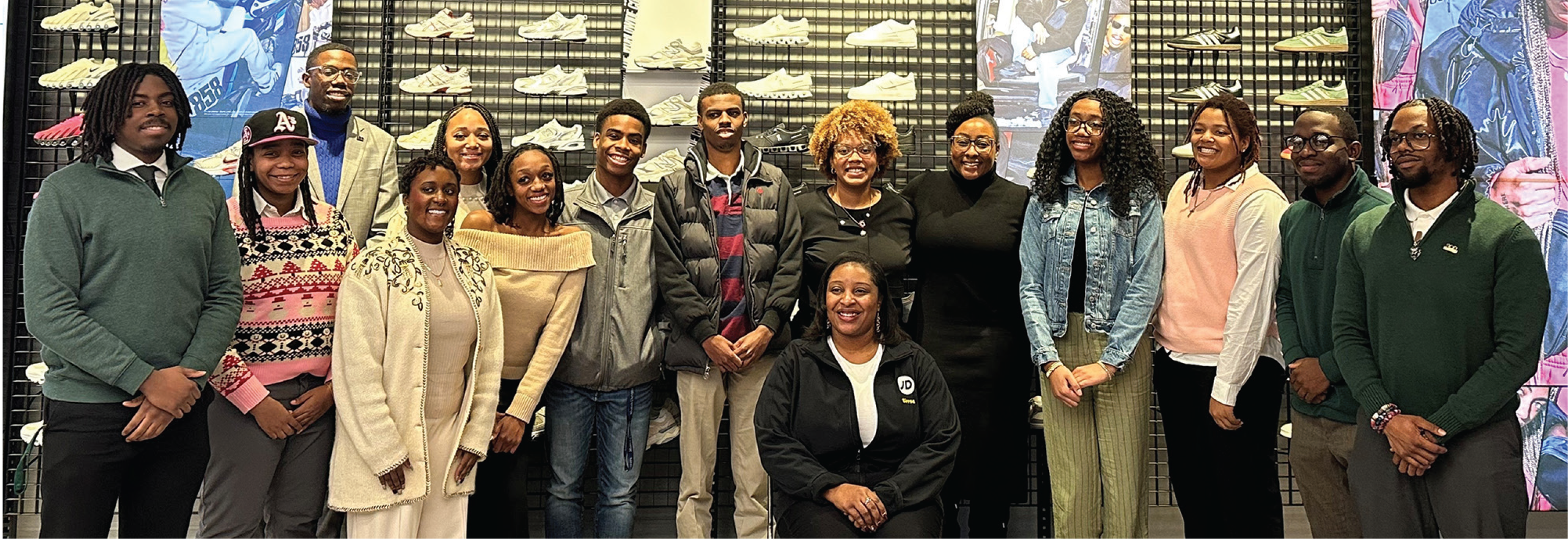
That’s what JD Sports (formerly Finish Line) did through its JD Foundation. Four years ago, the $5 million foundation based in Indianapolis asked JD Sports employees for input, took their feedback to heart and began an ongoing partnership with 100 Black Men of America, whose mission is to mentor and empower African American youth.
“Focusing on young black men and what they are going to be doing with their lives was incredibly important to our employees,” said Martin Posch, president of JD Foundation.
JD Sports acquired Finish Line in 2018 and is gradually rebranding all locations as JD Sports stores. The national partnership with 100 Black Men is one of three that JD Sports launched in 2022. The other national partners are Girls Inc. and Feeding America. All three were chosen for their potential to attract the involvement of JD Sports employees.
“There are many people who want to volunteer but aren’t going to wake up in the morning and figure out that they’re going to volunteer for an organization,” Posch said. “So, we put these opportunities in front of our employees.”
Posch said the company’ relationship with the Indy chapter of 100 Black Men is invaluable.
“Our employees see our city through the eyes of these young men and the challenges they face. It’s incredibly powerful.”
Through events and mentoring, JD Sports employees get opportunities through the partnership to develop leadership and management skills they don’t necessarily get in their day-to-day jobs, Posch said.
Inspired by their work with 100 Black Men, employees have joined boards and gained a deeper understanding of the community, he said.
Meanwhile, the youth get exposure to careers they might have never considered and learn about all that’s involved in getting products on the shelves of JD Sports’ stores.
Kraig Kinchen, executive director of 100 Black Men of Indianapolis, said the partnership with JD Sports has been beneficial for the young people and for members of his organization. “When we work with people who care about what we care about, it makes the ideas flow.”
Those ideas have resulted in programs that get to the heart of what 100 Black Men is trying to accomplish. The organization’s motto is “What they see is What They’ll Be,” and JD Sports is exposing the city’s youth to people and situations that inspire them.
For the last two years, the two organizations have hosted a workshop where high school students spend a day in a JD Sports store learning about career opportunities, the JD Sports business model and what it takes to build a team and manage effectively.
“These students love sneakers,” Kinchen said, making it easy to engage them in larger topics, such as how to sell them, how does inventory work, and how do you work as a team and as a leader to meet your sales targets.
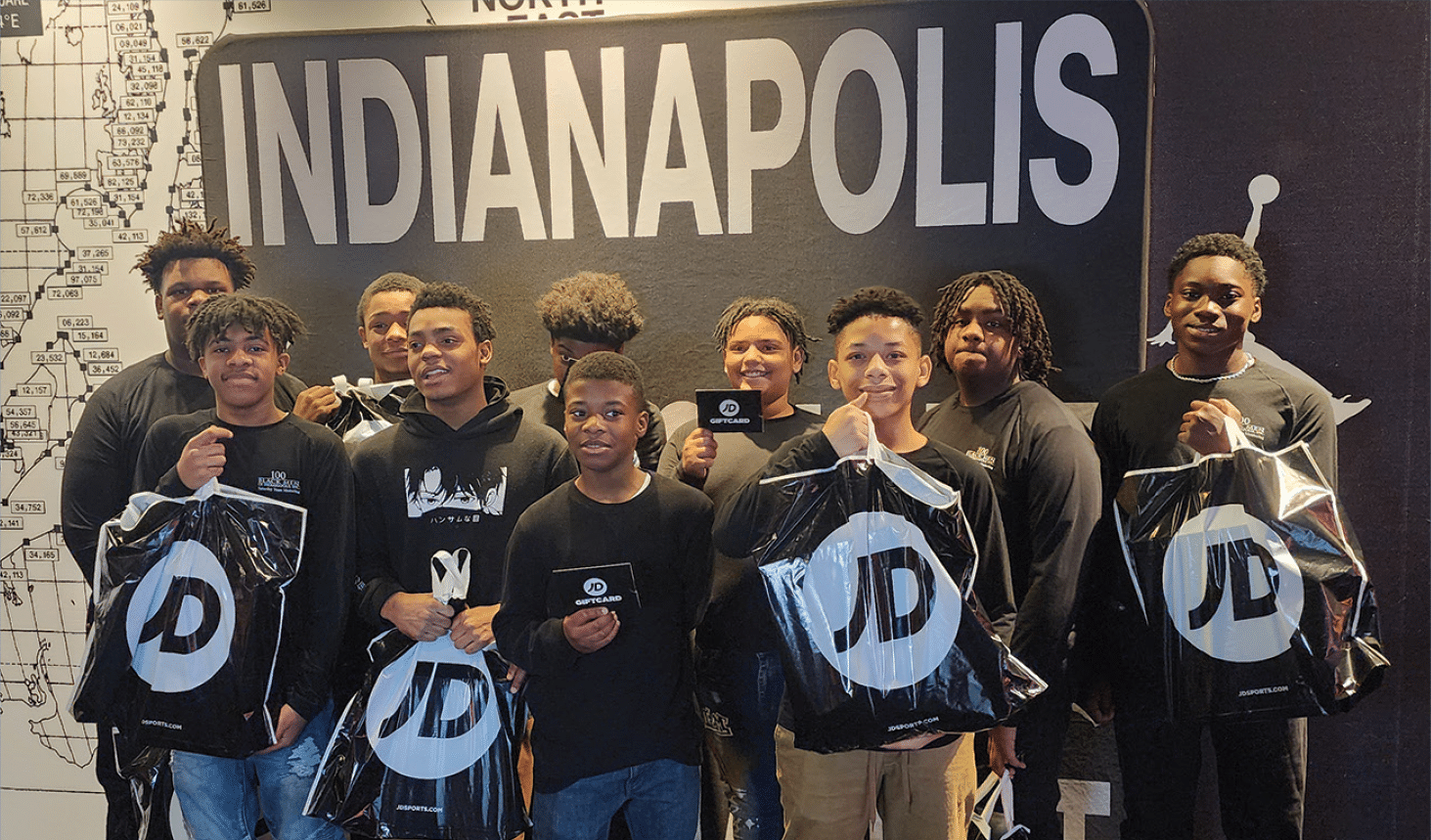
There’s also a one-day workshop for college students working with 100 Black Men. The Collegiate 100 workshop focuses on how to succeed in a work environment. Participants are exposed to part of the JD Sports employee curriculum and learn about building up social capital and succeeding within a corporate structure.
The programming exposes kids to a variety of careers: legal, marketing, finance and in-store roles that allow a company like JD Sports to succeed, Posch said. “They’re exposed to what it takes to run a multi-million-dollar store, what it takes to interview, what it takes to deal with a day of chaos in the store.”
For younger students, there’s a team mentoring program that exposes students in grades 5-9 to JD Sports stores. Students also have a chance to be a ballboy at an Indiana Pacers game or be present on the sidelines at an Indianapolis Colts game.
JD Sports executives have also spoken at the national meeting of 100 Black Men of America and at the local chapter’s fundraising breakfast.
Kinchen said a corporate partner can have a variety of reasons, including workforce development, for engaging with an organization like his, but he said there’s no better reason than simply doing the right thing. “The most effective partnerships are the ones where the company is really motivated by fulfilling their corporate mission and being a great corporate citizen.”
High school students hit the mark for corporate partners
It’s not unusual for a nonprofit to have one or two important corporate partners. Providence Cristo Rey High School has 99.
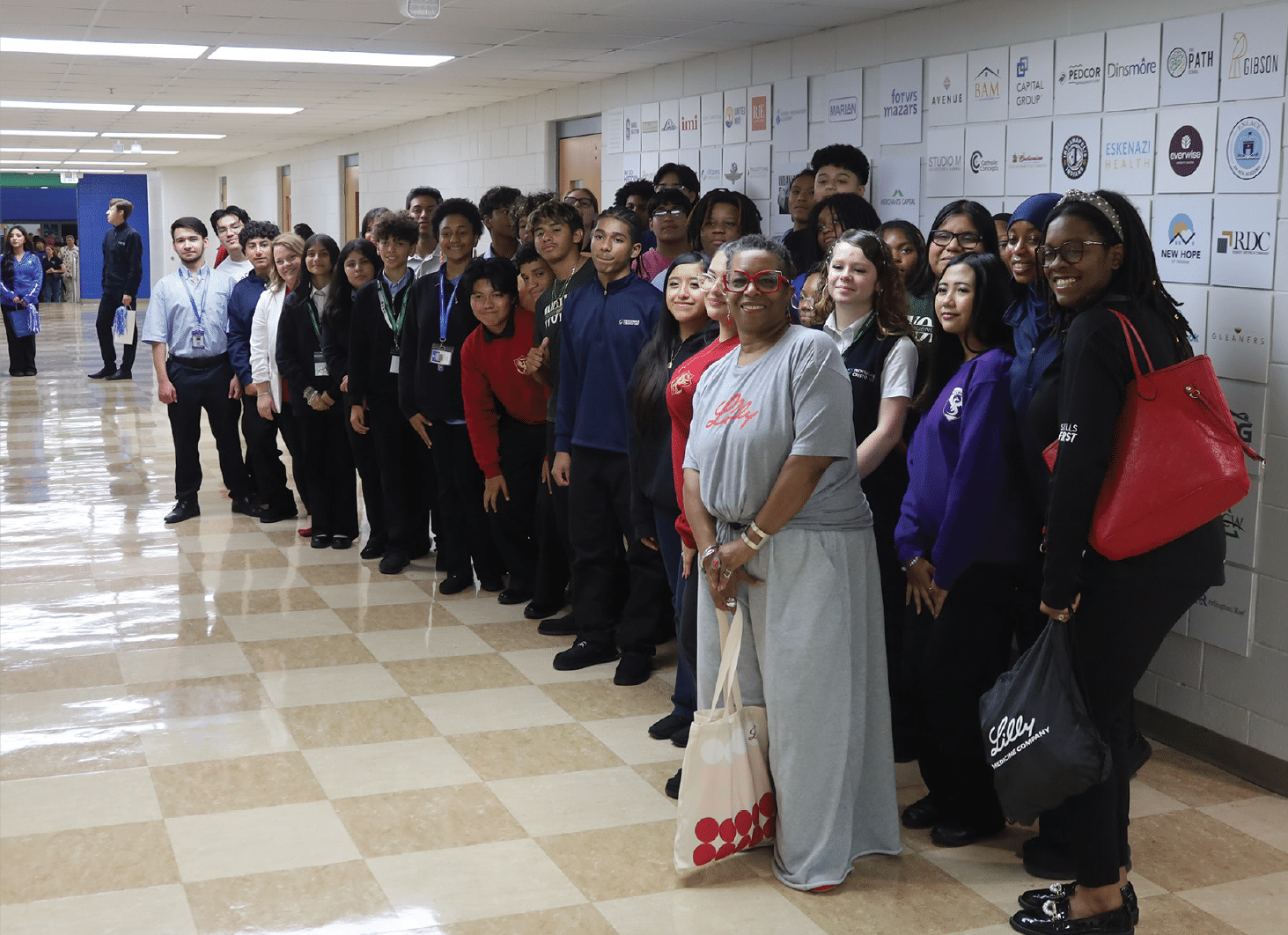
They’re all participants in the school’s Corporate Work Study program, which is beneficial—and potentially life-changing—for the students, who spend one day a week throughout their high school career working at a local business.
But the benefits go both ways. It makes sense for the corporate partners, too, said Mike Dury, president and CEO of Merchants Capital.
When Merchants became involved eight years ago, the pitch was that the program would provide Merchants with an “inexpensive workforce,” but that’s not really the value the program brings, Dury said.
It’s the morale boost that comes from working with the students that makes the program worthwhile. “When you see the joy our employees get from having an impact on these kids’ lives, it’s the greatest thing ever.”
Providence Cristo Rey is a Catholic college- and career-preparatory school in the Garfield Park neighborhood that offers a transformational educational experience to students with economic need.
The school, which has 290 students in grades 9-12, brought its national model to Indianapolis in 2007. A cornerstone of that model is the school’s Corporate Work Study program, which requires students at all four grade levels to spend one day a week working off-site at one of Providence Cristo Rey’s 99 corporate partners.
Incoming freshmen begin the program the summer before they start school by attending a two-week training session where they learn basic career skills, take an assessment test and begin the process of matching with a corporate partner.
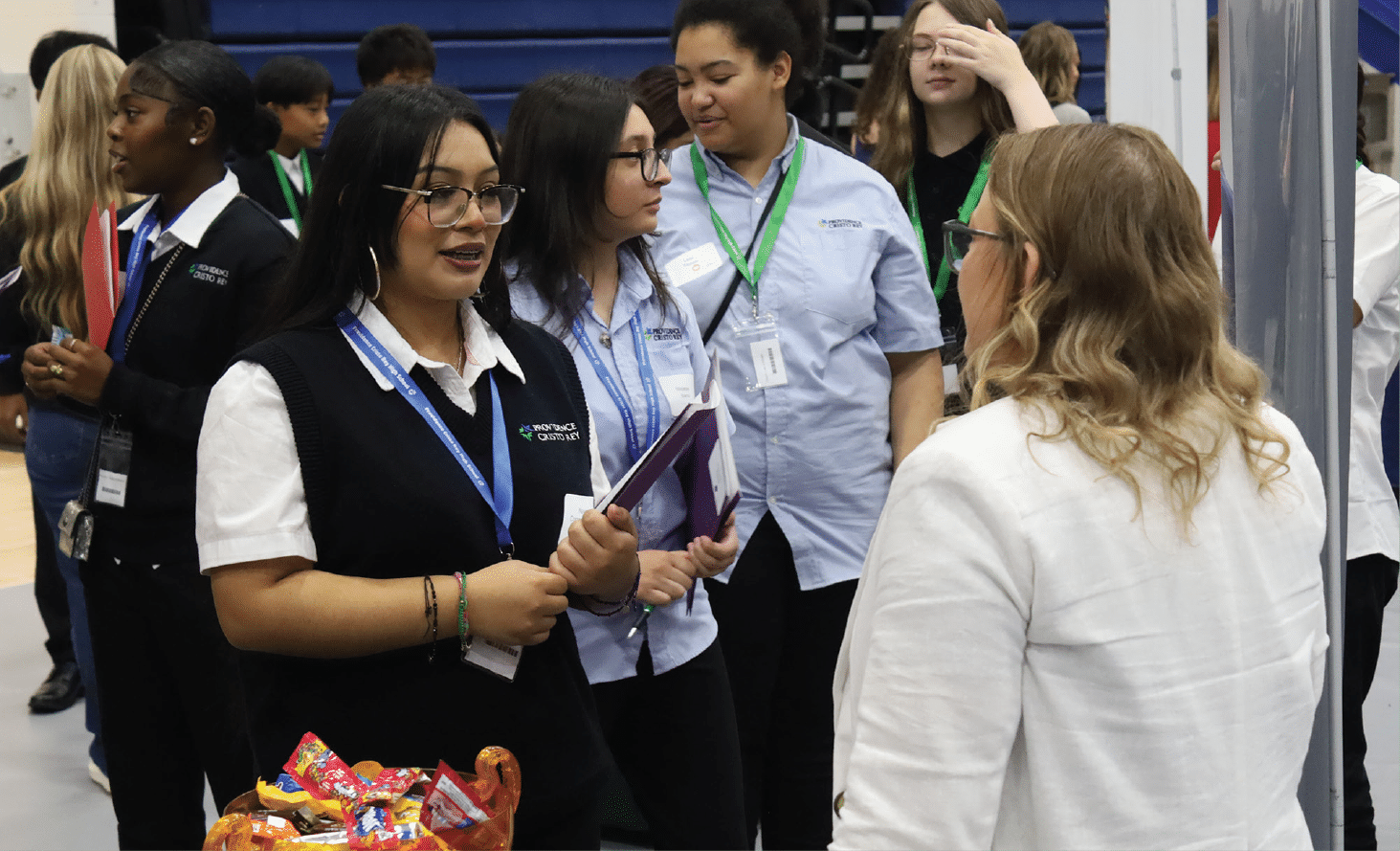
At the beginning of the school year, the school hosts a job fair where students and corporate partners become acquainted and complete the matching process.
More than half of the students stay with the same employer throughout their high school career, said Greg VanSlambrook, president and CEO of the school. Others change employers to get exposure to more career possibilities.
Corporate partners pay the high school $10,000 per student-employee, which offsets tuition expense for the students. Most partners host between one and six students per school year, but Eli Lilly and Co. and Indiana University Health host more than 30.
Students start their once-a-week workday at the school in a professional skills class before going to their employer, where they work on various projects.
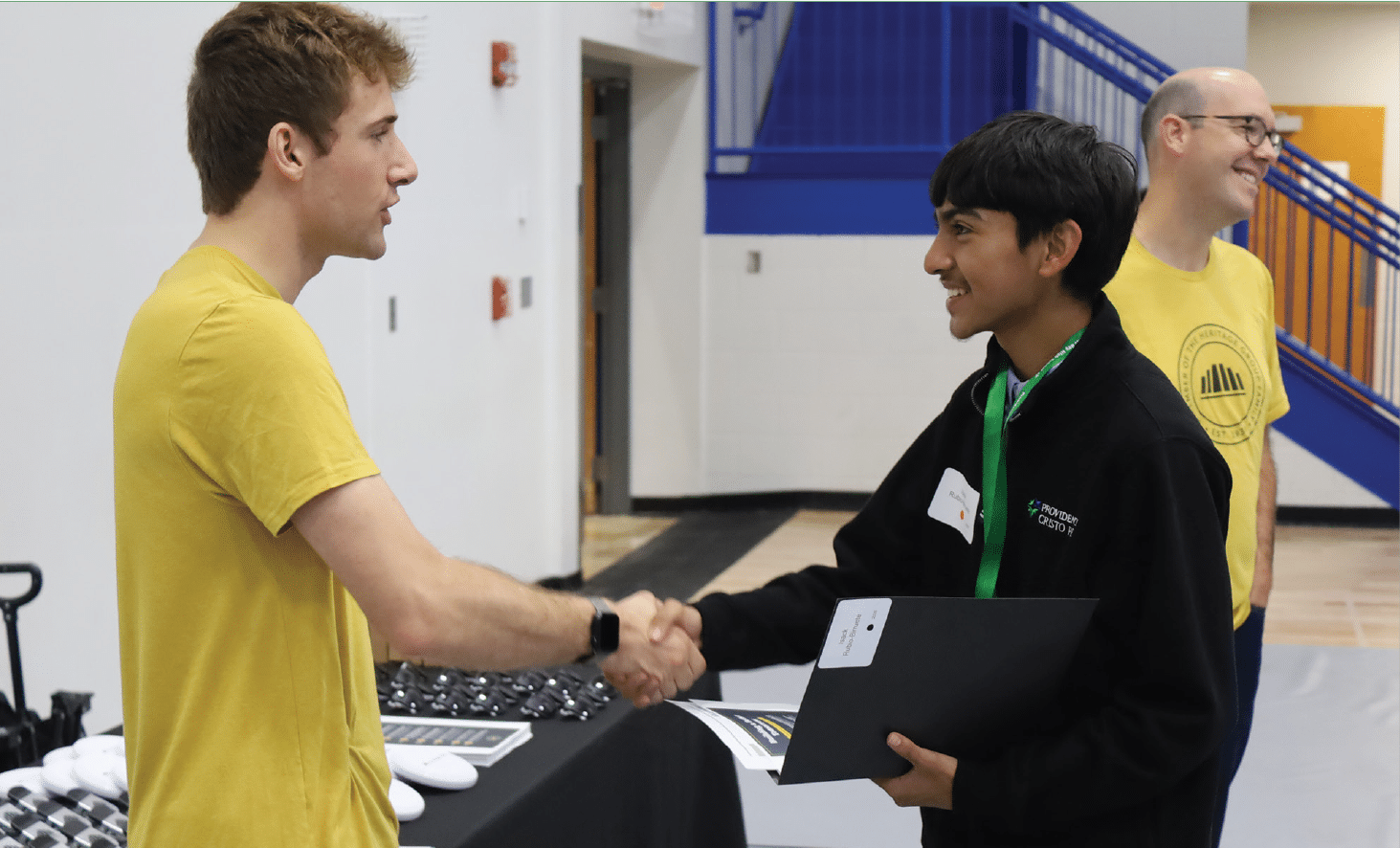
Dury at Merchants Capital absorbs a lot from the students. “If I hear a kid isn’t having a good experience in one of my departments, it tells me I’ve got some problems I need to address,” he said. The program also gives Merchants employees who lack management experience an opportunity to build their skills by managing the student-employees.
Dury is aware of other employers who’ve offered college internships and, later, full-time jobs to the students who start out in the program. From that standpoint, the program is a way for companies to think long-term and build their talent pipelines. Dury hopes that one day Merchants will hire one of its former Providence Cristo Rey students full time, but the partnership with the high school will have been worth it even if that never happens.
“We’re investing our time in these kids, and the return is 10-fold,” he said. They become an inspiration to Merchants employees because of some of the challenges they’ve overcome. “The adversity that they have to fight through to be successful is eye-opening.”
Dury chairs Providence Cristo Rey’s Work Study board, which is tasked with bringing in additional corporate partners. The number of partners, now just under 100, has risen every year, he said.
Elevate Ventures has been involved in the program since 2024 and employs two students.
Elevate, a venture capital firm, exists to build the entrepreneurial ecosystem in Indiana, and working with Providence Cristo Rey students fits that mission, said Managing Partner Matt Tyner. “We want to create Indiana’s next group of entrepreneurs,” he said, noting that the earlier you expose students to the concepts of entrepreneurism the better.
One of Elevate’s students is helping Tyner’s team evaluate investment opportunities by using artificial intelligence to research competitors and potential market size. After investments are made, students can monitor which companies are late with their reporting requirements, which flags them for follow-up by Tyner and his team.
“By the time our students are juniors or seniors, they can really have an impact on our organization,” Tyner said.