
Subscriber Benefit
As a subscriber you can listen to articles at work, in the car, or while you work out. Subscribe Now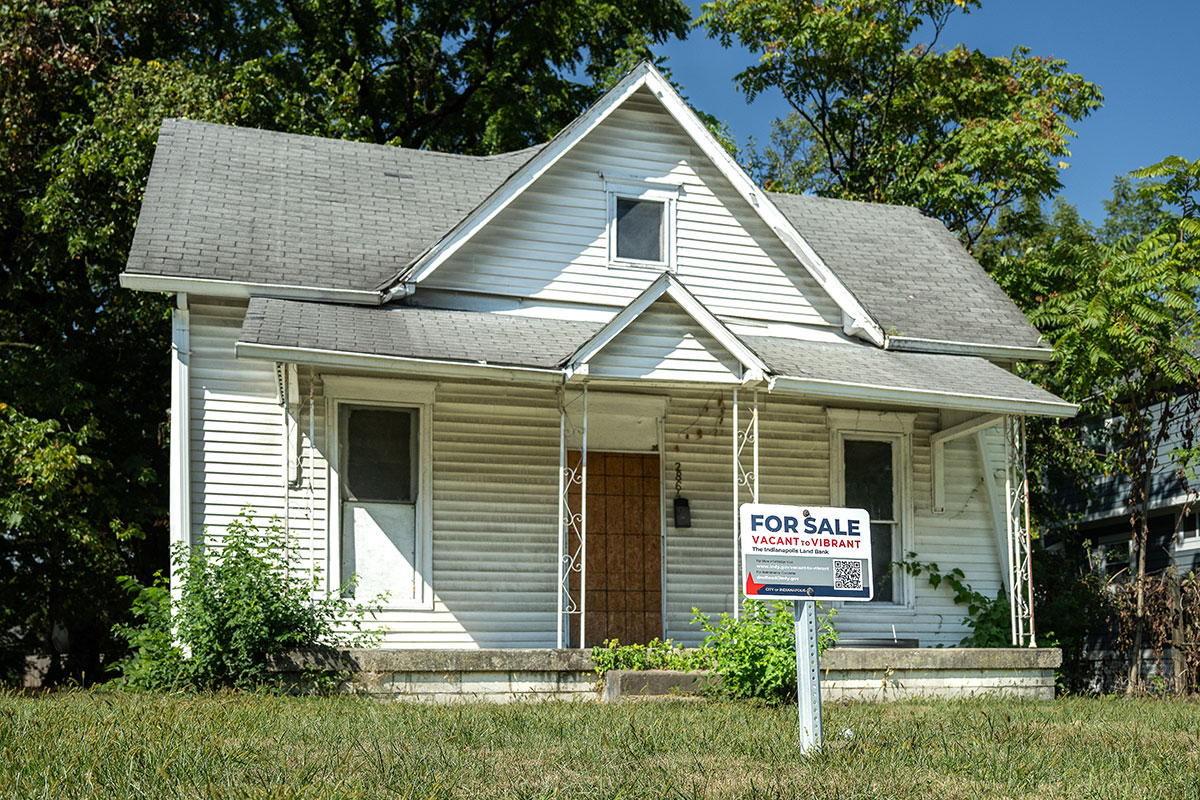
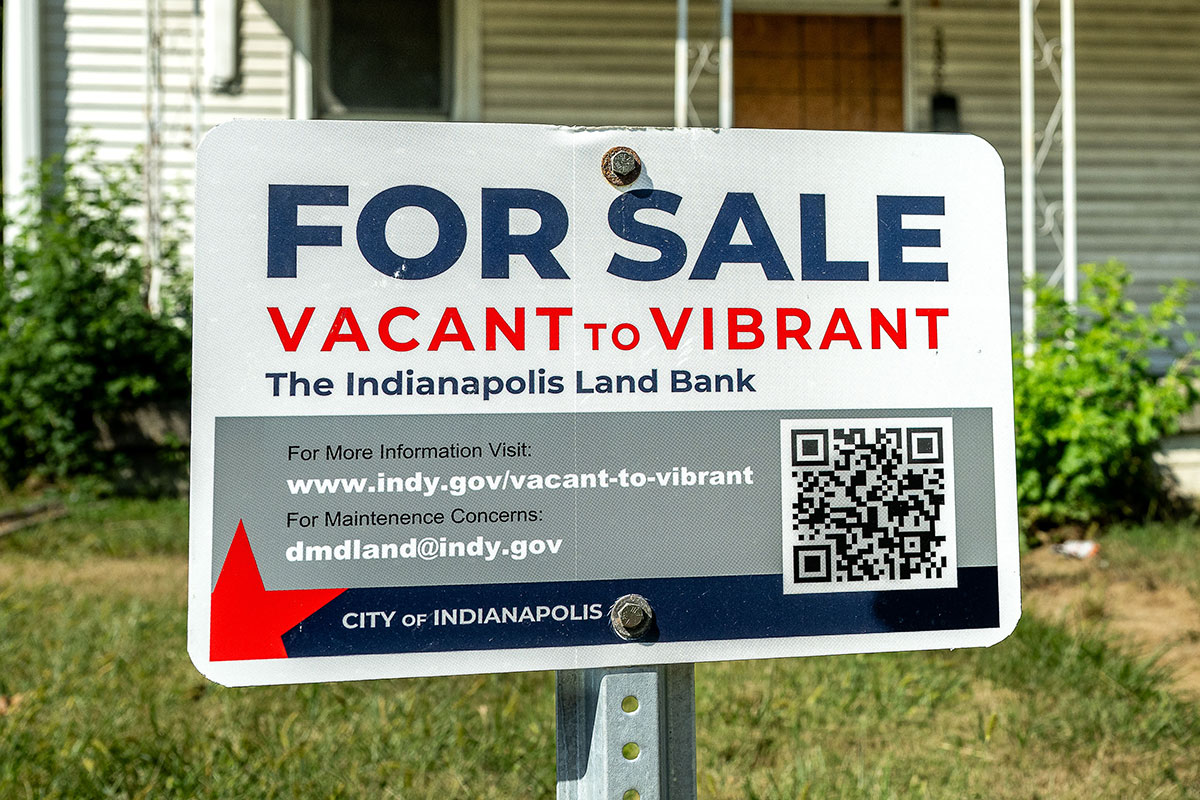
Over the past several months, Indianapolis leaders have been staking colorful signs into the yards of city-owned vacant properties in what amounts to a promise to neighbors that they plan to put the properties back on the tax rolls.
But through Vacant to Vibrant—the new name for the city’s land bank—officials are also pledging to exert more control over how those properties are developed.
The goal, at least in part, is to make sure new houses and other structures fit aesthetically and architecturally in the properties’ neighborhoods and that they meet the city’s other infill guidelines.
The Vacant to Vibrant effort—managed by the Department of Metropolitan Development—is a successor to a pilot program of the same name. And it’s ramping up some three years after the city ended a long-term agreement with a nonprofit to manage the city’s land bank.
Land banks are established to manage vacant, abandoned or deteriorated properties that are generally acquired after foreclosures or tax sales with the goal of returning them to productive uses. Most often, land banks are operated by government entities or nonprofits.
For eight years, the city contracted with Intend Indiana (a nonprofit that formed when Renew Indianapolis and the King Park Development Corp. merged) to manage the properties.
During Intend Indiana’s run, the land bank sold more than 1,300 properties to developers, significantly reducing the number of properties it was managing.
In fact, at its peak, Intend Indiana was managing about 1,200 properties in the land bank. Today, the land bank has just 168 properties.

“We actually were very successful,” Matt Hostetler, principal program manager of real estate at the Department of Metropolitan Development, told IBJ about the partnership with Intend Indiana.
But now that the number of properties under the land bank’s control is much smaller, he said, city leaders want to reimagine those properties’ best use.
That means focusing on “intentional development outcomes” that require more city oversight, reviews and approvals, Hostetler said.
A recent controversy regarding the design of an affordable housing project in the Northwest Landing neighborhood near Riverside Park and West 29th Street illustrates a need for checks on projects involving city-owned property, observers said.
For his Canal Village project, Gary Hobbs of Indianapolis-based BWI Development delivered what he admitted were homes that looked different from their initial renderings. Specifically, Hobbs said, the “biggest mistake” was not communicating with community leaders that the porches in the initial plans needed to be eliminated due to a conflict with the homes’ required setback from the road.
Indianapolis city-county councilors in August approved financing for a second phase of the scattered-site, affordable housing project—but with several guardrails. Among them: The city’s architect will review and approve the developer’s architectural plans before construction can begin.
Twenty-six of the 33 parcels to be used in that project are from the city’s land bank.
City leaders didn’t directly mention Hobbs’ project when discussing the new controls under Vacant to Vibrant. But like the city did with the Hobbs project, the revamped land bank will require all developers to submit plans for city architect approval.
Additionally, the Department of Metropolitan Development will solicit feedback from local neighborhood groups before selling a property. That’s meant to help projects from facing community pushback at the 11th hour.
Dwindling inventory

Jeff Hasser, manager of strategic initiatives at the Indianapolis Neighborhood Housing Partnership, which develops and rehabilitates affordable homes, told IBJ the city’s land bank has historically been the best way to acquire property for projects. And he said the work is incredibly important.
“With the amount of properties that we’re talking about, it would be very difficult for any entity to be able to take control of these properties, access them, maintain them, prepare them and get them ready to sell in an equitable way,” Hasser said. “I think that’s one of those instances where the city is obviously well-positioned to handle a lot of those responsibilities.”
The city’s contract with Intend Indiana ended in 2022. City government then picked up the land bank work through the January 2023 launch of a “Vacant to Vibrant” pilot program, which doled out $4.5 million to development organizations to revamp 100 city-owned lots.
City leaders issued the funds to developers through a request for proposals process that ended that August. Auboni Hart, DMD’s chief communications officer, told IBJ that department leaders decided to keep the name and branding for the land bank after the pilot ended.
Experiences with the pilot also shaped the current land bank program, Hart added.
When contacted by IBJ, an Intend Indiana leader described the organization’s split with the city as mutual but declined additional comment. The nonprofit no longer directly manages any city land banks. Instead, it provides technical assistance to municipalities, including South Bend, Elkhart, Michigan City and Kosciusko County.
Indy’s land bank had a rocky history before Renew Indianapolis took over in 2014.
In May 2013, a federal probe into the land bank led to charges against five men, including two city employees.
The land bank stabilized under Renew. But the nonprofit’s success in selling off dilapidated properties meant fewer houses were available for new projects.
Hasser, of the Indianapolis Neighborhood Housing Partnership, recalls a time early on in INHP’s housing development work when land was much more accessible. “Those are fewer and far between, unfortunately, because of the lack of supply from the land bank,” he told IBJ.
Because of that scarcity, the citywide affordable housing developer has to explore narrower lots, rehabilitation of existing units and sometimes demolition to build a new structure.
Additionally, Hasser said, the scarcity is forcing nonprofit developers to be more proactive in working alongside city leaders to explore options outside the land bank.
New course
The full rollout of Vacant to Vibrant coincides with the city’s annual budget-writing process for 2026, which gives officials the chance to set financial parameters for a higher-impact program.
The city paid Intend Indiana $100,000 a year to manage the land bank, and that organization received 45% of the proceeds of each property sale.
For the last two years, the Department of Metropolitan Development has operated a lower-key version of the land bank. Still, in August, DMD Director Megan Vukusich told councilors at the department’s budget hearing that it had acquired 140 properties in 2024 and 2025. She said 115 of those had already been put back on the market.
The city’s proposed 2026 budget requests $812,781 to run the program internally. That funds the cost of property maintenance—including boarding up buildings, cleaning up illegal dumping, removing graffiti, and when needed, demolition. It also covers mowing, title and land recording costs, property acquisition and taxes, software and technology, and supplies.
Currently, Hart said, the program’s revenue doesn’t cover personnel and administrative costs. Staff salaries are covered by other funds. The city does, however, collect all revenue from property sales and put it back into the program.
The city maintains a public, online portal of available properties at indy.gov/activity/Indianapolis-real-estate.
Most parcels can be purchased by three types of buyers: standard, homestead and affordable housing.
Standard buyers must rehabilitate existing structures or build a new home that can be used as a rental property or eventually resold to other buyers. Buyers in the affordable category must develop a residence that is available to occupants who earn 80% or less than the area’s median income.
Homestead buyers must overhaul existing properties or build a new home that will be the owner’s primary residence for at least two years.
The different types of buyers pay different prices.
For example, for a three-bedroom home at 2864 N. Sherman Drive built in 1930, the sale price for a standard buyer is $49,000. The same property would cost a buyer in the homestead category $39,200. A nonprofit entity with a proven track record of affordable housing creation or that has applied for federal low-income housing incentives would pay just $3,000.
Under a project agreement between the city and the buyer, the purchased property must be redeveloped within two years. That requirement was carried over from the contract with Intend Indiana, Hostetler said.
Interested buyers of each kind can apply online. Applications for the properties are due the first Friday of every month and take eight to 11 weeks to review, according to a city frequently-asked-questions document.
Finding productive use
The Martindale-Brightwood Community Development Corp. is an organization that qualifies in the affordable category and is using property it can acquire inexpensively from the land bank to improve its east-side neighborhood.
One of those properties is 2053 Ralston Ave. It showed up in a county tax sale in 2020 after its former owner had racked up more than $13,000 in past-due taxes, city property records show. No one picked up the property in the tax sale, which is the process through which governments try to recoup lost tax revenue.
That made the property available to the city, which can acquire it 120 days after the tax sale ends. Once the city bought the land and put it in the land bank, the Martindale-Brightwood Community Development Corp. purchased it for $1,000.
On Sept. 23, the nonprofit hosted a groundbreaking for an affordable housing project, called Ralston Hills, planned for the site. The project will include seven town houses along Ralston Avenue and use nearly $1 million in COVID-19 relief funds doled out by the DMD for development projects.
Amina Pierson, executive director of the Martindale-Brightwood Community Development Corp., told attendees at the groundbreaking that the city’s land bank is assisting in “turning empty lots into thriving homes and helping to revitalize the block.”
Many of the remaining land bank properties are clustered in areas that have seen disinvestment, including the near-northwest side and portions of Martindale-Brightwood.

Immanuel Ivey is executive director of Edna Martin Christian Center’s newly created community-based development organization. Ivey’s organization was formed in 2022 in response to the most recent Martindale-Brightwood Quality of Life Plan, which emphasized a need for affordable homeownership options.
Ivey said the number of dilapidated, abandoned homes in Martindale-Brightwood has decreased. However, many have been purchased by out-of-state investors who make offers to private homeowners before the properties reach a tax sale, he said. Often, the homes are then flipped into market-rate rentals.
In an attempt to preserve affordable options, the Edna Martin Christian Center’s development organization purchased 13 vacant lots from Intend Indiana in 2023. But Ivey said work on those properties is stalled because lead contamination in the properties’ soil is expensive to remediate.•
Please enable JavaScript to view this content.
Will they actually be an open market this time or just operate under nepotism and greased handshakes?
Work with High Schools, Ivy Tech and Trades Programs for education and student experience.