
Subscriber Benefit
As a subscriber you can listen to articles at work, in the car, or while you work out. Subscribe Now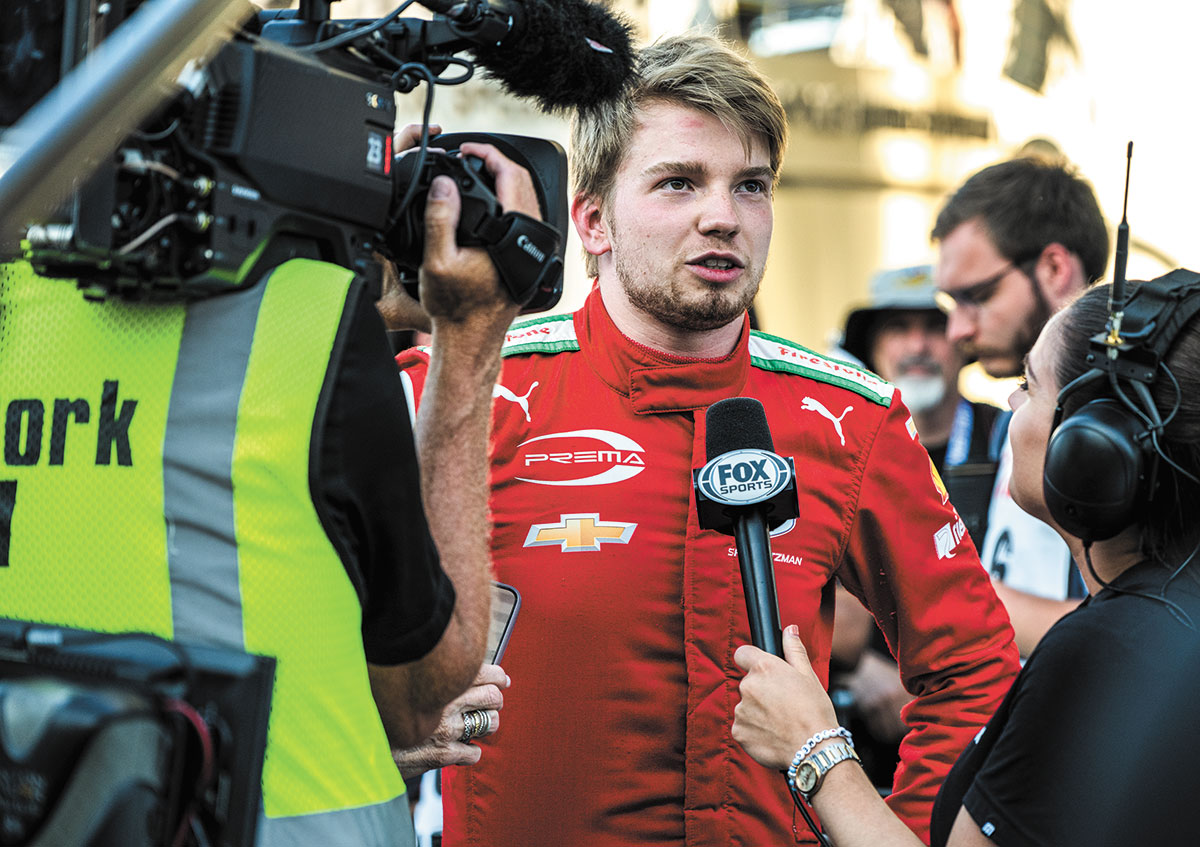
Auto-racing reporter Jamie Little says Fox Sports became an industry leader in televised events by demanding attention.
“It’s in your face,” said Little, a Zionsville resident who will report from pit road during Fox’s Sunday telecast of the Indianapolis 500. “It’s, ‘This is awesome,’ and, ‘You have to watch this. You’re missing out if you’re not.’”

Fox Sports, which launched in 1994 with an entertaining approach to broadcasting NFL games, will carry the race for the first time as part of a multiyear contract with the NTT IndyCar Series.
But this won’t be Little’s Indy 500 debut. While working for ABC in 2004, she became the first female pit reporter for the race’s television broadcast. Little, who continued to be an Indy 500 reporter through 2014, said Fox focuses on drivers and bold storytelling “through the eyes of those modern-day gladiators.”
Fox launched that idea well before May by showcasing three drivers—Josef Newgarden, Alex Palou and Pato O’Ward—in individual ads that aired during this year’s Super Bowl telecast.
Network officials say they consider the Indy 500 one of Fox’s “jewel” events, alongside the Super Bowl (seen on Fox in 2020, 2023 and 2025) soccer’s World Cup (2018, 2022 and scheduled for 2026) and baseball’s World Series (every year since 2000).

“When you’re the steward of these events, meaning that others have done it before and now it’s our turn, it’s incumbent on us to show Indy in a different light—perhaps a light that hasn’t been seen before,” said Mike Davies, executive vice president of field operations for Fox Sports.
Technology helps in the quest to show something new, Davies said.
This year’s Indy 500 will feature Driver’s Eye cameras for the first time. Placed in the padding between a driver’s head and helmet, the 8-millimeter cameras more or less capture what a driver sees. Because the cameras move with each head movement, Driver’s Eye lends credibility to Little’s remark about conveying the perspective of modern-day gladiators.
The audience for Fox’s telecast will include real-time viewers in central Indiana, which is a rarity in the race’s history. Because of a sellout of reserved grandstand seating, Indianapolis Motor Speedway officials lifted a blackout on Fox’s local affiliate, WXIN-TV Channel 59.
In 2016, the last time IMS sold out its grandstands, more than 300,000 households in central Indiana tuned in for the live telecast of the 100th running of the Indy 500. The total national TV viewership that year was 5.86 million on ABC.
The 2024 race attracted 5.34 million viewers on NBC.
While IndyCar is new to Fox, the network has been a broadcast partner of NASCAR since 2001. This year’s Fox telecast of the Daytona 500 attracted 6.76 million viewers.

Pam Miller, lead producer of Fox’s IndyCar telecasts, said the network has an inherent cadence and excitement when presenting races.
“We have an energy,” Miller said. “We have a team that wants to make this series relatable, understandable and entertaining. We love relating to fans all of the peeks behind the curtain that we can.”
Davies said the network’s challenge is to show “what speed looks like.”
“Utilizing whatever combination Fox has, be it ‘in your face’ and irreverent or being more about sights and sounds than X’s and O’s, these are the things that started this network,” Davies said. “You know, we don’t get a ton of chances to make our debut on a sport.”
The cutting edge
Although the space inside the track at Indianapolis Motor Speedway is famously large enough to contain Vatican City, Churchill Downs and Yankee Stadium with room to spare, the Fox Sports broadcast compound is found outside the track, north of the Turn 4 grandstands.
The compound is home to eight mobile production units, or “trucks,” and one serves as the workplace for director Mitch Riggin and producer Miller.
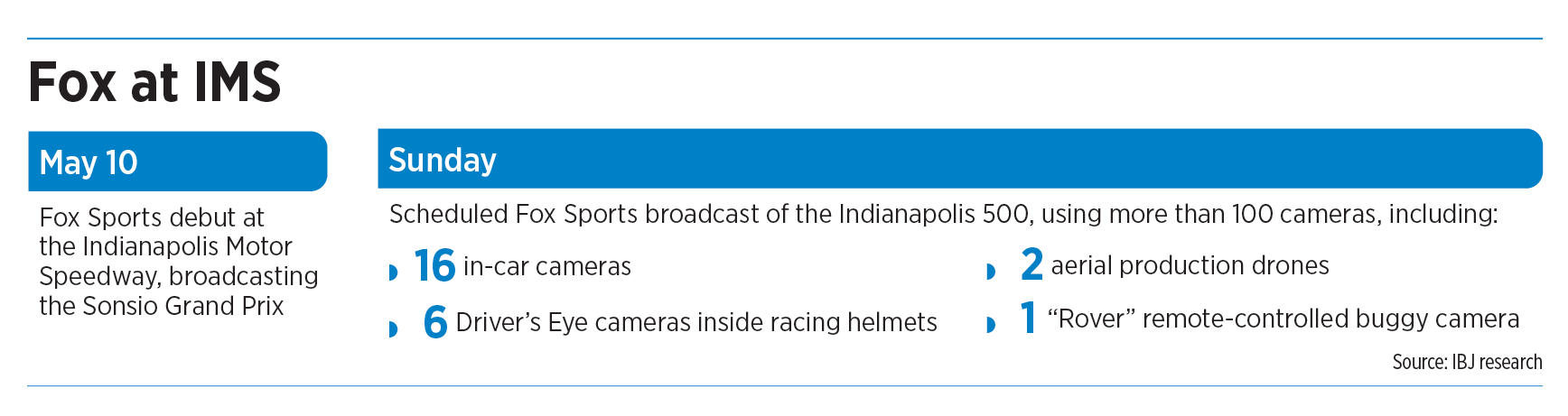
They make decisions regarding more than 100 cameras that Fox will use on Sunday. The camera roster includes 16 in-car models, two drones and the network’s “Rover” buggy operated by remote control.
Driver’s Eye cameras will be placed in the helmets of six competitors.
“You can make a camera as small as you like,” Davies said. “You have a pretty small one on your phone. But making it a broadcast camera, integrating it into the transmission system in the car and getting it out to a production truck is kind of where the magic is.”
Miller said the camera takes viewers remarkably close to drivers.
“If you really watch the camera, you can see the drivers thinking about how they’re setting somebody up for a pass, and you can see the struggle and physicality of handling the wheel through certain turns,” Miller said.

The technology impressed Doug Boles, president of both the NTT IndyCar Series and Indianapolis Motor Speedway.
“The in-car camera stabilizes everything so much that it doesn’t quite give you the view of the things you can’t see,” Boles said. “You just have to know where parts of the car are. The Driver’s Eye is really more like what you feel, because you’re moving. It’s the bumps you feel in your head, and your eyes are shaking.”
Davies said Driver’s Eye helps Fox telecasts pass “the bar test.”
“If you’re sitting in a bar, you’re going to look up, and you’re going to see something eye-catching,” Davies said. “We don’t do technology for technology’s sake, but we do try to show the race in different views.”
‘Work in progress’
IndyCar’s Boles and Fox’s Miller acknowledge that growing pains have been on display during telecasts of the first five races of the IndyCar season.
Most notably, the live feed of Southern California’s Thermal Club IndyCar Grand Prix was interrupted for more than 10 minutes in March when one of the production mobile units overheated.
Boles said the problem, which was related to upgrades made to distribute telecasts in 1080p resolution rather than 1080i, was “on our team, not on the Fox team.”
“What I loved the best about that is that Fox didn’t come out and say, ‘Hey, this is on the guys at IMS and IndyCar.’ They said, ‘We had a truck go down,’ and they left it at that,” Boles said. “That just tells you how the partnership was as we worked through that.”
Viewers have noted the timeliness of graphics as an opportunity for improvement, and Fox host Chris Myers was dinged during last weekend’s qualifications coverage for twice saying “Daytona 500” when referring to the Indianapolis 500.
Overall, Boles said, he gives Fox high marks for its work so far. Fox Sports CEO Eric Shanks grew up in Brazil, Indiana, and is a lifelong fan of the Indy 500. On Sunday, the full Fox crew will include more than 450 staffers.
Miller characterized Fox’s IndyCar season as a “work in progress” for a production crew in its rookie season.
Davies said Fox’s internal critiques likely match any external complaints posted on social media.
“When we go back and take a look at these productions, we probably to a fault don’t talk a lot about what goes right,” he said. “We talk about what we can improve. And that’s just the cross to bear when you’re on TV.”

Showtime
Similar to years in which a central Indiana TV blackout is in place, this year’s race will be offered as a delayed telecast Sunday night on WXIN-TV Channel 59 (in addition to the real-time airing).
But Boles said the evening repeat has never been an afterthought.
He said three audience components make the Indy 500 work:
◗ in-person attendance, which on Sunday is expected to be near 350,000 spectators.
◗ radio listeners, including scores of fans who tune in at the track.
◗ TV viewers.
“It’s a tradition for a lot of this market to watch the race on TV when they get home,” Boles said. “Or even if they haven’t attended the race, people watch when they’ve finished whatever they do on Memorial Day Sunday.”

Dominic Mancuso, vice president and general manager of WXIN, said his station gladly accepts the chance to carry Fox’s telecast as it happens.
On Sunday, Fox59’s staff will provide pre-race coverage from 5-10 a.m., followed by the network’s pre-race show from 10 a.m. to the scheduled green flag at 12:45 p.m. The telecast’s repeat will begin at 7 p.m.
Leading up to the race, WXIN aired local specials on Feb. 14 to mark a 100-day countdown and on May 1 to kick off race month.
“Fox does things big, and we try to mirror that,” Mancuso said.
In terms of what to expect during the race telecast, Miller said the 115-year-old Indianapolis Motor Speedway will play an important role.
“There is no better lead in a book or a play than the Speedway,” Miller said. “So many men have had a longtime romance with the Speedway that’s lasted their entire lives and defined their lives. You can’t overstate that. You feel the ghosts and the goose bumps when you walk in.”
When discussing modern drivers looking to conquer the track for the first time, Miller said Palou—winner of four of the season’s first five races—is must-see television.
“I think we have to remind people how rare this is and to appreciate excellence,” Miller said. “I tend to think the pressure on him must be immense to continue to be so perfect in a lot of ways. When you’re watching excellence, it’s hard sometimes to appreciate it in the moment. But when you’re covering it from our perspective, it’s amazing to watch.”•
Please enable JavaScript to view this content.
Really looking forward to FOX and what they do with the 500!
Looking forward to seeing the broadcast. While i appreciate the full season one location broadcast, early season races have way to many complete cutaway commercials