
Subscriber Benefit
As a subscriber you can listen to articles at work, in the car, or while you work out. Subscribe Now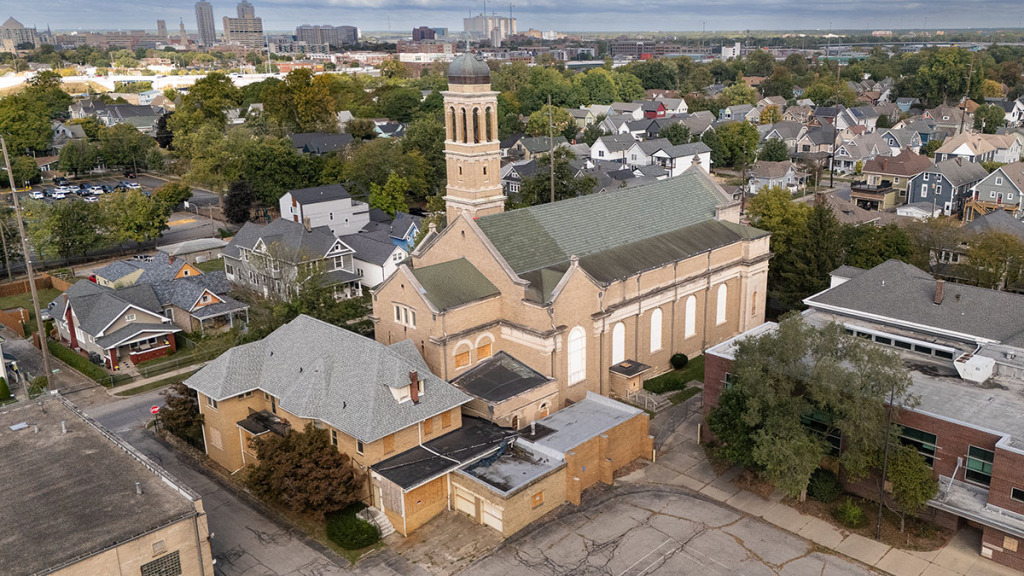 The Archdiocese of Indianapolis says restoring the Holy Cross Church building would cost $7.5 million to $8.5 million. (IBJ photo/Chad Williams)
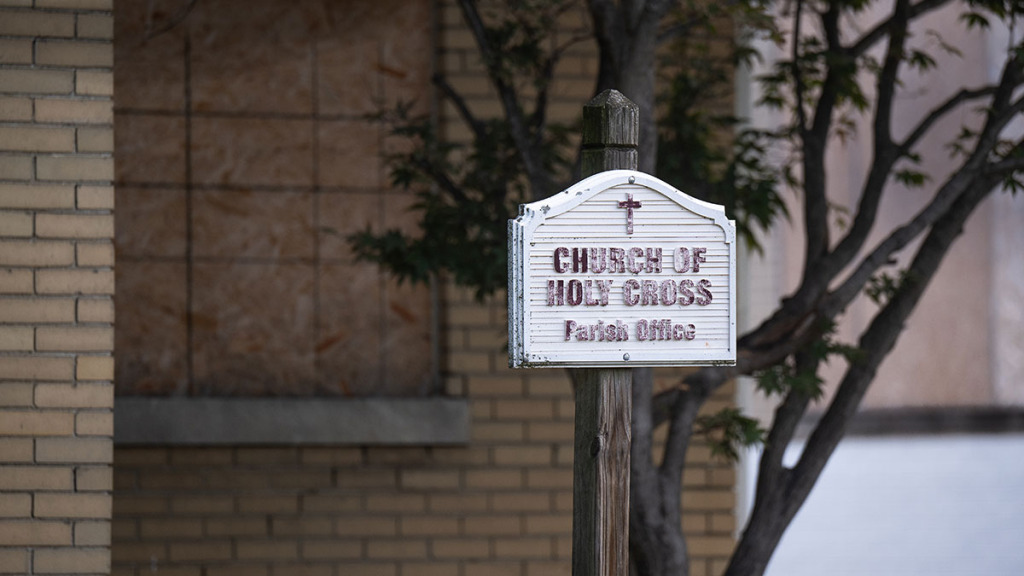 The Holy Cross parish was absorbed into adjacent St. Philip Neri Parish a decade ago. (IBJ photo/Chad Williams)
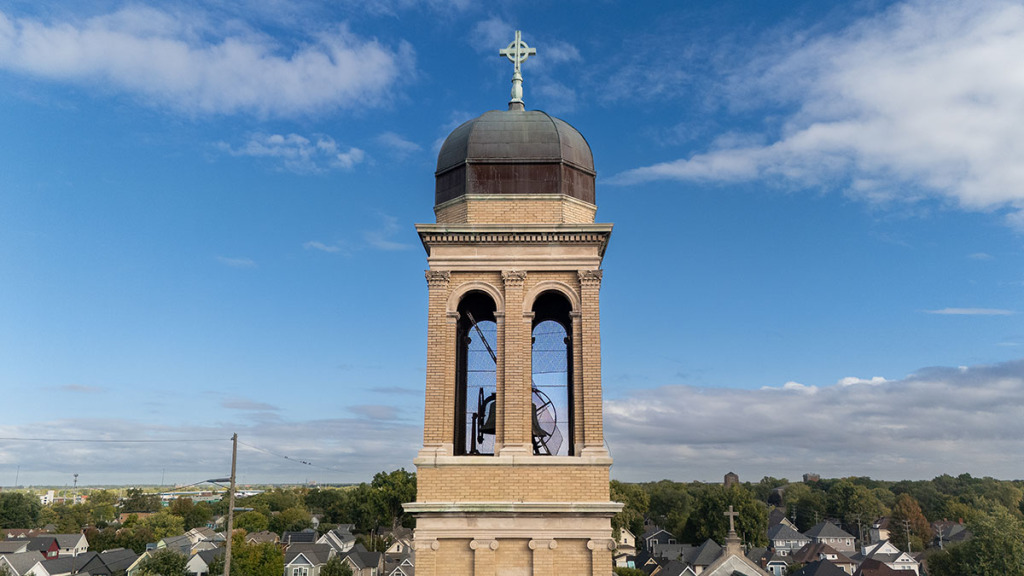 Holy Cross residents consider the church’s bell tower a neighborhood landmark and are strongly opposed to its demolition. (IBJ photo/Chad Williams)
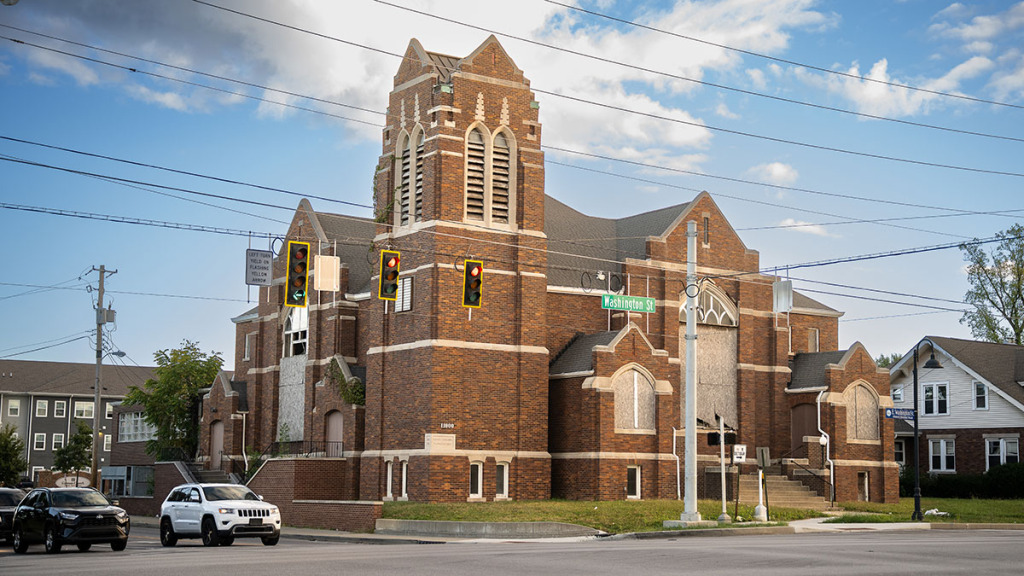 A decade after its congregation left, the St. John United Church of Christ building at East Washington Street and German Church Road in Cumberland sits empty, with no public plans in the works. (IBJ photo/ Chad Williams)
Russ Seiler recalls anxiously standing at the altar of the former Phillips Temple CME Church a decade ago as rain poured in through the open roof. He wondered if it was a sign.
“You know, maybe somebody was trying to tell me something,” Seiler said.
His development company, Indianapolis-based Van Rooy Properties, had embarked on an arduous journey to convert the church structure into an apartment building after it nearly faced demolition. Before even starting construction, workers spent six months removing debris from the interior.

“But it turned out great,” Seiler said.
Van Rooy Properties created a 40-unit apartment complex in 2016 using the century-old church on Martin Luther King Jr. Street and an adjacent new building. In all, the work to create what is now called Temple Lofts cost $4.2 million.
Stories like Seiler’s—successful adaptive reuses of historic church structures—were frequently cited at an Oct. 1 Indianapolis Historic Preservation Commission meeting at which commissioners voted down Indianapolis Catholic Church leaders’ request to demolish the 104-year-old Holy Cross Church at 125 N. Oriental St.
That church was closed about a decade ago when its parish merged with St. Philip Neri Parish. St. Philip Neri Parish has decided “removal is the only option” to uphold Catholic Church rules about former sacred places, according to parish priest the Rev. Jeffrey Dufresne.
But community members and historians have balked at the parish’s decision, in part because of the many examples of adaptive reuses of church buildings around Indianapolis.
At least for now, Dufresne said, reuse is off the table for Holy Cross. But even if it weren’t, eople involved in giving old churches new life say the process is expensive and time-consuming, complications Seiler is intimately familiar with.
“It’s absolutely not for everybody,” he said.
Because church spaces, like the Phillips Temple, are designed for large gatherings, Seiler said, his team had to get creative to manage the building’s quirks: a slanted floor that led from the back of the congregation to the altar and 20-foot windows that couldn’t be divided by floors.
Ultimately, Seiler’s solution was to “use the building as a shell” and “rebuild a structure on the inside.” Where the windows made it impossible for builders to create separate apartment units, they crafted an interior town-house loft that spanned the second and third floors.
Van Rooy beat out three competitors to purchase the building from Indianapolis Public Schools, which had bought the property with plans to demolish the church and convert the space into a parking lot for its adjacent Crispus Attucks High School. Vay Rooy paid IPS $124,000 for the site in August 2015. After renovation, the Temple Lofts market-rate units filled up quickly.
But not all projects are that smooth.
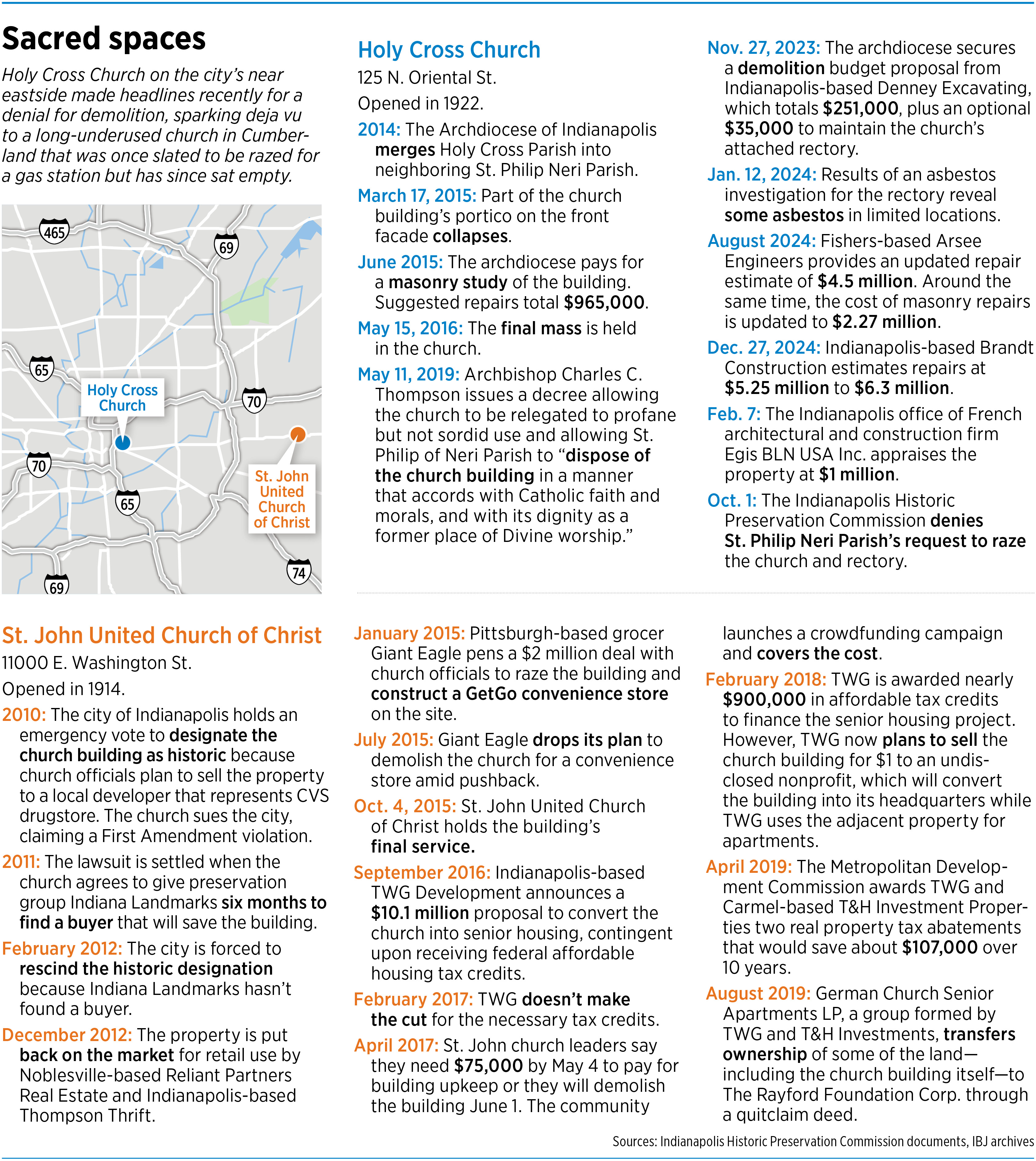
Another Indianapolis church saved from demolition still sits empty a decade later. St. John United Church of Christ, a behemoth structure at the corner of East Washington Street and German Church Road in Cumberland, has been a local point of interest for about 15 years.
Originally known as Deutsche Evangelische St. Johannes Kirche, German Church Road’s namesake hosted its final service for St. John United Church of Christ almost exactly 10 years ago. By that point, church leaders had already begun contemplating demolition of the structure in favor of a $2 million deal with Pittsburgh-based developer Giant Eagle to build a Get Go gas station. Giant Eagle pulled out amid controversy over the plan.
Ultimately, Indianapolis-based TWG Development and Carmel developer T&H Investments bought the adjacent land and developed it into German Church Senior Apartments using federal low-income-housing tax credits. That project, however, left the historic church structure alone.
In August 2019, the two firms transferred the church to The Rayford Foundation Corp. through a quitclaim deed. The Rayford Foundation Corp. was formed in 2017 as a nonprofit, according to Indiana secretary of state documents. Bailey Rayford is listed as the organization’s president; Jimmy Rayford is listed as vice president.
The two filed to dissolve the organization in 2020. When contacted by IBJ, Bailey Rayford declined to comment.
Christine Owens, assistant town manager for Cumberland, has worked for the town for 17 years. She said she’s been advocating for the church to be saved that entire time.
“We’ve talked with the owner in the past about different redevelopment options; we’ve had conversations with the city and others, trying to see if we could be a conduit to try to put something together to help facilitate some adaptive reuse,” Owens said. “Nothing’s really panned out at this time, so it’s kind of up to the owner at this point.”
Costs clash with passion
Holy Cross Church and the St. John United Church of Christ are examples of the conflict that emerges when neighborhood leaders and historians coalesce to protect historic structures, but owners are unable or unwilling to take major steps toward rehabilitation or reuse.
It’s unclear what the Rayfords intended to use the St. John church building for.
But Owens acknowledged that it would probably take at least $3 million to bring the structure to its former glory. Saving it remains important to Cumberland, which sees the building as a sort of gateway to the town from Indianapolis.
“Residents reach out to us all the time wanting updates, voicing concerns, wanting to see something,” Owens said. “We’re going through a new comprehensive plan. We had our visioning session a week and a half ago, and it came up there that the community would love to see it restored and turned into some sort of community asset.”
Also considered integral to its community, the Holy Cross Church at 125 N. Oriental St. is the namesake of its neighborhood. Neighbors consider the 136-foot bell tower a landmark and have expressed passionate opposition to its possible demolition.
Indianapolis City-County Councilor Jesse Brown, who represents the area, called the church building the “heart and soul” of the Holy Cross neighborhood at the Oct. 1 IHPC meeting.
William Selm, a German historian who testified in favor of denying demolition during that same meeting, said the church and its story make him think of his grandparents and great-grandparents saving nickels and dimes to build a church of their own. He said second-generation Irish in Holy Cross paid to build that church.
“They paid the architect, they paid the contractors to build something not for themselves, but for all eternity,” Selm said.
The sentimentality expressed by speakers and the commission contrasted with the practical approach taken by church leaders.
Combining estimates for masonry, structural work and interior improvements, Dufresne said, restoring the church would cost $7.5 million to $8.5 million and would boost the estimated sales price for the property only about $100,000, to about $1.1 million.
Dufresne pointed to a letter from Indianapolis-based Flaherty & Collins President Michael Collins, which stated, “a full-scale rehab would be too expensive to allow for a deal to work in the current environment. Construction costs remain a hurdle on even the most straightforward redevelopment and the presence of the need for the estimated $6 million façade repairs almost certainly makes this a non-starter.”
Churches left behind

More frequently in the modern era, congregations have been forced to make “tough decisions” about their buildings, based on their size and support from churchgoers, said Indiana Landmarks Vice President of Preservation Mark Dollase.
And that dilemma applies to more than just religious structures. Dollase said Indiana Landmarks’ list of 10 most endangered structures more often includes gathering spaces like fraternal lodges and masonic temples. But the holy spaces seem to create thorny legal situations.
Church leaders define the city’s involvement as an infringement on their First Amendment right to religious freedom, even threatening in the Archdiocese of Indianapolis’ application to demolish the “immediate filing of a lawsuit in federal court” to uphold that religious freedom in the case of a denial.
After that denial, the church released a statement saying it plans to appeal the decision to the Metropolitan Development Commission in November.
“The city’s denial of our application puts us in an unsustainable position, so we are currently exploring all legal remedies to preserve our religious liberty,” the church told IBJ this week.
Leaders at St. John United Church of Christ took similar action in 2010 after the city’s historic designation effectively killed the church’s negotiations to sell the property to a developer representing Rhode Island-based CVS drugstore. Due to that lawsuit, the city removed the historic designation.
As for Holy Cross, IHPC President Bill Browne Jr. emphasized before the Oct. 1 vote that the group’s charge was to provide guidance on preservation of historic structures, not to interpret constitutional or canon law.
“We’re going to be looking at this very pragmatically, as to why this should be saved or why this should be demolished. That’s obviously what our job is,” Browne said.
He declined to comment after the vote.•
Please enable JavaScript to view this content.
“”removal is the only option” to uphold Catholic Church rules about former sacred places“
Not even close to true when deconsecration is an option.
I’ve drank a beer while playing bingo in the former sanctuary of a Catholic Church, converted into a gym by the church itself.
Nevermind the deconsecrated Catholic Church (just west and north of Holy Cross, in fact) that is now a brewery.
Let it rot! The only assets are the stained glass and the bell tower, and once they are beyond rehab or reuse, its just another dereliction case.