
Subscriber Benefit
As a subscriber you can listen to articles at work, in the car, or while you work out. Subscribe NowNEW YORK—Many years ago, in a gray wooden house in Maine, there was a little girl who loved to curl up on the living room couch and watch “Mister Rogers’ Neighborhood.” When each episode wound down, she would dash to the television and press the side of her hand against the screen, as if to stop Mister Rogers’s model trolley from departing the Neighborhood of Make-Believe. She knew this meant the show was almost over, and she didn’t want it to end.
The trolley always vanished into its tunnel, but “Mister Rogers’ Neighborhood” never left her. She is 42 now, and her name is Rachel Griffin Accurso, or simply Ms. Rachel to the millions of children around the world who watch her educational videos on YouTube and, more recently, on Netflix. In a sea of animated children’s content—CoComelon, Peppa Pig, Paw Patrol—Ms. Rachel has become a household name among families of toddlers by fostering a more intimate, human connection: She is the primary face and voice of every 20-to-60-minute episode, which typically orbits a theme (animals, bedtime routines, talking about feelings) and features a diverse cast of actors, charming puppets, and catchy, original songs.
She is often called the Mister Rogers of our era, a comparison that overwhelms her. “I revere him as a saint,” she says. When people say this, they’re usually noting the most obvious parallels: Rogers was the beloved host of one of the longest-running children’s TV series in America, drawing millions of viewers over many decades; Accurso is the unrivaled star of children’s digital media, with a YouTube channel that has amassed nearly 16 million subscribers and more than 10 billion views. Mister Rogers sang “It’s You I Like”; Ms. Rachel sings “Hop Little Bunnies.” He had his iconic, zip-up cardigan sweaters; she has her signature denim overalls and knotted pink headband.
But lately, Accurso has been thinking more about the way Rogers used his vast platform to represent what he stood for. She recently rewatched the 1969 episode of “Mister Rogers’ Neighborhood” where Rogers—an ordained Presbyterian minister, devout pacifist and champion of civil rights—invited an actor portraying a Black policeman, Officer Clemmons, to share his wading pool, at a time when many White Americans were fiercely protesting the desegregation of public swimming pools.
Now, that formative choice in Rogers’s career is helping Accurso navigate a pivotal moment of her own: For months, she has been working on a special episode of “Ms. Rachel,” one that explores the concept of friendship and features a guest star named Rahaf Saed—a 3-year-old double amputee from Gaza who lost both her legs in an Israeli airstrike in August 2024.
“I think it’ll be really beautiful,” Accurso says of the forthcoming episode, which is expected to air on YouTube this fall, but she’s also braced for those who will feel differently. On Instagram and her other adult-focused social media channels, Accurso has been increasingly outspoken in her advocacy for the children experiencing trauma and starvation in Gaza. Though Accurso keeps her commentary fixed on the humanity of all children—“Children deserving access to water, food, education and medical care is not controversial,” she wrote in one post—it has drawn a fervent outcry from some supporters of Israel.
Accurso has seen hateful comments accumulate below her posts; she’s been the subject of derision from Fox News commentators; she’s received threatening messages. In April, the pro-Israel group StopAntisemitism published an open letter calling on Attorney General Pam Bondi to investigate whether Accurso was acting as a “foreign agent” who was being paid to “disseminate Hamas-aligned propaganda to her millions of followers.” This claim, Accurso says, is “false, hurtful and absurd.”
The criticism and controversy has weighed heavily on her at times, she says. But she keeps a screenshot of Mister Rogers and Officer Clemmons on her phone as a reminder of what it must have been like for Rogers to make that statement through his show. “I know it didn’t feel easy to do that,” she says. The scene was so simple, and also so radical, even if it doesn’t seem so now. She reminds herself of this, too: “I think, in time, what I’m doing won’t seem as controversial.”
The escalating criticisms and the threat of an investigation made her worry, at first, that she wouldn’t be able to spend time with Rahaf or film the new episode of the show. But she did not intend to be silenced. “Speaking out for kids in this situation is more important than my career,” she says.
And so, on a bright May morning, Accurso sits at a child-size table in front of a green screen in a Midtown Manhattan film studio. Rahaf sits next to her, wearing a new red dress, pink sneakers on her prosthetic feet, and an ecstatic grin. They are drinking tea, which is actually water, and eating cookies, which are real, and singing a song as they stir with tiny spoons. Accurso looks at the child beside her, and then she looks into the camera, at all the children who will eventually be looking back. She smiles.
“Rahaf is my friend,” she says.
– – –
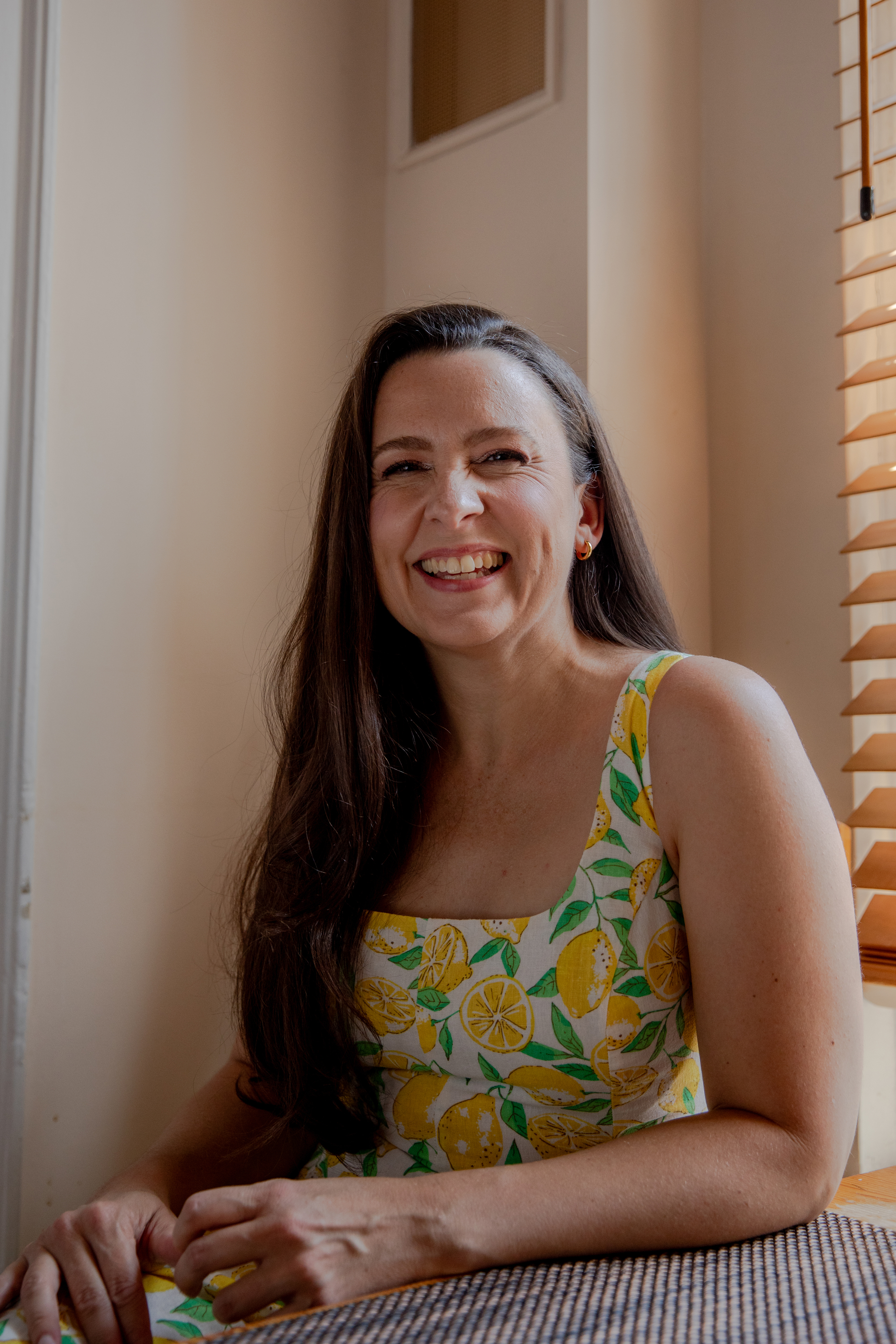
Without her signature headband, without the pink T-shirt and overalls, it could take a second glance to realize that Accurso is the Ms. Rachel. But then she speaks, and her voice—though half an octave lower—carries the same warm, lilting cadence.
She pads into the kitchen of the New York City apartment she shares with her husband and creative partner, Aron Accurso, their 7-year-old son, Thomas, and their infant daughter, Susannah, who arrived via surrogate in February. “Susie was up at 4 a.m., and I got maybe another hour of sleep after that,” Accurso says, pouring herself a cup of coffee. She has technically been on maternity leave since Susannah’s arrival, but it’s hardly been a quiet break for her.
She sits with her mug at her white kitchen table and reflects for a moment on the beginning of her story: the Sunday mornings of her childhood when she prayed at church; the hours she spent making up songs with her big sister; the way their single mother, a devoted social worker, raised her daughters to think of others first.
“I think,” Accurso pauses. “I think it might be a little abnormal, the amount of empathy I have.” This isn’t a boast. This is her explaining why she is the way she is—someone who has to leave the room during emotionally wrenching movie scenes, someone who has never been able to witness another person’s suffering without vividly imagining what it would feel like.
That fundamental quality has always led her to seek connection with other people, she says. “Before I did this,” Accurso says, “there were so many ‘Oh, now I’ve found what I’m meant to do!’ moments.”
As a teen working at a summer program for disabled children, Accurso bonded with a little boy with cerebral palsy and learned how to make him belly laugh. Later, she spent a year volunteering at a local hospice. She taught music to refugee children through the Boys & Girls Club in Maine. In her 20s, she considered going into ministry. But in 2009, she saw a video of a public school choir in New York City and decided that was what she was meant to do. She got on a bus with her keyboard and headed south.
She’s been in New York ever since. Accurso and Aron, a musician and former Broadway music director, met in 2010 at a Unitarian church: “He was hanging up his name tag to leave when he saw my smile, and he came over,” she says, “and we’ve been together ever since.” Together, they wrote a musical set in a psychiatric ward; Accurso is open about the fact that she has OCD and general anxiety disorder.
They married in 2016, and before their son was born in 2018, Accurso left her job as a public school music teacher in the Bronx. “I was like, ‘Oh—I’m meant to be a mother,’” she says. “I had always wanted to be a mother.”
When Thomas was about 6 months old, Accurso started hosting baby music classes in the city. “But the rental spaces were expensive,” she says, and she wanted to make the classes available free to as many parents as possible, so she began recording videos and posting them online to a YouTube channel she called “Songs for Littles.” When Thomas was diagnosed with a speech delay, Accurso started to focus on creating videos that would help him learn to talk. Aron joined in, voicing puppets and writing songs.
“He’s truly a musical genius,” Accurso says of her husband. “I’ll be like, ‘Let’s put this out, even if it’s not perfect,’ and he’s like, ‘Let’s make this the best it can be.’” (Unprompted, he echoes this dynamic in reverse: “I can be such a perfectionist,” he says. “But we never would have gotten this off the ground if she hadn’t been like, at some point – ‘Who cares if it’s not perfect? It’s for the kids.’”)
– – –
For a while, their online audience was modest, and they expected it to stay that way – maybe a few thousand people, max. Then came the pandemic, with multitudes of desperate parents trapped at home with stir-crazy toddlers, and their YouTube traffic began to take off. In the years since, “Ms. Rachel” has exploded into a multimillion-dollar empire, complete with best-selling children’s books (her debut picture book set the single-day preorder record for Random House Children’s Books when it was announced in 2024), branded toys (her recently released Tonie audio-playing figurine has repeatedly sold out), and a licensing agreement with Netflix, which in July said that “Ms. Rachel” was the most-watched season of children’s television on the streamer during the first half of the year. (A second season is coming in September.)
But this level of fame still “hasn’t fully sunk in,” Accurso says. The first time she was recognized in public outside of New York City, she was startled: “People can tell who I am?” She mostly just feels like herself. She was recently cooing at twins in a stroller, and it took their mother a full minute to realize that the person fawning over her toddlers was Ms. Rachel from YouTube.
The show is rooted in research: Accurso received graduate degrees in music education from New York University and early childhood development from the American College of Education, and after her son’s diagnosis, she pored over academic papers and studies to better understand how children learn to speak. When she tackles a new episode theme—like bedtime routines, or potty training—she scrupulously studies the topic and then blends that knowledge with her decades of experience working with kids to pace the different segments of her show.
“When I was teaching preschool, I was in front of, sometimes, thirty 5-year-olds, and I had to be very entertaining to help them pay attention,” she says. “I think that experience of teaching, and seeing when kids lost interest – that was really helpful.”
The result, says Julie Dobrow, a senior lecturer in Tufts University’s child study and human development department, is an alchemy that is irresistible to the littlest audience members.
When studying children’s media, “We think about attention, we think about comprehension, and we think about retention,” Dobrow says, and “Ms. Rachel” has elements that support all three objectives: There are funny sounds, and bright colors, and lots of close-ups of smiling faces; there is Accurso’s high-pitched, singsong voice, and her deliberate use of repetition, alliteration and gross motor movements. She often asks her viewers a question, then pauses as if to hear their answer, an interactive dynamic that thrills young kids, Dobrow says. The music is excellent, and so are the production values, which matters to kids and parents, Dobrow says—and research shows that kids are more likely to retain knowledge if there’s someone else watching with them.
“Another thing that I would really laud Ms. Rachel for is that, just like Fred Rogers, she doesn’t talk down to kids. She talks to children as they should be talked to—respectfully, like they are intelligent human beings who have something to contribute,” Dobrow says. “She really uses some of the best things that Fred Rogers pioneered.”
Yet Ms. Rachel is also very much her own thing—the product of a wildly different technological age. Mister Rogers was watchable at home, at a certain time of day, in front of a television. Ms. Rachel is everywhere: on a parent’s iPhone in the car, on a tablet at a restaurant, on a TV or a laptop screen anytime a parent needs their kids to be preoccupied for a few minutes. For Ms. Rachel’s millions of followers, her voice has become the constantly accessible soundtrack of early family life.
All of this—Accurso’s research-based approach, her aura of authenticity, her ubiquity—resonates with children in a way that transcends geographical borders and language barriers. Accurso hadn’t fully realized the scope of that reach, though, until earlier this year, when she was tagged in an Instagram reel: It showed three little children sitting in a tent in Gaza, surrounded by the wreckage of war, riveted by one of her videos playing on a tablet.
– – –
In May 2024, Accurso posted a video to her Instagram announcing a fundraiser: She would sell personalized “Ms. Rachel” Cameo videos for $100 each, with all money going directly to Save the Children’s Emergency Fund. The money would benefit children in conflict zones, including Gaza, Sudan and Ukraine. Accurso’s followers bought 500 videos within an hour.
Her family and friends urged her to keep the recordings short and sweet, but she couldn’t bear the thought of any child feeling disappointed. “I wanted to make each video really long and special,” she says. So she did, and soon she started losing her voice.
She hadn’t anticipated such enthusiasm—or such outrage: Comments quickly amassed on her posts and circulated across social media from people who accused her of an anti-Israel bias and of excluding Jewish children from her advocacy. Accurso had experienced backlash before: In 2023, she drew condemnation from some followers and conservative commentators after she featured nonbinary singer-songwriter Jules Hoffman on the show. But she felt particularly stunned by the criticism following her fundraiser for Save the Children.
“It broke my heart that people would be like, ‘You don’t care about Jewish kids because you did this,’” she says. “I was in a lot of pain, because I just didn’t understand. And now I am definitely speaking out, saying—if you care deeply about one group of kids, it does not mean that you don’t care about other groups of kids. That’s not fair, and it’s not right to say that.”
She didn’t stop posting about Gaza; she also continued to make statements condemning antisemitism and expressing grief for Israeli families whose children and loved ones were taken hostage by Hamas. “I just felt led to keep going,” she says. “I have this platform. Kids gave me this platform, and I want to use this platform for kids.”
As Accurso’s posts about Gaza drew more widespread attention, Tareq Hailat, director of the Treatment Abroad Program for the Palestine Children’s Relief Fund, received a message from his sister-in-law, the mother of Hailat’s young nephews: You need to talk to Ms. Rachel.
He contacted Accurso over Instagram, asking about the possibility of partnering with PCRF. “She is in real life as she is on screen—just so kind,” he says. “She was approaching this from the place of, ‘Children should not be getting killed.’ And that’s both sides—Palestinian children, Israeli children. Children should not be getting killed.”
At Accurso’s first meeting with PCRF in January, she was moved by a video of Rahaf sitting on a couch and bouncing along to her favorite “Ms. Rachel” song, “Hop Little Bunnies.” When Hailat suggested that perhaps Rahaf, who has been receiving medical care in the United States since December, could be part of Accurso’s show, he never imagined how enthusiastically that idea would be embraced.
Hailat, the son of a Palestinian refugee, spent his early childhood in Jordan; he remembers how intently Palestinian children watched the celebrities of the Western world, as if from an invisible periphery. “But now,” he says, “Ms. Rachel is going to be looking back at them.”
– – –
Some of Accurso’s critics have urged her to be more like Mister Rogers, meaning: Steer clear of politics. “Mister Rogers didn’t lecture kids,” one Fox News contributor said. This is true – Mister Rogers didn’t lecture kids about politics. He did something far more profound than that, says Michael Long, author of “Peaceful Neighbor: Discovering the Countercultural Mister Rogers”: He modeled his ideals – equality, pacifism, empathy.
“We don’t often consider Rogers a political figure, because he operated so deeply in children’s media, and so we’ve pigeonholed him as somebody who is concerned only with the feelings of children,” Long says. “But he was also somebody who was deeply political and presented his political views in his show.”
In the first week that “Mister Rogers’ Neighborhood” aired nationally – against the backdrop of the Vietnam War—Rogers created an episode exploring the nature of conflict and the necessity of peace, Long says. That same week, he adds, Rogers invited a Black teacher and her interracial students into his house, even as many Americans were fighting against school integration. Later, Officer Clemmons became the first recurring role for a Black actor (François Clemmons) on children’s television.
When Rogers accepted his Lifetime Achievement Award at the 1997 Daytime Emmys, he asked the audience to reflect on those who had helped them along the way: “All of us have special ones who have loved us into being,” he said. He was talking about real-life figures—parents, grandparents, teachers. But even through the remove of a screen, his own influence was undeniable. Mister Rogers loved generations of children into being, and one of those children grew up to be Ms. Rachel.
“I wouldn’t be Ms. Rachel,” Accurso has said often, “if I didn’t care deeply about all kids.”
On the day Accurso greets Rahaf in the film studio, she wraps the child in a hug and looks up at her mother. “I really feel that Rahaf is going to change the world,” Accurso tells her. With the cameras rolling, Accurso and Rahaf sing “Hop Little Bunnies” and dress up like fairy princesses. They play follow-the-leader, and Rahaf is ecstatic to be the center of attention as they march across the green screen floor, giggling in the bright lights. The little girl skips and twirls and shows Ms. Rachel what to do, and Ms. Rachel listens and follows and never looks away.
Please enable JavaScript to view this content.
Editor's note: You can comment on IBJ stories by signing in to your IBJ account. If you have not registered, please sign up for a free account now. Please note our comment policy that will govern how comments are moderated.