
Subscriber Benefit
As a subscriber you can listen to articles at work, in the car, or while you work out. Subscribe NowMonrovia resident Chris Green had a simple request during a public meeting of the Morgan County Board of Commissioners on Oct. 6: Wait to approve a rezoning for a data center project until residents’ questions were answered.
Green urged commissioners not to rezone the additional 158 acres, or to at least postpone the decision, “until we can figure out the data or the details of all the questions I have here that have so far gone unanswered because of all the [nondisclosure agreements] that everybody is hiding behind.”
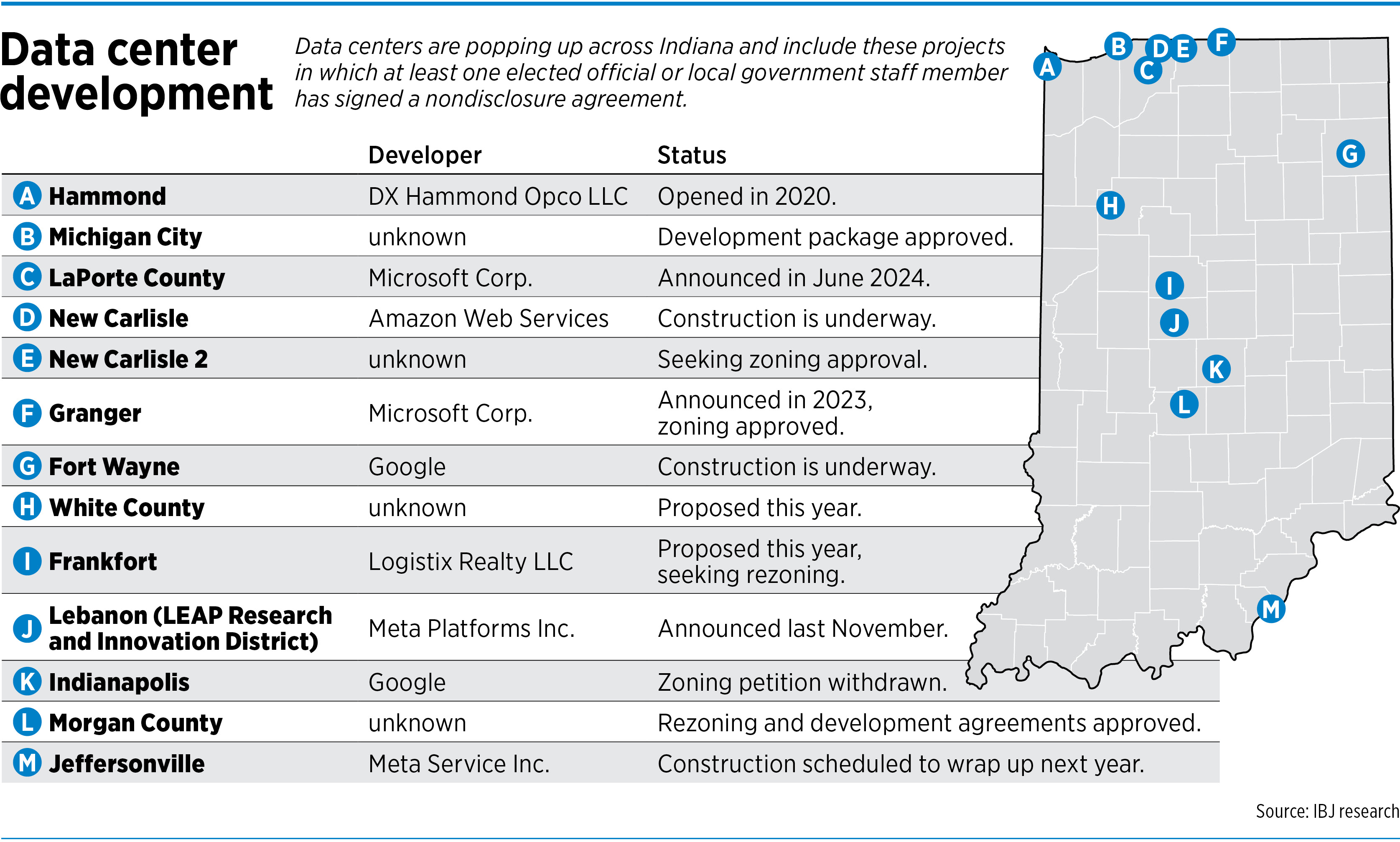
Morgan County commissioners still approved the zoning change, but Green’s sentiments on nondisclosure agreements reverberate throughout Indiana as data center projects face uphill battles to win public support.
While nondisclosure agreements, or NDAs, have long been common across all types of economic development to protect information from leaking out through contractors, business partners and elected officials, they’ve become particularly divisive recently when associated with data center development.
Data center opponents cite a number of reasons they don’t want the projects near them, including water and electricity usage, property values and quality of life. The NDAs public officials are signing early in the development process are a growing source of friction between tech giants and Indiana residents.

The companies say the NDAs are necessary to prevent trade secrets from leaking or giving an advantage to competitors, and officials say NDAs are necessary for Indiana to be competitive in attracting large tech companies.
But some Hoosiers note the irony of data centers storing vast amounts of information to power the internet while the companies behind them use NDAs to keep their information private.
“We don’t like the fact that a big reason why we weren’t able to start to prepare to protect ourselves from this data center is because of the NDAs,” said Christopher Lamberson, who has organized opposition to the Morgan County data center project.
Getting in the room
Morgan County Economic Development Corp. Executive Director Mike Dellinger said that because data center projects involve a good deal of proprietary technology, tech giants like Google, Amazon, Meta and Microsoft demand secrecy.

Dellinger has signed an NDA with the company behind the Morgan County data center that’s rezoned around 550 acres so far for a project that could bring $1 billion in private investment. He added that data centers have lots of moving parts, from tax structures to utility and water availability to zoning ordinances; NDAs can help the company get a better sense of the area they want to do business in without revealing who is behind it.
“The NDA is simply required so that the company can get in a room with local leadership, and they feel each other out. They can ask, ‘Is this the right thing? Here’s what I need to do. I don’t know this. Can you help me understand that?’” Dellinger said.
Jeff Rea has signed a number of nondisclosures over the years, first in his role as Mishawaka mayor from 2003-2010 and now as president and CEO of the South Bend Regional Chamber of Commerce.

Rea noted that companies keep info close to the vest since news that they’re expressing interest in an area could affect stock prices or land value.
He said economic development leaders are often the first people to sign NDAs when developers explore project sites. Once the companies narrow their searches to a handful of locations, the firms bring in local officials to get a sense of what tax abatement packages might look like and how the municipality’s rezoning process works.
An example Rea cites is the General Motors plant in Mishawaka that made Hummers from 2002 to 2009.
“When the Hummer 2 project came to town, for example, we worked with them to try to figure out if that was even possible in our area,” Rea said. “It was a big economic development opportunity, but they also had several places they could make that, so we were competing with other communities at the time for that project. I think it was just critical, as they were doing their due diligence, that that information not get out there and impact the deal in a positive or negative way.”

Scott Shackelford, associate vice president and vice chancellor for research at Indiana University’s Kelley School of Business, said NDAs are challenging for public officials who see value in protecting a company’s trade secrets but also want to be upfront with their constituents.
“It is a tough one, because the public has a right to know. I mean, these are big investments. They’re going to have major impacts on the power grid, on water use, on potential pollution in the area,” Shackelford said. “But you have to balance that against these legitimate business interests and wanting to make sure that a site remains secure, that valuable trade secrets are protected.”
He noted that officials might feel especially pressured to sign NDAs for data centers because they can’t afford to ignore the tax revenue the centers represent. That’s particularly true in rural areas, creating a dynamic where local governments are often dealing with large corporations and teams of lawyers without a full-time attorney on staff themselves.
Strong opposition
But for those opposed to data centers, NDAs have become a sinister acronym, and officials who sign them are accused of making backroom deals and selling out their communities.
Advocates say residents should know the name of any company looking to locate in their community so they can assess its track record on previous projects.

Over the summer in White County, Republican County Council member Joanne Mosher railed against Republican county commissioners for signing NDAs on a data center project there.
“There is no reason any issue needs to be hidden from the public,” Mosher told reporters. “If a business is good enough to come into our county, they are good enough to put up a sign and say, ‘We are coming into your county. This is who we are, and we’re happy to serve you.’ We do not need all of the secretive stuff.”
That sentiment was shared by Franklin Township residents who fought this summer against a hyperscale data center proposed by Google on the southeastern side of Indianapolis.
Google eventually publicly revealed itself, then withdrew its proposal last month before a rezoning vote on that project. But in other parts of the state, data center developers remain anonymous through the rezoning and development deal process, including in Morgan County where the data center is named “Project Louie,” or Michigan City, where officials approved a development deal for “Project Maize.”
Joe Calderon, an attorney who represented Google in its efforts in Franklin Township, declined an interview request for this story, saying he is “not authorized to make any comments.” Calderon also represents the entity moving forward with the Morgan County data center.
Change unlikely
Though NDAs are unpopular in local communities, state legislators have shown little interest in reconsidering their use in development deals.
A 2023 Indiana House bill that would have prevented the Indiana Economic Development Corp. and other state agencies from entering into nondisclosure agreements died without a committee vote.
Rep. Robb Greene, R-Franklin, and Rep. Zach Payne, R-Charlestown, the authors of that bill, did not respond to interview requests made through a spokesman.
Some lawmakers say NDAs are necessary for the state to remain competitive in the business climate.
Speaking at a town hall in July, Senate President Pro Tem Rodric Bray told Morgan County constituents that NDAs are simply a part of doing business.
“Corporations, when they begin to shop for a site, they don’t want competitors to know they’re shopping around, so that’s a big part of it,” Bray said. “They just won’t come if they don’t have that confidentiality to start with.”
Rea agreed.
“If we refuse to sign [NDAs], for example, [companies] would just go to another community. We would be out of the mix on those even if we had great sites and great utilities,” he said.
That view will soon be tested as other states enact stricter policies around NDAs. California this year passed a law prohibiting elected officials from entering nondisclosure agreements on any matter related to taxpayer funds.
Shackelford of the Kelley School of Business said he doubts Silicon Valley will pick up and move because of that new regulation.
“Whether or not [banning NDAs] would be determinative, I think you’d have to look at the states like California that have banned NDAs,” he said. “They still have data centers.”•
Please enable JavaScript to view this content.
This is starting to look and sound like the dot-com boom and bust of 2000. FOMO is creating a frenzy. Let’s wait and see how many of these companies actually make these huge investments pay off.
And if they do deliver, then we will see a different kind of bust as new technology disrupts the work force.
I’m glad Indianapolis has pushed back on these. I haven’t seen anything to show me that these are worth the cost of our utilities increasing.