
Subscriber Benefit
As a subscriber you can listen to articles at work, in the car, or while you work out. Subscribe Now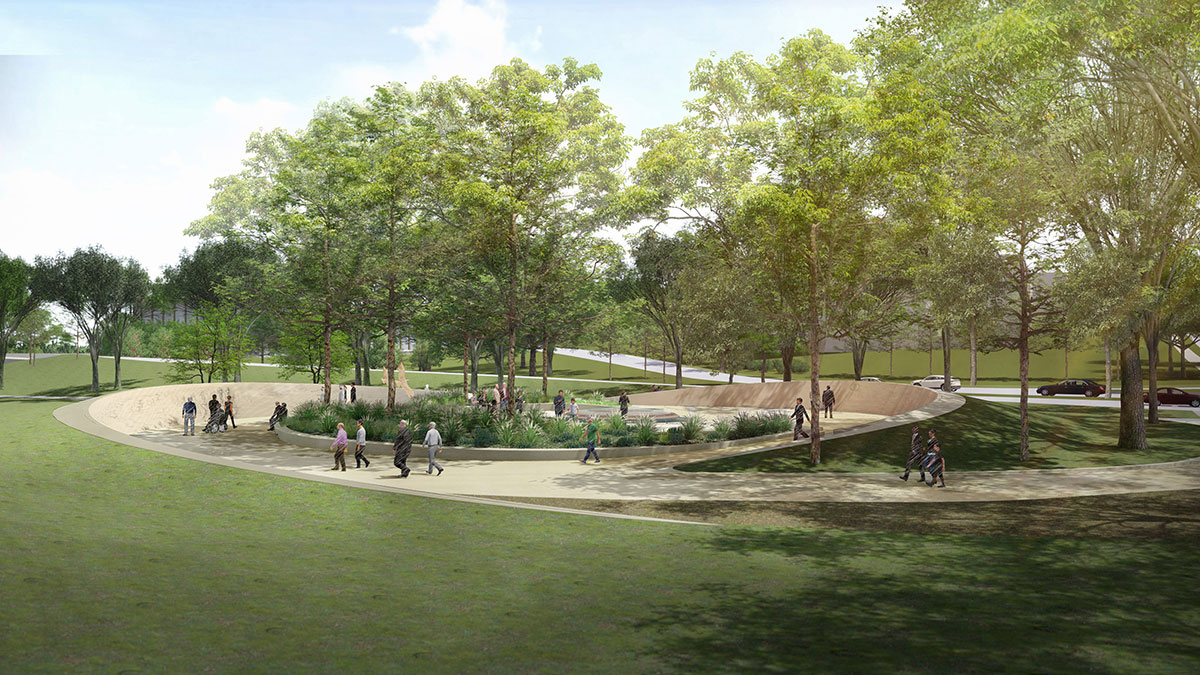
After a nearly 15-year journey involving one of central Indiana’s largest architectural firms, construction is finally underway on a memorial in Washington, D.C., that will honor veterans of the Gulf War.
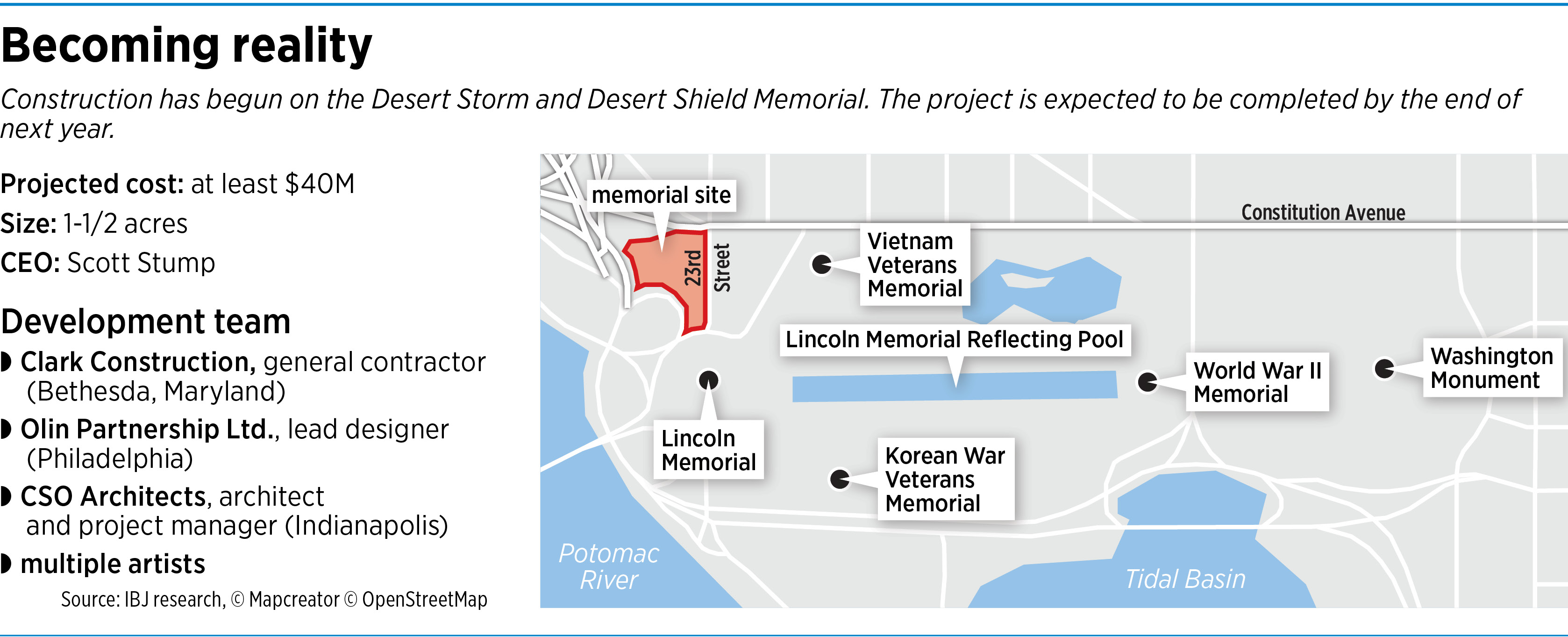
The National Desert Storm and Desert Shield Memorial will occupy about 3 acres just north of the Lincoln Memorial, using a design to which Indianapolis-based CSO Architects heavily contributed. The $40 million project is expected to be completed by the end of next year.

CSO has been involved in the memorial’s development since 2012, after the firm’s principals were connected with Scott Stump, a Marine Corps veteran who in 2010 began building a coalition around establishing a monument in the nation’s capital.
“It’s just mind-blowing,” Stump, CEO of the National Desert Storm War Memorial Association, said of the design firm’s initial attitude toward the project. “For them to take this on is very humbling, because they didn’t have to. ‘This is big stuff, and it’s probably never going to happen’—they could have easily taken that [perspective], and they didn’t. That’s pretty rare in today’s world.”
Now more than 50% complete, the memorial at 2300 Constitution Ave. NW will pay homage to the international military effort that freed Kuwait from the grip of Iraqi dictator Saddam Hussein in 1991, during which nearly 400 U.S. and international military personnel died.
The project is the first national memorial in which CSO has been involved, although Indianapolis is second only to Washington, D.C., for its proliferation of monuments and memorials.
While the architecture firm led most of the early design work, including the original plans for a site just east of the current one, it has since handed off design leadership to Olin Design, a Philadelphia-based landscape architecture firm. Indianapolis-based Context LLC was also involved in earlier stages of the project.

A long journey
Legislation enabling site selection passed in 2014. The federal government provides land for national memorials but does not contribute additional funds.
Stump, CSO, Olin and others have spent more than five years soliciting donations for the memorial and fine-tuning the design with the U.S. Commission of Fine Arts. The entity, whose members are appointed by the president, has extensive say in the final design of a project, down to the materials used in construction and the appearance of any statuettes.
Numerous delays have made the Desert Storm and Desert Shield Memorial one of the longest-simmering memorial projects in decades. The project has been kept alive through four presidential administrations—those of Barack Obama, Joe Biden and two for Donald Trump—and the pandemic.

“There have been countless meetings,” said Randy Schumacher, an architect at CSO who has spearheaded the memorial design since the firm became involved.
Schumacher’s design originally featured a curved wall that ranged from 6 feet to 16 feet in height, a nod to the “right hook” military maneuver that helped the international coalition defeat the Iraqis.
The new design features lower walls meant to evoke imagery of desert sand dunes, as well as a central water feature.
“There were times we were worried we might get sent back to start over with new [commissioners] coming in and, thankfully, that did not happen,” Schumacher said.
To receive a construction permit, the National Parks Service requires a fundraising campaign to have 110% of the project’s budget in the bank, Stump said.
About one-quarter of the $40 million needed was raised by the end of 2019, with the rest trickling in since. Stump declined to say exactly how much has been raised. In 2022, the country of Kuwait announced it would contribute to the memorial—on top of $10 million committed in 2020—to ensure the project came to fruition.
A ceremonial groundbreaking was held in July 2022, but active construction didn’t begin until this March. Most of the concrete foundation has been laid, with added support columns introduced to the design because of the soft ground on which the memorial is being constructed.
Granite blocks for the walls themselves are being installed over the next few weeks, with plans for a bas-relief sculpture depicting allied forces along one of the walls. The design also features a bronze sculpture of an eagle and falcon.
The design is in many ways a global effort, with granite from Brazil being shaped and carved by artisans in Italy, and a 28-foot bronze “Unity Shield” fountain under construction in England.
The Indiana connection
Getting the project off the ground also required a bipartisan coalition of legislators to support the National Desert Storm and Desert Shield War Memorial Act.

Then-Sen. Joe Donnelly, a Democrat, helped spearhead the 2013 effort to create the memorial, alongside Sen. John Boozman, a Republican from Arkansas. When the enabling legislation went before the House of Representatives in 2014, Democratic Rep. André Carson was among more than 100 representatives—one of six from Indiana—to sign on as a co-sponsor. Another co-sponsor was Republican Sen. Todd Young, who at the time was the congressman for Indiana’s 9th District.
“Not only will the memorial honor and remember the 700,000 Americans who served in the Gulf War, it will also educate new generations,” Carson, who represents Indiana’s 7th District, said in a written statement. “We can’t move towards the future without understanding our past. Preserving America’s history continues to be essential for our democracy.”
Schumacher said he has enjoyed working on the memorial, calling it the “most important thing I’ll ever do,” and acknowledging that the project has consumed a large portion of the past decade or more of his professional life.
“I still pinch myself thinking that I’m going to be able to go to the National Mall and stand inside this thing that I’ve been designing for 15 years,” he said. “It defines you a little bit when you’ve been involved with something for this long.”

After joining the effort in 2012, CSO worked pro bono for more than four years. It now charges a reduced rate for its work on the project.
While local firms can be employed for certain elements of memorial projects, several architectural practices have dedicated designers focused on memorial development—making CSO an outlier for its participation.
And it’s likely CSO won’t look to become a regular in the memorial space in Washington, D.C., said company President Alan Tucker
“We’re obviously very proud of our legacy projects,” Tucker said, pointing to work at the Indianapolis International Airport, the new Indiana University Health hospital and the JW Marriott. “But [this memorial] is truly going to be our longest-lasting structure. This is probably going to be around in 150 years. … This project for us is kind of a one-off—we’re not looking to say, ‘Let’s go do memorials.’ But it’s going to show others that … we’re capable of doing work that anybody around the world is doing.”
Stump, the Marine Corps veteran, said he’s hopeful the project will draw attention to CSO’s other work.
“This work is ultimately going to be on the international stage, period,” he said. “It makes a statement loud and clear that talent resides in a lot of places.”•
Please enable JavaScript to view this content.
The design achieves a certain quiet competence. I like how the pathways curve gently through well-manicured plantings, evoking a sense of calm reflection. Looks like visitors will find a pleasant grove, a circular walk, and ample shade. Alan and Randy, congratulations on seeing the Desert Storm Memorial finally rise from vision to reality. What a testament to your perseverance, integrity, and quiet craftsmanship and how you stayed with this effort through more than a decade of bureaucratic hurdles, four presidential administrations, and endless design reviews. Alan, you’re right, this will stand 150 years from now, representing Indiana talent on a national stage. Congratulations!
Worthy of every dollar for the 400 lives sacrificed to rid the world of tyranny.