
Subscriber Benefit
As a subscriber you can listen to articles at work, in the car, or while you work out. Subscribe NowInside Amazon’s 100,000-square-foot Greenwood warehouse—which provides the greater Indianapolis area same-day shipping for everything from paper plates to vitamins—robots and people collaborate in what looks like a futuristic mechanized dance to fulfill tens of thousands of orders each day.

The robots, called Hercules, look like a large, sky-blue version of a Roomba robot vacuum. These units, which operate inside a fenced-in area, can carry about 1,250 pounds of goods at a time. Their role is to find and bring pods—think of a 10-foot-tall moveable shelving unit—that are filled with items that have been ordered, directly to employees who remove the items and prepare them to be packaged and delivered.
Every 10 to 15 seconds or so, a Hercules unit brings another pod to where an associate is waiting, giving the employee enough time to remove the item or items for each order.
Amazon describes Hercules like this: “Hercules makes key decisions about how it moves independently but takes overall direction from centralized planning software. It then uses a forward-facing 3D camera to differentiate between people, pods, other robots and other objects in its path to make safer decisions. Hercules uses its camera to read a grid of encoded markers on the floor, which enables it to navigate, find its position and locate any pod.”
Andrea Kassel, the Amazon site leader overseeing this operation, explains the system like this: “Efficiency definitely helps us improve our speed to our customer. We can do things quicker and get more orders to our customers. But safety is more of the focus of the robotics.”

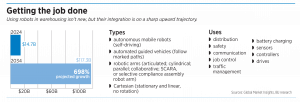
What’s going on here—this teaming of robots and people—is happening in warehouses throughout Indiana and elsewhere. And it’s only going to continue as robots take on routine tasks and workers do work that requires more skill, like problem-solving and quality control.
“People need to understand that there is a digital transformation coming across multiple sectors in the economy,” said Amrou Awaysheh, associate professor of operations and supply chain management at the Indiana University Kelley School of Business in Indianapolis.
“And people need to understand where the world is heading and where their skill set can help contribute to this economy. That’s just an inevitable wave of innovation and technology.”
Taking jobs?
While robots are not taking over warehouses, experts say, they are making processes faster, safer and easier on the workers.
“In a lot of the e-commerce and fulfillment warehouses, it’s not that robots are taking over and replacing humans; it’s very much technology that works alongside to really enhance quality,” said Sonya Snellenberger, vice president of partnerships at Conexus Indiana, the advanced manufacturing and logistics initiative of the Central Indiana Corporate Partnership.
“It’s really like a co-habited sort of situation. But typically, the point of the technology is to enhance quality and to help fix ergonomics, because the wear and tear on the human body in e-commerce and fulfillment warehousing can be pretty intense.”
A 2024 Conexus report found that “contrary to typical rhetoric about automation eliminating jobs, technology adoption continues to produce a net increase in job count. … While automation does reduce manual-labor-intensive tasks, Indiana manufacturers are quick to upskill, reskill and redeploy their labor pool to new jobs with higher-value tasks.”

According to Conexus, warehouses serve a variety of businesses, including e-commerce and fulfilment-focused companies with large distribution facilities in Indiana like Sweetwater, Vera Bradley, TaylorMade and Walmart; large logistics and delivery service companies such as UPS and FedEx; and third-party logistics and warehousing providers like IDS Fulfillment, Langham Logistics, Mavpak, Kem Krest, Backhaul Direct LLC and ITS Logistics.
Each uses different technologies, depending on customers needs.
“I don’t imagine that automation anytime in the near future is going to fully replace the need for human beings in the workplace,” said Sam Charron, vice president of governmental affairs for the Indiana Manufacturers Association. “In Indiana, we have in the manufacturing industry somewhere close to 40,000 job openings. So, there may be some demand for automating some of those job openings.”
 Human mechanics, analysts
But the jobs that continue to exist will be more challenging and higher paying.
Charron said the workforce of the future will need specific skills to work alongside robots. One of those skills will be data analytics.
“You’re still going to need people who can interpret and process and kind of deal with the massive amounts of data that are going to be generated by those sorts of technologies,” he said.
In addition, “you’re going to still have folks who have an agile mindset and are good with critical thinking and problem solving. And with that, I think you’ll see a demand for advanced maintenance technicians, which is kind of already a big thing in manufacturing, but even more so with automation coming into the workplace. And you’ll still always have the need for the interpersonal skills in the workplace with communication and collaboration.”
John Goo, president of Mavpak, which specializes in packaging, equipment maintenance and warehousing for manufacturing, warehousing and distribution businesses, said his company works with about 120 of the warehouses around Indianapolis and has watched its customers experiment with robotics the last 10 years.
His overall assessment: “It’s definitely becoming more prevalent and delivering better results as the technology improves.”
Additionally, he said, robots are helping to solve the problem of finding workers willing to do reliable, low-wage, repetitive task work.
“Every single customer of ours, every warehouse or warehouse leader, director of operations, if you break it down with them on, what are the biggest issues that they have, it’s always around people: How do we attract, train and retain talent when there’s constant downward cost pressure on companies to figure out how to do fulfillment and warehousing cheaper?”
The future of robotics
So, what’s next in robotics in warehouses?
That’s the question being asked at TaylorMade Golf, which operates a distribution center in Evansville.
“We don’t have much of an idea yet, but we’re starting to go through a discovery process of understanding what automation, robotics, what pieces of technology are out there that can help easier facilitate the work happening within our building,” said Austin Rhodes, TaylorMade’s PMO project manager.
In the meantime, Rhodes said, TaylorMade is making good use of a robot called RRCE–Random Robotic Case Director that it purchased two years ago to build boxes to ship its golf equipment. The company needs a wide range of box sizes that can fit balls or golf clubs and other accessories.
The RRCE consistently makes 10 to 14 boxes a minute, depending on the size of box needed, Rhodes said. While TaylorMade still has personnel who make boxes, the RRCE enabled the company to move some employees “to better job functions where they’re more valuable.”
At Mavpak, Goo said he’s seeing AI-enabled robots that are fully replacing some human functions, like inventory management. At night, these robots—“whether in the form of a drone or full-blown, forklift-looking robots”—go through the entire warehouse, take pictures of every item on every shelf, capture the barcode and count the products.
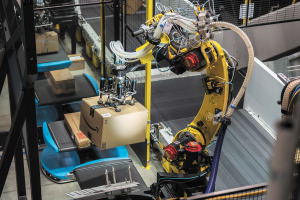
“What used to be maybe one or two full-time people walking around, taking inventory—they can now have a robot do it at night, when nobody else is in the building,” he said. “And these are easy investments to make because the cost of robotics have come down, and the price of employees has gone up.”
Awaysheh, the IU professor, said you can soon expect to see dark warehouses. “In most warehouses or factories, you have lights [so] the workers that walk around can see where they’re going. A robot doesn’t need the light,” resulting in savings on electricity.
Amazon will open an 800,000-square-foot robotic fulfillment center this fall in Elkhart, its third facility in Indiana. (The others are in Fort Wayne and Greenwood.) Amazon has announced plans to hire 1,000 workers there with three kinds of robots: Robin, a robotic arm system that lifts and sorts packages; the Hercules robotic drive system; the Pegasus robotic drive system, which is used to take finished parcels from employees and sort them by ZIP code or delivery route within the fulfillment center; and the Xanthus, or X-bot, which is designed to carry smaller packages.
“We are always looking for ways to make it more efficient, to make it safer, to make opportunities for employees to learn something new,” said Andrea Kassel of Amazon. “So, I think that’s the biggest part of what’s coming next. There will always be something within Amazon to help us continue to grow and to serve more customers.”•
Please enable JavaScript to view this content.
The tax burden that is imposed on human workers should be shifted to the AI robots that are replacing human workers ! The tax burden that was being paid by the human workers that was funding our social safety network would then be restored with the taxes imposed on the technology that replaced human workers . That would increase funding to Social Security, Medicare and Medicaid . That would help even up the cost advantage corporations get by replacing human workers with robots.