
Subscriber Benefit
As a subscriber you can listen to articles at work, in the car, or while you work out. Subscribe Now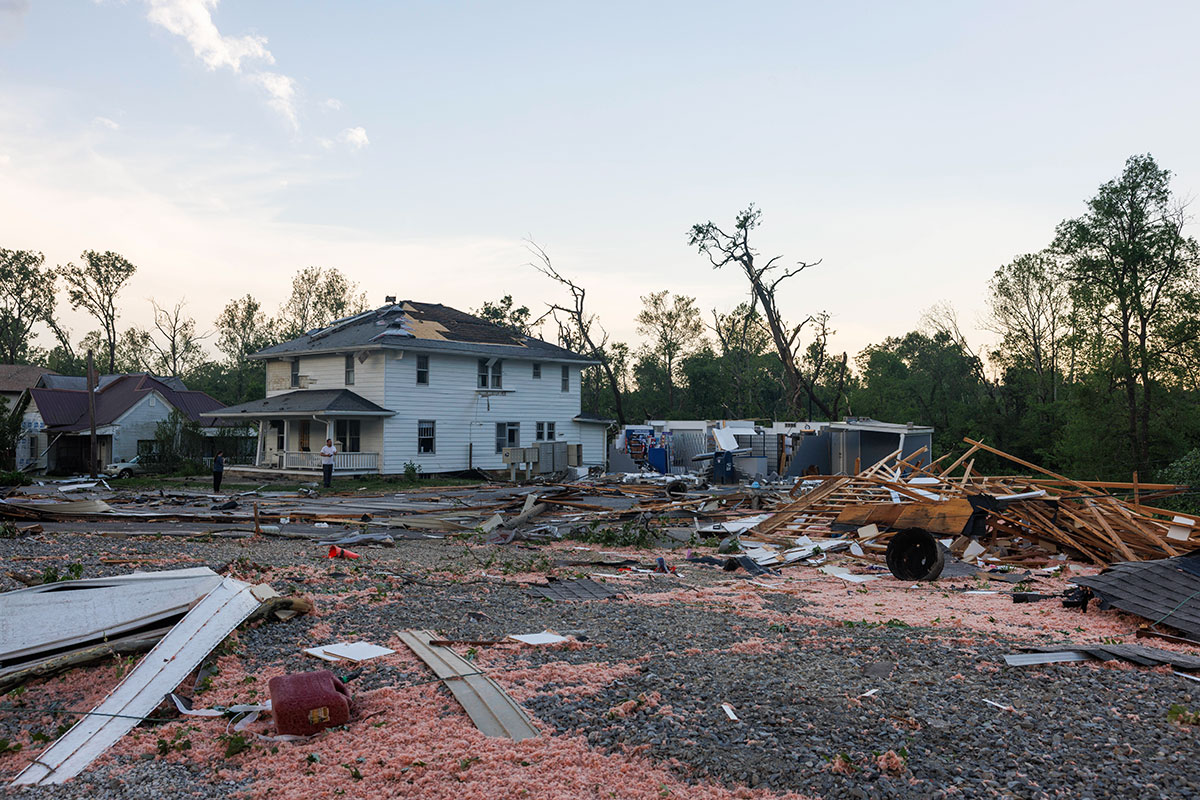
Alessandra Souers experienced sticker shock when she saw how much her home insurance premium increased this year.
Souers, who lives in the near-east-side Woodruff Place neighborhood with her fiance Neil Wright and their dogs Duncan, Jack and Molly, said the annual premium on her policy through Bloomington, Illinois-based State Farm Insurance jumped 18%, from $2,046 last year to $2,415. In the seven years since she purchased her 120-year-old house, her home insurance premium—initially $1,397—has ballooned 73%.
She said finding an insurer in 2018 was difficult because “insurance companies aren’t exactly champing at the bit to insure historic homes.”
Souers has spent the past seven years renovating her house, and she said the jump in home insurance costs aligns with the increase she has seen in property taxes (71%) and labor (50% to 80%) and outpaces the rise in the cost of building materials (40% to 60%).
Despite the spike in her insurance rate, she is not searching for other options because of her previous difficulty in finding an insurer.
“The idea of going through the process again to find a company willing to insure the home, coupled with figuring out how it would affect my other policies if I separated them, is just enough of a burden to make me say, ‘Forget it,’ and eat the increase,” Souers said. “I think insurance companies are betting on that mentality—especially for homeowners with limited options—and taking advantage of it. ‘You’re locked in. How far can we push this before the cost outweighs the aggravation of starting over?’”
Souers’ experience is not unique in Indiana—or nationally, for that matter. Fueled by climate change and a significant increase in severe weather, home insurance premiums are on the rise nearly everywhere.
In January, the U.S. Department of the Treasury’s Federal Insurance Office released a report that detailed how home insurance is becoming more expensive and less accessible due to worsening climate-related events.
The report analyzed data from more than 246 million policies from 2018 to 2022 and found that average premiums increased 8.7% faster than inflation. Homeowners in the top 20% of ZIP codes at the highest risk for climate-related catastrophes paid 82% more in premiums than those in the lowest-risk areas, and they were more at risk for non-renewal.

“Home insurance across the board is becoming more expensive in most states, and that’s because home insurance claims are becoming more expensive and more common,” Natalie Todoroff, a home insurance expert with New York-based consumer financial services firm Bankrate, told IBJ. “And when those two things happen at the same time, homeowners can generally expect that their rates will go up even if they didn’t file a claim.”
While home insurance premiums are rising in Indiana, they are still not as high as those in three of its four border states.
The average annual premium for a $300,000 house in Indiana is $1,756, compared with $3,501 in Kentucky, $2,351 in Michigan and $2,174 in Illinois, according to an analysis by Bankrate. Only Ohio’s average rate is lower, at $1,406, among Indiana’s nearest neighbors.
Kentucky has experienced multiple devastating tornadoes in recent years, including an EF-4 tornado last month that tore through three counties with wind speeds as high as 170 miles per hour, according to the National Weather Service.
This month, State Farm defended its impending 27.2% home insurance premium hike in Illinois following criticism from Gov. J.B. Pritzker and consumer groups. The insurance company cited severe weather, particularly hail, as the reason the company lost money in 13 of the past 15 years.
“As extreme weather becomes more extreme, more widespread and more catastrophic, it’s only going to make [insurance] more expensive,” Todoroff said. “Unfortunately, I think the best we can hope for is a bit of a plateau, and that would be asking for a lot. But the days of home insurance rates plummeting year-over-year are not looking very likely.”
Costs rising
Although home insurance helps pay covered losses for natural disasters like hail, wind and wildfires, flooding—one of the most common natural disasters in the United States—is not covered by most policies.
Eric Wilson, who operates Irvington Insurance in Indianapolis, has spent about 20 years in the insurance industry. He said home insurance rates “are a huge topic with everybody.”
“In 20 years, we’re talking about pricing for homeowners insurance that has almost tripled, and that’s a crazy trend because if we’re going to talk about forecasting the future, I would hate to think that pricing in insurance is going to triple again in the next 20 years,” he said.

Neil Alldredge, CEO of the Indianapolis-based National Association of Mutual Insurance Companies, said home insurance premiums are rising because of a confluence of events: extreme weather, higher construction costs, rising home values and increased litigation.
“There’s not really a geographic phenomenon anymore,” he said. “Those dynamics are sort of playing out all over the country, regardless of really where you are.”
Alldredge said Indiana typically averages 22 tornadoes per year. Last year, the state experienced 61. This year, Indiana has already seen 44 tornadoes, including 22 that were confirmed by the National Weather Service during widespread storms on April 2 that impacted central Indiana.
“I don’t think people completely always digest the totality of what it takes to repair a home that’s been damaged by a storm,” Alldredge said. “And everything in that component is 30% more [expensive] than it was five years ago.”
Todoroff said home insurance has become a much bigger topic of conversation among both homeowners and people working in the insurance industry.
“It used to be something just that was a bit of an afterthought,” she said. “You get your mortgage, then, ‘Oh, I’ve got to buy insurance to fulfill this requirement.’ But now it’s something people are definitely putting more front of mind, even if they’re in the home-buying process. Or if they’ve had their policy for years and, suddenly, they’ve been dropped, or their rates have gone up significantly.”
Opinions vary on whether Indiana insurance rates suffer a downstream effect from disasters elsewhere, such as wildfires in California or hurricanes in Florida.
Alldredge said that the insurance business in each state stands on its own and that “losses in Indiana affect the pricing in Indiana.”
“That’s part of the regulatory system in terms of how they require insurers to manage their capital,” he said. “Because if you did it the other way, if you did have losses in one place that were being paid for by another, you wouldn’t have enough money to pay for the losses when they come to Indiana.”
Wilson said Indiana feels an indirect impact through the cost of reinsurance, which is coverage an insurance company purchases from another insurance company to protect itself from financial losses.
“Nationally, there’s more wildfires, there’s more hurricanes. The impact is not direct,” Wilson said. “It’s very indirect. But it still does change the overall price.”
Last month, the Fair Housing Center of Central Indiana released a report citing data from the Consumer Federation of America that found the average home insurance premium for a typical Indiana homeowner increased 16%, or $412, from 2021 to 2024. During that time span, home insurance rates rose 16.5% in the Indianapolis metropolitan area.
The report also included data from the Federal Insurance Office, which showed that 1.8% of policies in Indiana, or one in every 54, were canceled in 2022 due to homeowners falling behind on payments. Statewide, 1.2% of policies, or one in 85, were not renewed by insurers.
In Indiana, people who lose their home insurance policies can apply for the state’s FAIR Plan, which provides $250,000 in coverage for a house and its contents. Across the country, 34 states, plus Washington, D.C., offer FAIR Plans, which Todoroff described as “a home insurance option of last resort that’s meant to be a temporary stopgap and not a long-term solution.”

“But unfortunately, in states like California, we are seeing more and more FAIR Plan growth, which is never a great sign for the private home insurance market,” she said.
Amy Nelson, executive director of the Fair Housing Center of Central Indiana, said the increasing home insurance premiums lead some low-income homeowners who have paid off their mortgage to risk going without insurance.
“They don’t want to leave this home, but because of fixed incomes, they may not be able to keep up with the increasing cost of insurance,” she said. “And that really puts that main asset that they have at risk, as well as generational-wealth-building through passing down that home to children or grandchildren.”•
Please enable JavaScript to view this content.
Once this state went to market value basis for property taxes, the insurance companies up it a little more on the market value, and mortgage goes up even more.
I feel for Alessandra Souers. She may have a 120 year old house, but I doubt she has replacement cost coverage for that house. Most likely her insurance covers the mortgage and little else. In a catastrophic event, I’ll bet her insurance will replace her hardwood floors and oak trim with laminate flooring, and plastic moldings.
I owned a top end historic home and with replacement coverage my policy rates were closer to $6K a year.
in a similar situation – my rate is up about 70% in two years. over $10K now
But Republicans told us we could not afford the price tag for addressing climate change. Looks like we can’t afford the cost of ignoring it (just as we were warned).
so you are saying that climate change has not been addressed? I see solar and wind everywhere. of course you can’t have a dam anymore – or nuclear. you whackos want to depopulate the earth to save it. when is enough enough?
Call it what it really is Steve D.: the weather. It has been changing for thousands of years, and always will be, and there is nothing anyone can do about it. It does not mean that we should not be good stewards of the planet, but if we adopt the leftist ideas of climate change, and not only have to deal with the current costs of property taxes and homeowners insurance, the added burden of the draconian measures of the climate alarmists coupled with large increases in utility costs, will devastate the real estate market as more and more people will not be able to afford ownership. We cannot go down that road.
This is exactly what the right has been saying for two or three decades, and their arguments have prevailed in the policy arena. Problem is, those “climate alarmists” have turned out to be right about the dangers, which is why we are seeing so many “hundred-year” or “thousand-year” weather events happening every year, with tragic death tolls and property damages so costly that many homeowners in such places as Florida can’t even get insurance anymore. Ask the actuaries — it’s no longer a safe bet.