
Subscriber Benefit
As a subscriber you can listen to articles at work, in the car, or while you work out. Subscribe NowEli Lilly and Co. is funding and participating in an Indiana University study that examines the health outcomes of people on weight loss drugs, including Lilly medications. The study, which includes Lilly contributing researchers, focuses on worker productivity and the cost to those paying the lion’s share of workers’ health insurance: employers.
The IU-Lilly study comprises large Indiana employers who are self-insured, meaning they pay their own claims—the exact category of employers who most often add GLP-1 coverage to their health insurance plans.
The study, which is ramping up this year and is set to conclude in 2029, comes as more employers are considering whether to provide health insurance coverage for expensive GLP-1 medications such as Lilly’s injectable weight-loss blockbuster, Zepbound, which had second-quarter U.S. revenue of $3.38 billion, up 172% from a year earlier.
The research comes as the Indianapolis-based drugmaker conducts its own late-stage clinical trials for a highly anticipated GLP-1 pill, orforglipron.
Morgan Stanley estimates that by 2030, the annual U.S. market for obesity drugs could reach $80 billion, more than half of the projected $150 billion global estimate.
Health insurance coverage of GLP-1s for obesity is a hot topic with huge financial implications. Such drugs are typically covered on employee insurance plans for type 2 diabetes but not for obesity, meaning patients can pay hundreds of dollars or more a month out of pocket.
A one-month supply of a 5 milligram dose of Zepbound, for example, costs $499 through Lilly’s online LillyDirect portal.
In an IU news release announcing the study, Lilly Group Vice President of Global Value and Access Frank Cunningham said Lilly was “proud to sponsor research that explores the real-world impact of our medications.”
Lilly has four researchers named as contributors to the study.
Experts in bioethics say they have ethical concerns about examining health outcomes in relation to workplace productivity, and about universities taking funding from and collaborating closely with pharmaceutical companies that have a significant financial interest in the subject being studied.

Dr. Carl Elliott, professor of philosophy at the University of Minnesota who has a medical degree and focuses on bioethics, said universities collaborating with drug companies for research is a common practice. But it can be problematic.
“If you’re really interested in science and getting scientifically valid results, then you’ve got to be worried [about] working with a multinational company with a lot of money to throw around, who has an obvious interest in the outcome of the study being positive for their drug,” Elliott said.
“If you want to collaborate with them, you have to do it with eyes open and be prepared for clashes if the data is not coming out the way that they want it to be.”
As for the IU-Lilly study, the Fairbanks School of Public Health at IU Indianapolis said it is leading the study while Lilly provides an advisory and supporting role. Fairbanks researchers will have the final say on the study design and data analysis.
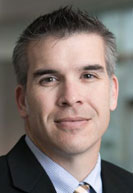
“All of the data, all of the analysis, all of the actual working on the study—that component—is all done by Fairbanks School of Public Health folks,” said study co-lead Joshua Vest, associate dean for research and professor of health policy and management for IU’s Fairbanks School. “Eli Lilly folks will not see data. They will not be doing the analysis.”
Fairbanks also said the research team will submit the protocol and report all findings to clinicaltrials.gov for transparency.
The study
Vest said the study hopes to work with four to six large Indiana self-insured employers totaling around 50,000 people covered by those plans.
Researchers will use anonymous data from the participating employers’ health insurance plans, analyzing job-related factors such as absenteeism, worker’s compensation and disability claims. Vest declined to identify any of the participating employers, but Fairbanks said multiple employers from the private and public sectors have agreed to participate.
The study will comprise two patient groups:
◗ People who have obesity or are overweight who are using obesity-management medications.
◗ A matched comparison group of individuals who have obesity or are overweight who are not using obesity-management medications.
IU’s Fairbanks School noted that Indiana’s adult obesity rate is 37.8%, seventh-highest in the nation.
The study—titled “Estimating the Impact of Obesity Medications on Clinical and Economic Outcomes”—began recruiting employers earlier this year and will run through Nov. 30, 2029.
“This study offers a unique opportunity to understand how our innovations can impact health outcomes and workplace productivity, helping employers make informed decisions about benefits that truly support their teams,” Lilly’s Cunningham said in the news release.
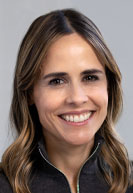
Bioethicist Jennifer Miller of Yale University was critical of the tone of Lilly’s focus on workplace productivity as a justification for covering a medicine.
She called the Lilly quote “myopic.”
“Nobody wants humanity or a person or a patient to be reduced to their productivity,” said Miller, co-director of the Program for Biomedical Ethics and associate professor at the Yale School of Medicine. “It almost implied, whether they meant to or not, that the product would be reimbursed if it was in the interest of the company, the employer.”
Lilly declined IBJ’s request for an interview and did not disclose how much money it provided to IU to fund the study.
In an emailed response to IBJ, Lilly said the study aims to highlight how new FDA-approved obesity medications can help improve patient health outcomes and potentially impact costs related to obesity care, for patients and employers, who might face billions in excess health care spending, absenteeism and disability claims due to untreated obesity.
“Through education and collaboration with Indiana employers, we’re aiming to help advance access to evidence-based obesity care, in a continued effort to ensure patients can get access to the medicines they need to manage this chronic disease,” Lilly spokesperson Rachel Sorvig said in an email.
Lilly also said obesity is a chronic, progressive disease requiring comprehensive care, “yet many insurance plans and employers do not provide coverage for obesity-management medications.”
Cost considerations

Dr. Shaun Grannis, professor of family medicine at the Indiana University School of Medicine, said when he talks with patients with obesity about GLP-1 medications, he is clear about cost considerations.
“That’s where we need to have a conversation about whether they can comply with the regimen. Not only simply take the medicine and remember to do it, but can you pay for it?” said Grannis, also vice president of data and analytics at Indianapolis-based Regenstrief Institute.
Lilly said while other chronic diseases like diabetes are covered through well-established markets and plans, “obesity remains an area where patients continue to experience a number of challenges, including stigma, care gaps and access to new FDA-approved obesity medications.”
By designing the study to analyze people covered by self-insured health plans, the research is focused on the employers most likely to add GLP-1 medicines to treat obesity to their health benefits.
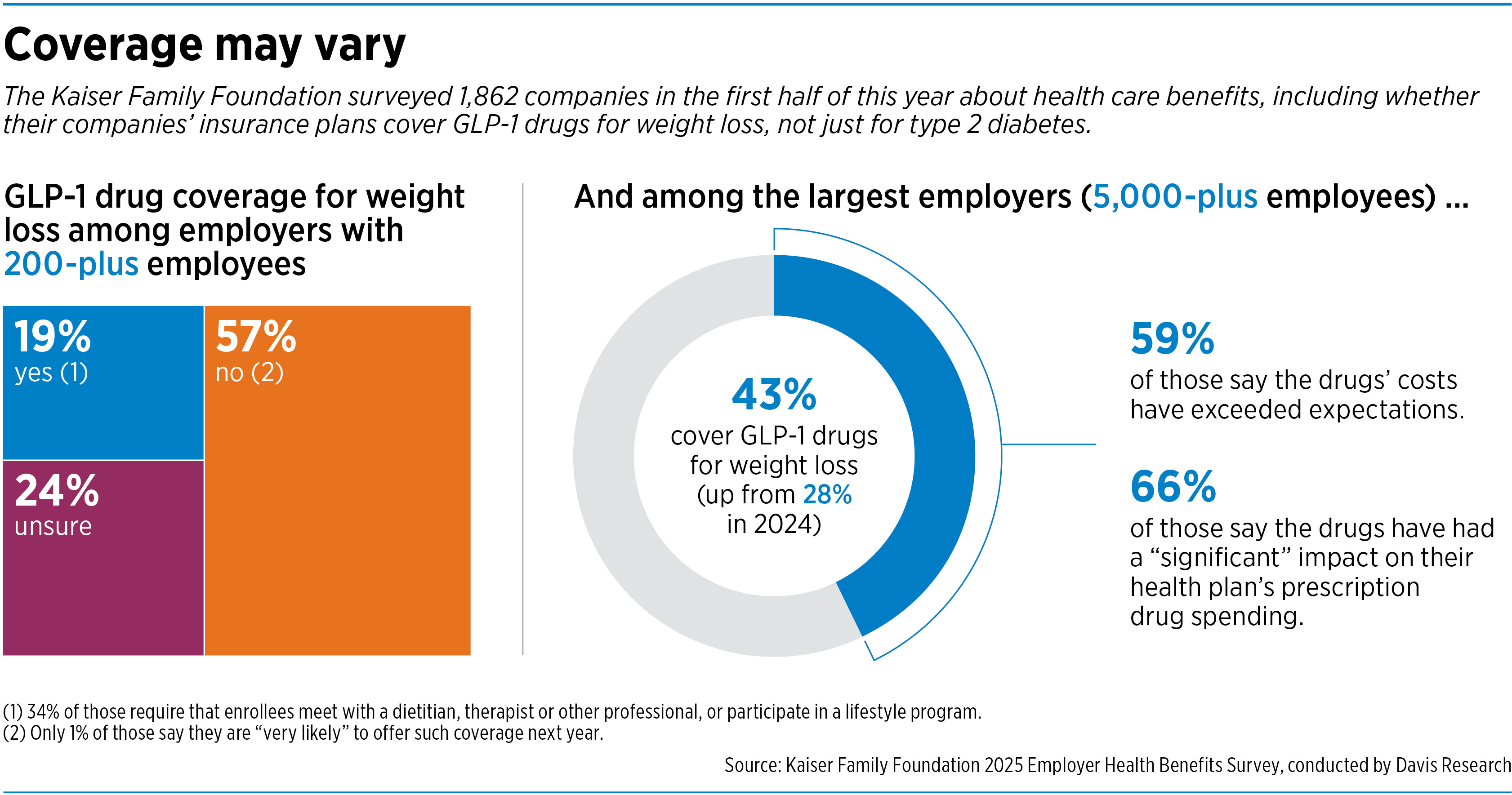
More large employers already are adding GLP-1 coverage for obesity to their health plans but worry about the drugs’ costs, according to the Kaiser Family Foundation’s 2025 Employer Health Benefits Survey released this month.
And the largest employees are the most likely to cover weight loss drugs.
In 2025, only about one in five, 19%, of firms with 200 or more workers said they cover GLP-1 drugs for weight loss, according to the KFF survey. But among the largest of those firms—employers with at least 5,000 workers—43% said they covered GLP-1 drugs for weight loss in 2025, up from 28% the previous year.
What’s more, those big employers often find the cost of that coverage to be more than they expected.
According to the KFF survey, almost 60% of employers with 5,000 or more workers offering the drugs for weight loss say their cost has exceeded expectations, and two-thirds say the drugs had a “significant” impact on prescription drug spending in the company’s health insurance plan.
John Sadtler, CEO of Columbus-based SIHO Insurance Services, said he is seeing that caution about costs play out in Indiana.
“More employers are exploring GLP-1 coverage for obesity treatment, but adoption remains mixed and often comes with significant restrictions,” Sadtler said in an email. “Interest is strongest among large self-insured employers that can customize utilization management strategies and negotiate contracts.”
Such employer controls over coverage include requiring patients to receive prior authorization for their prescription, try less expensive options first, limit duration of coverage, and require healthy lifestyle programs.
Sadtler said self-insured employers have more flexibility to customize benefit design since they are helping to pay their employees’ medical bills. “SIHO’s fully insured plans do not currently offer GLP-1 coverage solely for weight loss,” he said.
Vest of IU’s Fairbanks School said researchers will publish the results of the study as well as share them with Indiana’s business community.
“As part of our mission as a research university and scientist, we will be publishing results regardless of the findings,” Vest said.•
Please enable JavaScript to view this content.
“Bioethicist Jennifer Miller of Yale University was critical of the tone of Lilly’s focus on workplace productivity as a justification for covering a medicine….’Nobody wants humanity or a person or a patient to be reduced to their productivity,’ said Miller, co-director of the Program for Biomedical Ethics and associate professor at the Yale School of Medicine. ‘It almost implied, whether they meant to or not, that the product would be reimbursed if it was in the interest of the company, the employer.’”
Ms. Miller is apparently unfamiliar with decades of employer support for “wellness” programs, which corporations fund mostly because they provide a good ROI for the employer while helping the employee get (or remain) healthy and productive.
Agree with Chris B. This is potentially a transformative drug for our society, but we do need detailed understanding of the costs and benefits. Having the School of Public Health conduct the analyses as proposed is a safe and acceptable approach to get the data.
The vast disconnect between Employment and Health could not be more clear. Employers are vocally refusing to cover drugs intended to keep their employees healthy until they’re proven to make them more productive too – this is a massive conflict of interest. The US allows it, so employers will continue to harm their employees in the name of profit.
Government funded medicine to fight obesity is not the answer. These people just need to shove themselves back from the table and eat more vegetables. They will take the drug so they can eat like pigs.