
Subscriber Benefit
As a subscriber you can listen to articles at work, in the car, or while you work out. Subscribe Now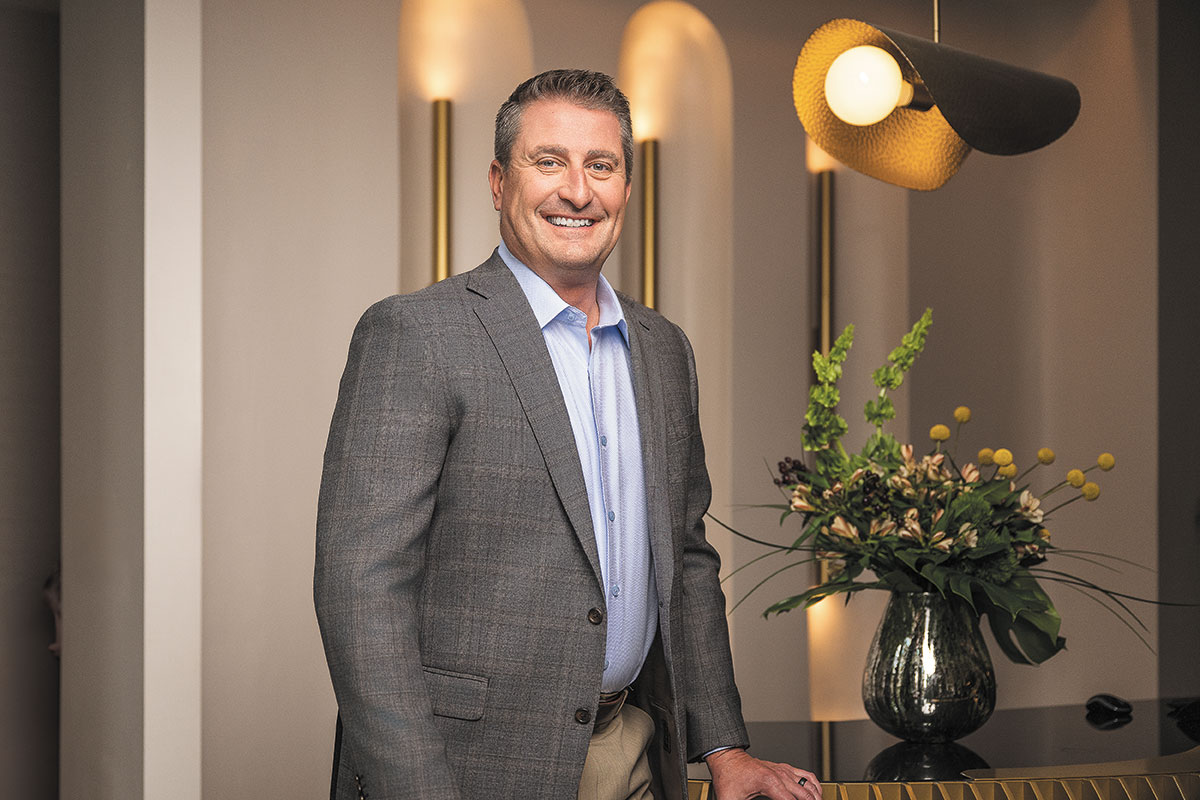
Mark Hardwick joined First Merchants Corp. in 1997 as corporate controller and was promoted to chief financial officer and then chief operating officer and eventually, in 2021, to CEO.
During his career there, the Muncie-based bank has grown considerably, from a couple of hundred employees and $1 billion in assets to more than 2,000 employees and nearly $19 billion in assets.
First Merchants now has locations in four states and a regional headquarters building at Keystone at the Crossing. Hardwick spent most of his life in Muncie and raised his family there, but he moved two years ago to Carmel and now calls the Indianapolis office his home base.
He talked with IBJ about what the Indianapolis building has meant for the company and for recruiting, what operations remain in Delaware County and what his time as a Ball State basketball player taught him about leadership.
The interview has been edited for brevity and clarity.

It’s been a little more than a year since First Merchants moved into its regional headquarters building—a space built originally for Duke Realty—in Indianapolis. How has that worked out?
It’s really been exceptional. In today’s environment—post-COVID, with so much remote work—I think you have to have spaces that are attractive to employees in lots of different ways. And I think convenience matters, although it’s hard to provide the convenience everyone wants based on where they live.
This building has so much light and so many open work areas, access to your fellow employees or your colleagues. We have multiple areas that are gathering spaces and then just access to things like food or even basics of shopping, etc., that allow for the convenience of running errands over lunch, that kind of thing.
It’s helped us recruit. We’ve attracted a number of new employees to the space, and I think retained some employees because of how appealing the work environment is in that building. So it’s been really successful.
How has your approach to the office changed since the pandemic?
Before, if you worked in an administrative function or role in our company, it was 100% centralized. So we either had people in the Muncie headquarters office or in our Muncie Operations Center, but we really didn’t allow administrative employees to work somewhere other than in the exact same space as their teams.
[Since then,] we have started hiring pretty aggressively for some of our administrative leaders and teammates in all of those regional markets. That’s opened up the hiring pool for us in a different way, where we’re not recruiting just to those central offices in Muncie or Daleville. We’re willing to hire an HR person in Farmington Hills and have them work in that office with other teammates that may not be in the same department.
How much are employees in the office versus remote?
We have a policy limiting full remote work to 10% of the company, and we track it pretty closely. Then, most everyone else has three days in the office, two days remote—and that’s agreed upon in a written agreement, and we monitor those agreements pretty closely.
Some companies are rethinking their remote-work policies. Do you feel any need to make yours stricter?
Ours works great for us. I just don’t see any reason to change it.
Do you think the physical space employees work in is important? Or is it the culture people find when they get there?
I think it’s all of it. But I think it’s tougher to really grow a career when you work 100% remote, and over time, people come to that understanding themselves. And so if you want to progress and end up in a management role or leadership role, it’s much easier to do that, from a physical location where you’re close to your teammates.
And I think it’s much more difficult to lead in a fully remote work situation or one where you try to work from home a larger percentage of your week. It’s hard to build culture, teamwork, to grow employees, all of those things when too much of the time you’re remote.
First Merchants is based in Muncie, but many of your executives are in Indianapolis. And you moved not long ago to the Indianapolis area and are working out of the office. What remains in the Muncie area?
It’s about 500. That’s an estimate. The Daleville Operations Center is in Delaware County and has 375 to 400. Then our main office in Muncie, the headquarters office, has at least 100 employees and is a large percentage of our administrative functions as well as a large percentage of our private wealth and commercial team.
How has your move worked out?
That’s been good. The majority of our executive team is in the Indianapolis market. Our prior CEO is in Indianapolis. Our prior board chair and our current board chair are in Indianapolis. And we just have found, over time, that we were able to attract the talent we needed to Indianapolis a little easier than attracting that talent to Muncie. And so the company has migrated over time to Indianapolis.
It’s also become an incredibly important market to us—but so is our legacy market of Muncie. We have over 50% market share there.
You’re still highly involved in Muncie. Why do you think it’s important to keep that tie?
In addition to the market share, it’s also where I raised my kids. It’s where my personal network is its highest. And I still think I have the ability to have a significant impact in that market. And I think the market needs leadership.
I don’t have people in Indianapolis demanding or calling out for my help. That already exists in Indianapolis. But in Muncie, First Merchants is incredibly relevant. And there are leaders in that community that have asked for my personal help, and I enjoy doing it.
What are your favorite contributions there?
I love that I’m on the board of trustees of Ball State University. The impact that Ball State has had on Muncie and Delaware County is really significant. The revenue of that university is about the same as our revenue. I think they have more employees than First Merchants, and they’re all in Delaware County. The economic impact is significant.
When you think about these old manufacturing communities, and the difference between Muncie and some of the others that didn’t have a university or a hospital to anchor those communities—in challenging times, they haven’t done as well. And so to be engaged in educating and helping inspire young people to understand their life’s purpose has been a lot of fun.
And then there’s the YMCA project, where we raised about $35 million to build a new YMCA on Muncie Central’s campus. That has probably been one of the coolest projects I’ve ever done in my career. And to see that come to fruition and to use the YMCA to work out there and to just look at the quality of space that we built is exciting.
How do you talk to younger people at your company about the importance of getting involved in the community?
Our volunteer hours are extensive. We have thousands of hours of volunteer time that we encourage and track and monitor. It’s really about the fact that our company is built around communities where we all live and work.
We are a community bank. We want to be sure that the community feels like we’re a community bank. It’s Main Street. It’s not Wall Street, and that’s what our organization has been built on.
What do you think you learned from your time on the Ball State basketball team—including two trips to the NCAA Tournament—that has impacted what kind of leader you are today?
One thing that affects how I lead and how I live my life is that you learn pretty quickly in a team environment that it’s not about you—it’s about the team. We all have a role to play to have the success that we want to have, and that applies at work and at home.
I have a role. And when I think all the way back to being corporate controller and CFO and chief operating officer, the way I tried to lead is that it wasn’t about me. What I’m always focused on is making sure that the team is successful.
And I feel like my home, my family dynamic, is the same way. My wife and I and our kids are a team. We’re trying to be the best people that we can be and have as much success as possible together.
I just think I learned all of that by going to practice every day and at 18, 19 years old having had coaches that made it really clear that for us to be our best, I had to play a certain role, and that it’s not about me.•
—Lesley Weidenbener
Please enable JavaScript to view this content.
Editor's note: You can comment on IBJ stories by signing in to your IBJ account. If you have not registered, please sign up for a free account now. Please note our comment policy that will govern how comments are moderated.