
Subscriber Benefit
As a subscriber you can listen to articles at work, in the car, or while you work out. Subscribe Now
The $710 million Pan Am Plaza redevelopment is passing its halfway mark, on course to open next fall. But it’s been a long road.
The project, consisting primarily of the 38-story Signia by Hilton hotel and a 50,000-square-foot ballroom addition to the Indiana Convention Center, was announced in 2018 but delayed significantly by the pandemic and then financing problems that led the city to take over. Its completion will help keep Indianapolis competitive in the national convention market, tourism leaders say.
Construction is about 50% completed, and nearly $503 million in contracts have been awarded.
“Indianapolis is really fortunate to have a strong stable of regular, building-wide customers that come every year and fill downtown,” said Andy Mallon, executive director of the Capital Improvement Board. “But they were starting to outgrow the current space. We just got to the point where, if we weren’t adding space, they were going to have to start looking at other cities.”
Besides the 800-room Signia and the ballroom, the project includes several smaller meeting spaces, a climate-controlled skywalk connecting the hotel to the convention center, and a redesigned west block of Georgia Street, which will become an urban green space available for private events.
There’s still lots to do before that vision is realized, however. As anyone who’s tried to drive through the area over the last year already knows, Pan Am Plaza is still a hectic construction zone.
“On a job like this, the deadlines are pretty intense, and the size—just the sheer area to cover—becomes a challenge,” said Bill Sewall, vice president at AECOM Hunt, the project’s construction management firm. “Right now, we’ve got about 750 workers on site every day. By the time we’re done, the project will have supported roughly 4,000 construction jobs.”
The cramped build site leaves little room for error. With the property hemmed in on all four sides by other hotels, restaurants and the existing convention center, there’s no space for a marshaling yard to store construction materials until they’re needed. That necessitated developing a complex system to make sure the only materials arriving on a given day are the ones needed for that day’s work.
“We call it ‘just-in-time delivery,’” Sewall said. “If something arrives on a truck today, it’s going into the building today. There’s no place to leave material piled up and draw from later. Deliveries start around 3 a.m. and run until 5 or 6 in the evening, and we use an electronic scheduling system to make sure 50 different subcontractors don’t all try to unload at once.”
 Digging into the ground didn’t uncover any schedule-crushing setbacks, but it did reveal some interesting curiosities. Mallon recalled one unexpected discovery unearthed while placing reinforcement walls near Illinois Street.
“We ran into the old streetcar tunnel that connected to Union Station,” he said. “It had been closed for decades, but it was still there. We had to tie back the walls while demolishing the old Pan Am Plaza structure and parking garage, and that meant working around this historic piece of infrastructure.
“It’s creepy, but it’s also a nod to the history and progress of Indianapolis.”
The project was further complicated by the fact that Signia by Hilton is a relatively new brand, with specifications for items like interior furniture, fixtures and equipment still under discussion as construction progressed.
“The designers and even the brand itself were still developing their standards for what goes into Signia and what doesn’t,” Sewall said. “Lots of times, it was hard to get questions answered because they simply didn’t know what the answer was. But most of that’s behind us now.”
During the dark days of the pandemic, when the project was being formulated, problems far more existential than wall treatments and carpet designs had to be faced. Back then, it was debated as to whether such a huge expansion was even necessary anymore. Would people ever again risk gathering in great numbers for conventions, or would they settle instead for Zoom calls and virtual confabs?
“Every major city in the nation and the world was looking at the horizon to think, how will people meet in the future?” said Chris Gahl, executive vice president and chief marketing officer for Visit Indy. “How will large-scale gatherings evolve? And what we saw was a hunger to still have peer networking and in-person conversation. Ultimately, exhibit halls lit up again with trade show booths for products to be sold.”
Gahl said the combination of the Signia hotel and expanded facilities gives Indianapolis new flexibility.
“We have to be able to layer conventions and meetings,” he said. “We need to have one meeting using the JW Marriott and the north side of the convention center, and a second meeting happening simultaneously in the Signia Hotel and the south half of the convention center, including this new expansion. That’s something we haven’t been able to do as effectively until now.”
Mallon said officials have been deliberate about making sure the project is justified.
“The Indiana Convention Center opened in 1972, and this is the sixth time it has expanded,” he said. “We’ve been very judicious as a city in only expanding when we truly believe it’s warranted. Over the last decade, we’ve studied this to the nth degree to make sure it’s viable, needed and warranted.”
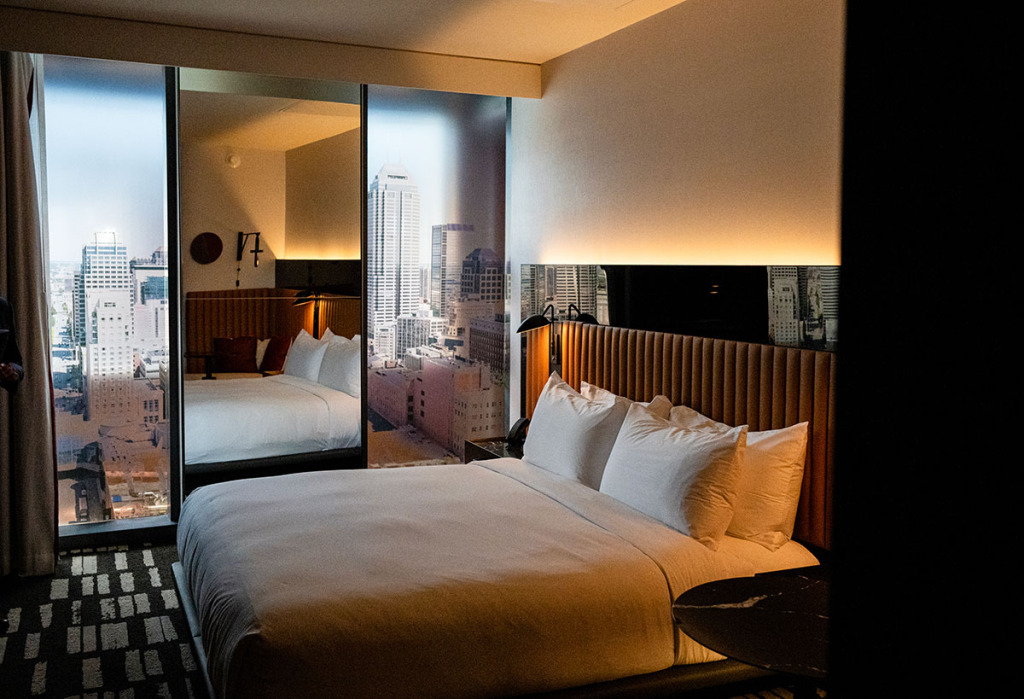 Pictured are model rooms inside the Signia by Hilton hotel in Pan Am Tower on Aug. 18. (IBJ photo/Mickey Shuey)
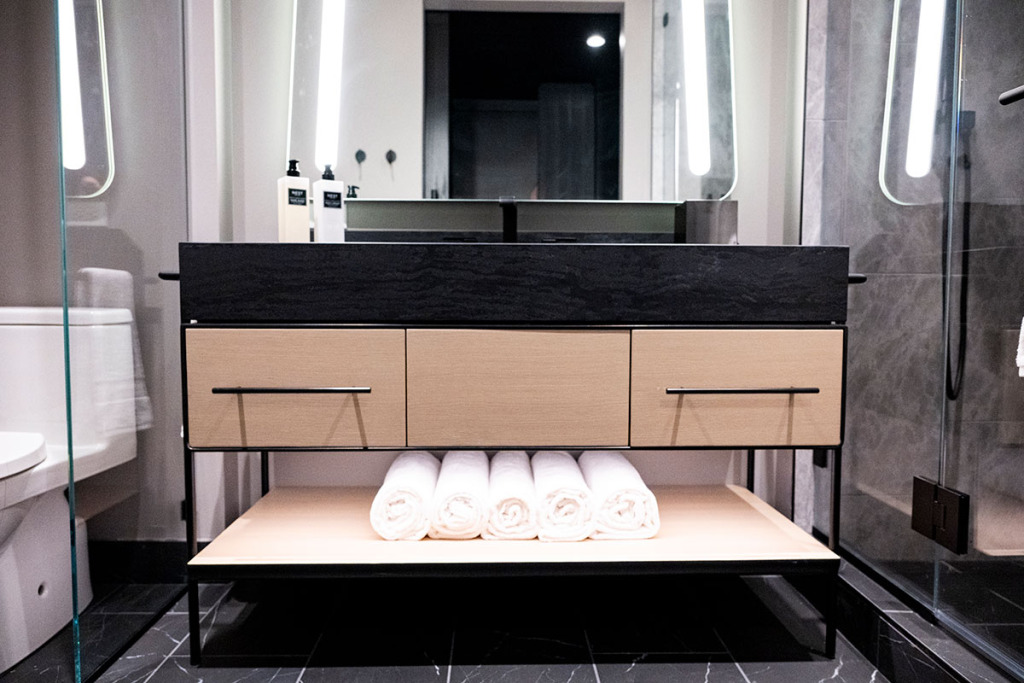 Pictured are model rooms inside the Signia by Hilton hotel in Pan Am Tower on Aug. 18. (IBJ photo/Mickey Shuey)
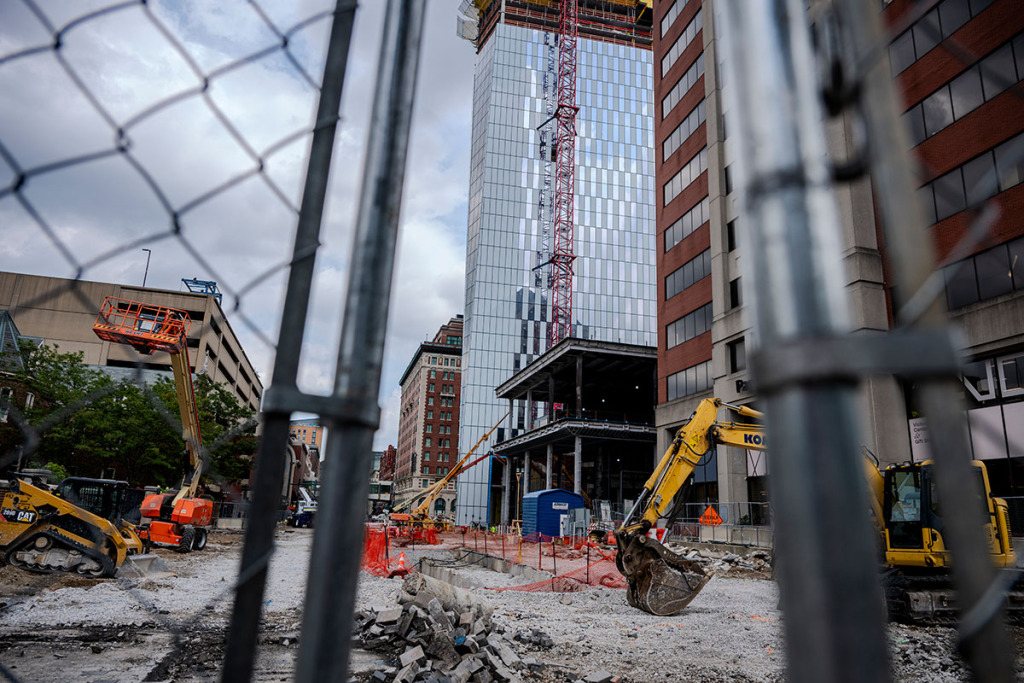 The Signia hotel and convention center expansion gives Indianapolis new flexibility for hosting conventions and events. (IBJ photo/Mickey Shuey)
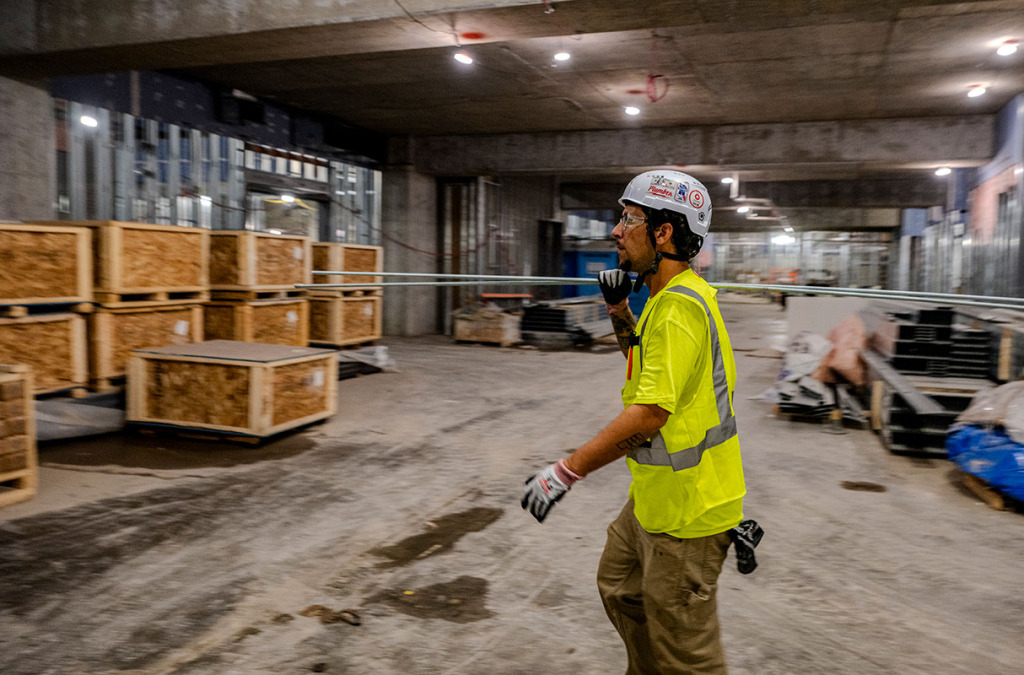 The Signia by Hilton hotel is about 50% complete. It's expected to open next fall, but currently the project is ahead of schedule. (IBJ photo/Mickey Shuey)
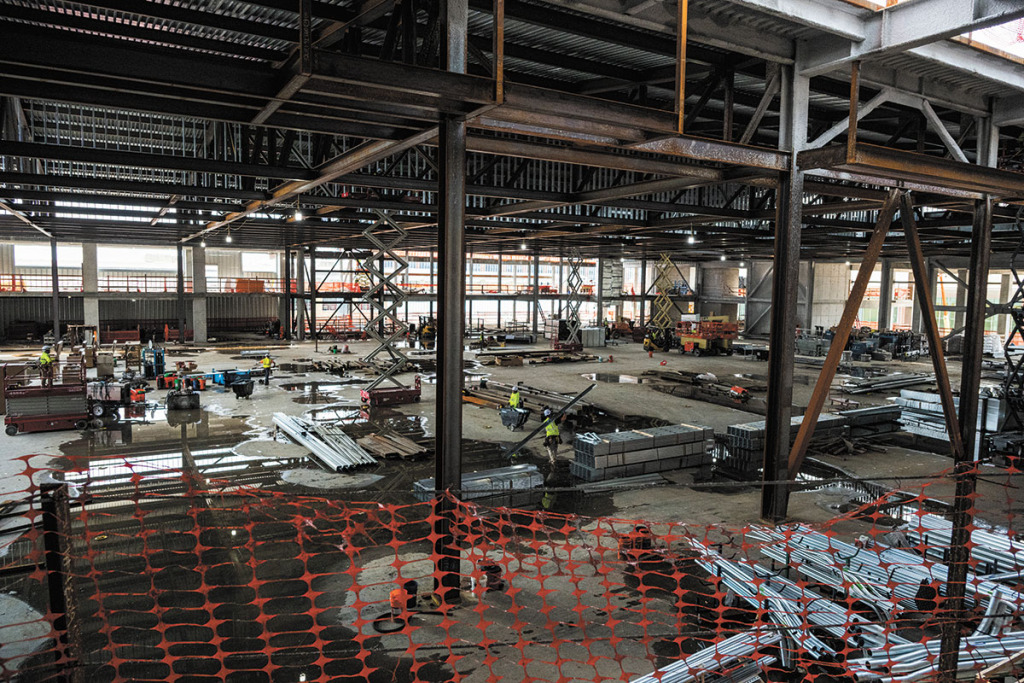 The Signia by Hilton hotel is about 50% complete. It's expected to open next fall, but currently the project is ahead of schedule. (IBJ photo/Mickey Shuey)
Despite the complexity of the work, Sewall said construction hasn’t run into any major problems since it started late last year. Quite the opposite, in fact.
“The topping-out of the [hotel] is ahead of schedule,” he said. “It’s too early to say if that will translate into an early delivery of the end product, but we’re in a good place for where we are right now.”
Exterior construction on the Signia tower is expected to be complete by the end of September.
Mallon said the ultimate goal is twofold: retaining events that have helped shape the city’s convention business while securing new business Indianapolis couldn’t accommodate before.
“This expansion saves and retains these time-tested annual conventions, like the Future Farmers of America and Gen Con,” Mallon said. “But it also attracts new ones, particularly in the medical space, which we’ve targeted very specifically with this expansion.”
Gahl hopes the city’s investment will position Indianapolis to compete at the highest level for years to come.
“We’re competing with some of the biggest names in the industry,” he said, “and this expansion gives us the specs we need to compete and win.”•
Please enable JavaScript to view this content.
Editor's note: You can comment on IBJ stories by signing in to your IBJ account. If you have not registered, please sign up for a free account now. Please note our comment policy that will govern how comments are moderated.