
Subscriber Benefit
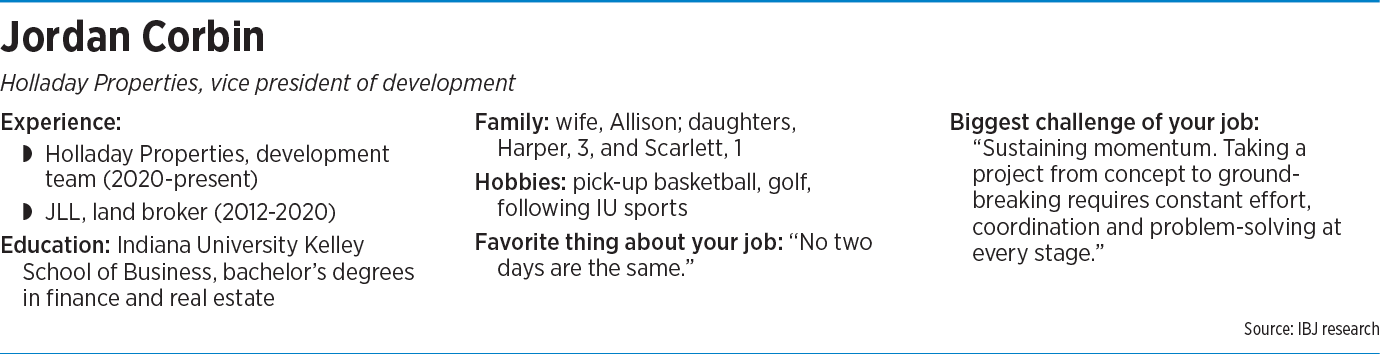
As a subscriber you can listen to articles at work, in the car, or while you work out. Subscribe NowFor the past five years, Jordan Corbin has seen his role within the real estate industry shift from brokering property for others to developing projects as an executive with South Bend-based Holladay Properties.
While the company is almost finished with the development of its decades-long Ameriplex industrial campus on the west side of Indianapolis, Holladay has several other major projects underway, including two downtown: Pembroke Place, the redevelopment of the former Angi Inc. headquarters, and the conversion of Circle Tower into a hotel.
IBJ spoke with Corbin—the company’s vice president for development in Indianapolis—about his role, the evolution of the company’s interests in the capital city and the importance of relationships and trust in securing business deals.
This interview has been edited for length and clarity.

You’re a graduate of Indiana University’s real estate program. How have you seen that change over the years, and how did that prepare you for what you do now?
The Kelley School has a really strong real estate program, and it’s growing quite a bit. When I was there, I graduated with 30 or 40 people—several of whom I still work with today in the market. I think over the last couple of years, they’re graduating a few hundred kids per year, so Doug [Morris McCoy, the program director] has done a great job of really growing that.
It really gave me a good baseline understanding of real estate, but truly there’s no comparison to actual experience. It takes several years to see a full real estate project come to fruition. When we start a project, it could be two to three years later before we’re even under construction, let alone finishing construction, leasing it up, stabilizing and selling it.
Before starting at Holladay, you were on the brokerage side of things—mostly selling land. What is it about the development side that drew you in and keeps you interested?
The brokerage world is a very important facet of commercial real estate; it’s all about connections and networking and making sure you’re putting the right people together. But it’s very transaction oriented.
What I was really attracted to on the development side is that it’s still about creating value and returns to investors, but it goes deeper than just the surface-level transaction.
We live and breathe these projects for years; they kind of become like our babies.
What I brought from the brokerage world was that networking piece, that ability to uncover deals, to go look for new projects and think outside the box. I’m always wanting more, and in knowing that deals can fall apart at any moment, I’ve also gained some resilience from my work in both areas of the industry.
Ameriplex out by the Indianapolis International Airport is a behemoth of a development, and it has been for years. How has Holladay evolved its strategy from a project like Ameriplex to now focusing on the downtown projects?
Holladay really got its start here with the 1,500-acre Ameriplex, but the team kind of developed itself out of a job there—which was always a goal. But from there, we really transitioned to try and take on other projects throughout the city—and outside of industrial.
We’ve built three multifamily projects in Indianapolis, and we didn’t need public incentives for those. But certainly we do now, yet we’re still bullish on downtown. There are a lot of great projects in the pipeline, and we’re hoping to be a part of that with our projects like Pembroke Place that’s under construction downtown and hopefully others.
Sticking with Ameriplex for a moment, what all do you still have available for development out there?
We have very little land left there—it’s under 30 acres. There’s one industrial site, kind of in the back of the park that we would eventually look to develop that could be for a 100,000-square-foot building. We’ve got a couple of hotel sites, and we just sold a site to Wawa for a gas station that’s now under construction.
Do you think it benefited Holladay, in pursuing the funding for your downtown projects, that you didn’t ask for incentives for your previous projects?
I think that it builds credibility when you’ve been able to do projects without incentives. But cities understand these are challenging economic times—interest rates are higher, construction costs are higher than they’ve been, vacancies are higher. … That’s affected all the asset classes, really.
Since arriving at Holladay just before the pandemic, how have you seen your role within the company change?
Well, Chris Wilkes, our senior vice president of development, hired me and has mentored me—he still does, and I still lean on him a lot. He served as the guy in the corner office here [in Indianapolis] for 20-plus years.
And after I was hired and as Holladay and Chris were looking toward the future, it was a natural transition where I took over the day-to-day responsibilities of leading the office. That happened in 2023, and I oversee our efforts to fill in the pipeline, hire people and manage projects. But Chris is still a partner within Holladay and still a big part of what we do.
You’ve mentioned Pembroke Place, the redevelopment of the former Angi Inc. headquarters at 130 E. Washington St. into about 180 apartments. What is the latest on that, and what have you taken from other conversion projects over the past couple of years?
We are currently in the last phases of demolition. We’ve started on a mock unit, and here soon, we’ll start framing and getting all the mechanical, electrical and plumbing work going. We hope to welcome residents next September.
When we first started, we looked at the conversion of 220 North Meridian that Keystone developed. We knew that a critical design element to converting these old office buildings is looking at the mechanical, electrical and plumbing design—you can spend a lot of money on design, but if the project can’t support the system that’s designed, it’ll stay on paper, right?
What’s the target tenant for a property like this one?
First, because of the public subsidy, we do have 21 units that will be designated as affordable—[for people who make] about 60% of the area’s median income, or AMI.
The remaining units will be for your typical downtown renter, a young professional. It’s a lot of one bedrooms and studios, about 80%. … We’re seeing that trend of maybe not wanting roommates in our other projects, so we’ve adopted that here.
And as far as price goes, it’ll be somewhere around $1,550 per month on average for most of the units, I’d expect.
The team also has the Circle Tower conversion on Monument Circle in the works.
Yes, that’s one of those deals that we’re under contract for the property but haven’t purchased it yet. We’re in the design phase, in the budgeting phase. So we’re very hopeful that that project comes to fruition.
And that’s going to be another kind of conversion, but this time from office to a hotel rather than apartments. Why go that route, instead?
Parking is a big one there. Hotels, they need parking, and some guests will look at self-parking, but really, it’s mainly valet for your hotel guests. We don’t have connected parking there, and there’s really no way to get parking into that building like Keystone did for their 220 North Meridian project. So that was a big factor.
Then you have the layout of the building; apartment units are on average about 750 square feet, while a hotel room is around 350 square feet. So to get the count we need, the shape of the building didn’t lend itself to, in our opinion, multifamily. You could do multifamily, but it wouldn’t have been the highest and best use.
Have there been any challenges in working through the designs, given it is considered a historic building and has to adhere to more development guidelines?
It’s a beautiful building, and a lot of people have worked in and around it. And they have a lot of passion for that building. I think everybody’s excited to see that we weren’t really changing anything to the exterior of the building or the lobby. There’s certainly been more attention on that building than any other project I’ve worked on.
So what else do you guys have in the hopper at this point?
Nothing else in downtown Indianapolis, right now. We do have our business park and land sites up in Westfield, like North Point Business Park. We’re working on designing a speculative industrial building for that park, and we’ve got roughly 250 acres left to develop up there.•
Please enable JavaScript to view this content.
Too bad Holladay does terrible work.