
Subscriber Benefit
As a subscriber you can listen to articles at work, in the car, or while you work out. Subscribe Now
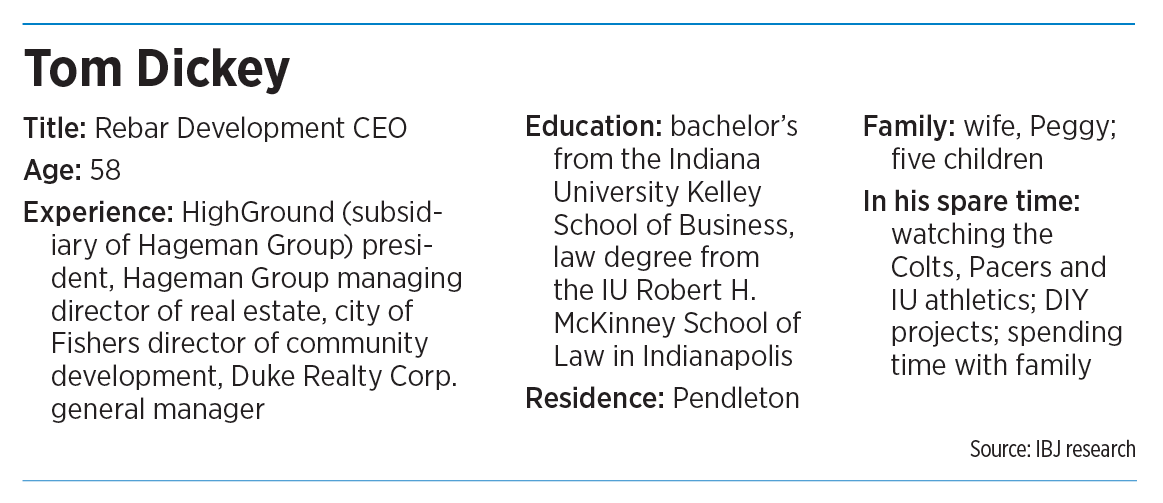
Tom Dickey’s career has spanned the legal, city planning and real estate worlds. Now, for the first time, he is leading a company.
Last month, Fishers-based Rebar Development announced that Dickey, a company partner, would become its new CEO. He succeeded a longtime friend, founding partner Shelby Bowen, who transitioned into a strategic advisory role with the company.
Dickey joined Rebar last year after eight years with Carmel-based Hageman Group. His previous stops also included the former Duke Realty Corp., where he led development of the 1,700-acre Anson project in Whitestown and the city of Fishers, where he planned and managed development of the Nickel Plate District.
Outside the office, Dickey is an assistant coach for the U.S. Soccer Federation’s Power National Team, which is for athletes who use power wheelchairs. His three adult children, who were born with a neuromuscular disease, have all played on the team. Dickey and his wife, Peggy, have also fostered more than 40 children and have adopted two sons, one who is 17 and another who is 7.
Dickey sat down with IBJ to talk about his career, the housing industry, his long list of DIY projects and being a foster parent. This conversation has been edited for length and clarity.
What have been some of the most influential impacts on your career?
My career has been influenced by a couple of things. One is working with really good people that didn’t have to but treated me as a mentee, and that has really impacted my life. And then my family has impacted my life. I always had this entrepreneurial sort of ideas and spirit, but particularly before, when things like pre-existing conditions and so forth were really prevalent in the insurance industry, I had to make sure that I had insurance coverage for my oldest three children who have a neuromuscular disease. I’d been a W-2 employee my entire career, but really doing things that I love to do, which is law and real estate development.
What do you consider your big break in your career?
At Duke Realty, I became a staff lawyer getting to touch and feel real projects, and I really wanted to keep gravitating more toward the development side. My first big break to move from law to development was the Anson project in Boone County. I started on it as a lawyer, just doing zoning and some tax-increment-financing work and tax abatement work, and then fortunate for me, some folks that were kind of mentors to me were retiring. And they were overseeing the Anson project. And so that gave me a chance to kind of be the last man standing and do something about that project. I got to become the general manager of that 1,700-acre project—a massive investment and a big change for Boone County—and kind of became the face of that up there. That’s where I really was able to build skills and build coalitions between landowners and stakeholders.
Did you have a career goal of eventually leading a company like Rebar?
Looking back at my career, I kind of have these eight- or nine-year seasons where I get an itch to go find another challenge, and that’s exactly where I was at Hageman. Certainly, I wasn’t running from anything. They’re great people. Still great friends.
[At the start of my career], I was very focused on just getting a job. I didn’t care where it was. I wanted to make a living. My dad worked in a factory and worked overtime whenever we needed to go on vacation. But I wanted to get a job, and I never had this plan. Other than to marry my wife, who I had dated since I was 13 and have kids in the house. But I knew I loved real estate. I loved the law. So, I just kept looking for opportunities that were in central Indiana. From a law firm to Duke Realty to the city of Fishers in its booming era and then to a family office that had lots of capital to invest in real estate. It’s kind of like I’ve been sort of purpose-built to lead this small company.
Why is Rebar putting a focus on active-adult communities?
We think it’s a missing piece. It’s coming to central Indiana. It’s somewhat about the asset and how you build it, and you’ve got to get that right. I think some folks are doing that, and we are doing that. It’s really about operations on the active-adult side, making that person who’s moving from their home or moving from another rental really become part of a community.
Where in the metropolitan area do you see the biggest untapped potential for multifamily housing?
Bargersville and the south side. There is tremendous potential there. It’s just like how these communities [on the north side] started growing 25 years ago. It takes time and momentum. Between Bargersville, the Center Grove area, then to the south of Greenwood, and even the south side of Indianapolis, I think it is really untapped and has potential. I think Fort Harrison still has more room and just the Lawrence area, generally. Lebanon has already made a tremendous investment in their downtown, which you can see when you drive around, and so, I think more housing there will continue to bolster those shops.
How would you describe your leadership style?
My leadership style is based on respect and collaboration and humility. I always feel like I’m not the smartest person in the room. That’s a little bit of the imposter syndrome, but it’s a bit of my style because I know I’m not, and so I’m often asking questions that I probably know the answer to, but I want other people’s perspectives on it.
Having worked on the Nickel Plate District early in its development, what does it mean to you to look out there and see all the activity today?
It’s tremendously gratifying. It’s like a sixth child. To think about where we started and where it is today, it’s just tremendously gratifying. You weren’t doing it to see the buildings. You can build buildings anywhere, and you go to “Architecture Digest” and look at buildings. It was to just create a community of people that were passionate about their community. To see the extent that’s happening, that’s what’s really cool.
What are some of your interests outside work?
Colts, Pacers and Hoosiers. I try to get to games all the time there. I love doing things with my hands. I’m a DIYer. I can build just about anything. A complete remodel of our master bath during COVID, including tile, plumbing, electrical, to changing the steering knuckle on a car. I’ve got more tools than you could probably ever need. With three adult kids in wheelchairs, I’ve widened enough doorways, and I know exactly what tools I’ve got, and I’ve perfected it because I could widen a doorway without having to do any drywall work.
What have you learned through your experience of being a foster parent?
What it’s taught me is just perspective. I very seldom get too stressed about work things because, at the end of the day, they’re just work things. There’s a lot of bigger issues out there. I try to manage risk and make good decisions so that stress doesn’t come, but when it does, [I remember] two things that God’s given us, which is really cool kids that have special needs that are just incredible people and knowing people through that community, and then … foster parenting. [That] just gives us perspective that there’s many, many, many things in our lives and your life and everybody else’s lives that are more important than whether this project makes one dollar or loses a couple of cents.
Where are your favorite places to travel?
The beach. My wife and I are beach bums. We go to Florida a lot. We recently discovered the Michigan City area. Those are really cool beaches in the right season. We like the little towns and walkable things. We tend to try little off-the-road sort of spots. We’ve done some international traveling. Peg and I both want to travel to Europe together.•
—Daniel Bradley
Please enable JavaScript to view this content.
A great read and a wonderful perspective on life. Thanks for setting an excellent example in a time where this form of generosity is increasingly rare.