
Subscriber Benefit
As a subscriber you can listen to articles at work, in the car, or while you work out. Subscribe Now
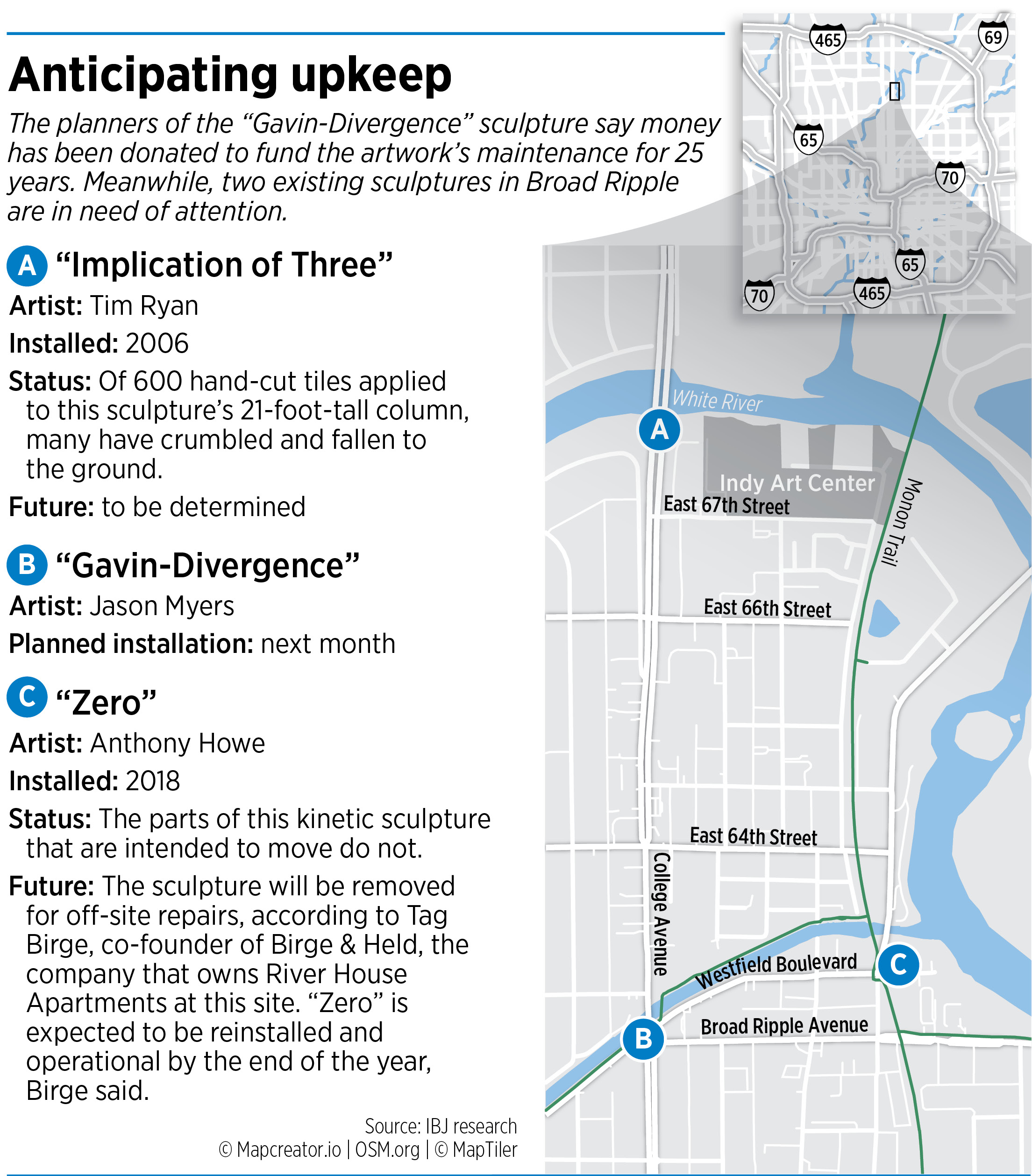
The planned installation of a 30-foot-tall sculpture in Broad Ripple is bringing attention to other examples of public art in the neighborhood, specifically two sculptures in disrepair.
Moving parts on “Zero,” a kinetic sculpture near the intersection of the Monon Trail and Westfield Boulevard, no longer move. The 14-foot-tall metal artwork by Anthony Howe was installed in 2018—and is now slated for a rejuvenation.
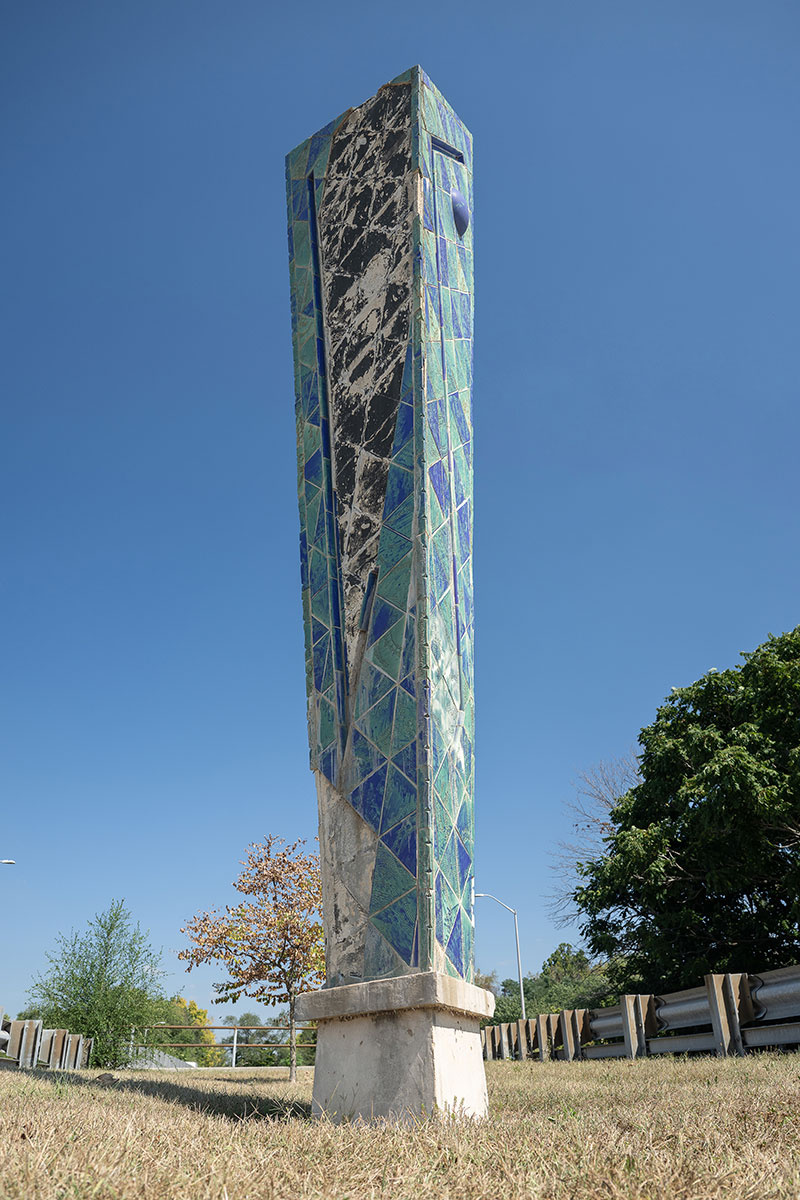
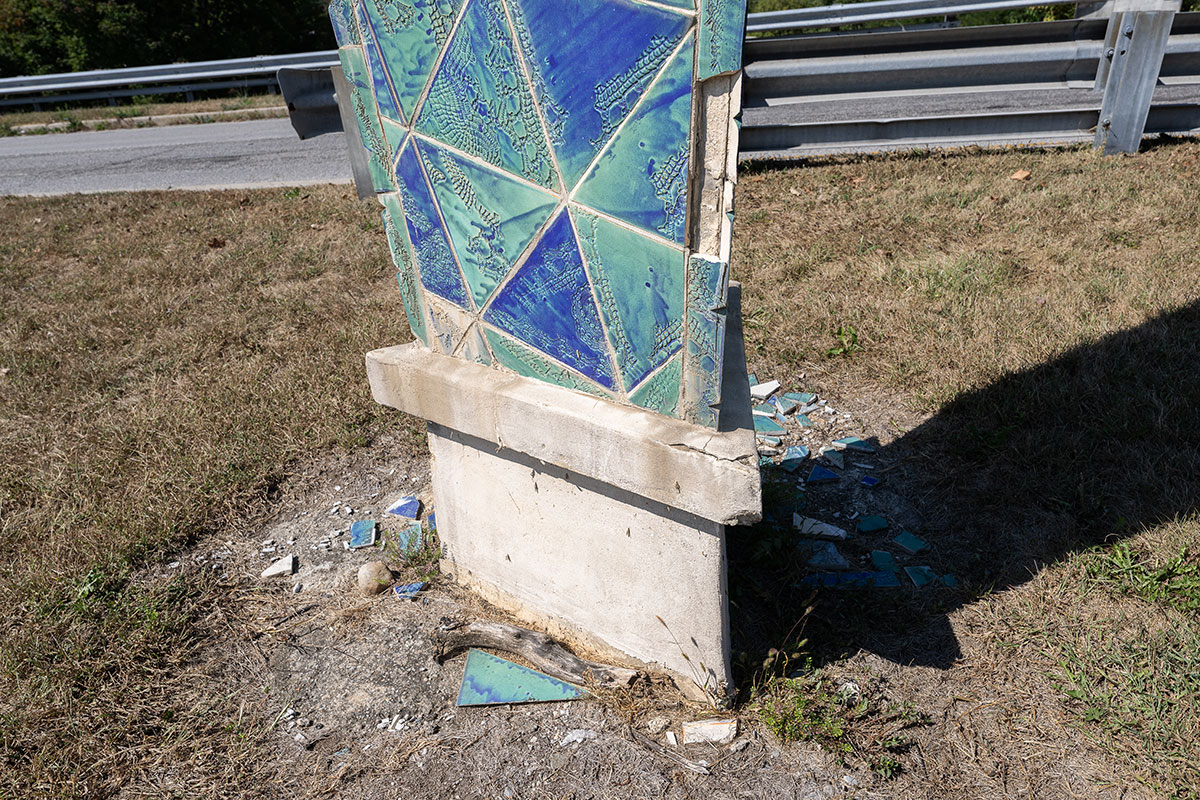
Dozens of ceramic tiles on “Implication of Three,” a 20-foot-tall monolith in the grassy median of College Avenue north of East 67th Street, have fallen to the ground.
Created by artist Tim Ryan and installed in 2006, “Implication of Three” was envisioned as a visual gateway at Broad Ripple’s northern border. Today, it’s commonly described as an eyesore.

“It is in poor condition,” said Julia Muney Moore, director of public art for the Indy Arts Council. “The tiles are falling off of it. It has some mold on it. It’s not been kept up.”
“Gavin-Divergence,” a much-discussed sculpture by Jason Myers, is expected to be installed next month at the northwest corner of Westfield Boulevard and College Avenue.
The abstract human figure made of steel I-beams is proposed as a visual gateway at the western edge of Broad Ripple’s business and entertainment district. Opponents of “Gavin-Divergence” have criticized the sculpture for appearing unfriendly while others deemed it a potential distraction for motorists.
The five-member Indianapolis Board of Zoning Appeals unanimously approved the sculpture’s placement during a Sept. 2 hearing in which attendees were split in opinions. Some detractors pointed to “Zero” and “Implication of Three” as evidence that Broad Ripple doesn’t take care of its existing artwork.
When one resident mentioned the Indy Art Center as caretaker of “Implication of Three,” several people in the audience spoke up to say that’s not the case. The art center, 820 E. 67th St., hosts classes and exhibitions down the block from the sculpture, but the facility and the three-sided sculpture aren’t related.
The city of Indianapolis owns “Implication of Three.” Representatives of the Indy Arts Council and Broad Ripple Village Association said ownership of the sculpture had become a fuzzy detail across its two decades of existence.
After the zoning hearing, the city’s Department of Public Works contacted Indianapolis-based sculptor Ryan to discuss possible renovation of the artwork. It’s not the first time the idea has been considered.

Moore, of the Indy Arts Council, and Jordan Dillon, executive director of the Broad Ripple Village Association, said estimates to refurbish or even remove the sculpture were presented to the city within the past five years. The costs were rejected as being too high.
Ryan said the need for upkeep should not have been a surprise.
The city “was told right up front that, after about 10 years, it would need a little maintenance,” Ryan told IBJ. “But nothing happened. At the 10- or 12-year point, I would have volunteered my help. I’d have made new tiles without expecting pay.”
The planners of the “Gavin-Divergence” sculpture say money has been donated to fund the artwork’s maintenance for 25 years.
“That’s really critical,” Ryan said. “If a pot of money is set aside for maintenance, then it might actually happen.”
Multiple entities—including the Birge Family Foundation, Broad Ripple Village Association, Indy Art Center and the Penrod Society—announced plans for “Gavin-Divergence” in July. Indy Art Center plans to assume ownership of the sculpture and maintain it.

Mark Williams, Indy Art Center’s executive director, said public art that falls into disrepair is a form of blight.
“It’s not good for any community,” Williams said. “I think it diminishes the sense of belonging. There’s no sense of pride in anything like that.”
Broad Ripple Village Association leader Dillon said upkeep can’t be an afterthought.
“Looking at things like public art, or any project a nonprofit like the BRVA or other entity takes on, the long-term financial support and maintenance of that has to be considered,” Dillon said.
The Indy Arts Council published a list of best practices for public art in 2023.
The list recommends strong agreements that identify the relationship between artist, site owner and community. The list also recommends setting an intended lifespan for pieces of public art.
In plain sight
“Implication of Three” made a high-profile debut.
The Indianapolis Cultural Development Commission, established in 2002 by Mayor Bart Peterson, commissioned the sculpture as part of funding for gateway and enhancement projects in Broad Ripple.
The commission, primarily known for designating six cultural districts (Broad Ripple Village, the Canal and White River State Park, Fountain Square, Indiana Avenue, Mass Ave and Wholesale District), dissolved in about 2010. The city added a seventh cultural district, Market East, in 2014.
The Capital Improvement Board and Lilly Endowment Inc. contributed a combined $12.5 million to fund the commission.
After the commission’s demise, “Implication of Three” and its blue and green glazed tiles stood with no group in an active role as caretaker. Ryan said the city pledged to maintain the sculpture in the artist contract he signed in 2006.

“It’s a piece of art that people drive by all the time,” Dillon said. “But, honestly, a lot of people probably don’t notice it’s there because it’s not functioning in the way it was originally intended, when it had the colorful tiles.”
The mayoral administrations of Greg Ballard and Joe Hogsett followed Peterson’s. In the words of Daniel Stevenson, deputy director of policy and planning for the Department of Public Works, the cultural development commission “existed long before our time here.”
On the topic of salvaging “Implication of Three,” Stevenson said the city would like to explore funding through philanthropic sources. He said the city is “working on a path forward” to refurbish the sculpture.
Plans to move again
The “Zero” sculpture is noteworthy for being the first artwork financed through the city’s Public Art for Neighborhoods ordinance, Moore said.
In 2017, Birch Tree LLC received nearly $2.7 million in developer-backed bonds to support the mixed-use River House Broad Ripple project at 6311 Westfield Blvd.
For real estate developers who receive tax-increment financing, the city’s “percent for art” program requires that funds are set aside for public art. The amount is equivalent to 1% of the project’s TIF incentive.
Developers can choose to place artwork on site or deposit their 1% into a fund for public art elsewhere in the city.
Birch Tree spent 2% of its TIF incentive, or $52,600, to commission “Zero,” a wind-powered kinetic sculpture by Washington-based artist Anthony Howe.
“It’s balanced so that it’s supposed to spin with a little wind or breeze, and it just really hasn’t been doing that,” Moore said of the artwork’s present status.
In 2022, Indianapolis-based real estate investment and management firm Birge & Held purchased River House Broad Ripple.
J. Taggart Birge, co-founder of Birge & Held, leads the Birge Family Foundation, which donated the funds to place the “Gavin-Divergence” sculpture in Broad Ripple.
Birge envisions three to five additional pieces of public art by multiple artists in Broad Ripple. All are expected to be funded by private donations.

“There’s a whole generation of kids who have never seen our original arts and culture district get any new art,” Birge told IBJ after the zoning hearing for “Gavin-Divergence.” “It’s been over 20 years. You’ve watched Carmel put millions into it. Downtown has public art. But we’ve neglected our real jewel, which is Broad Ripple Village. It needs more investment.”
Indianapolis-based “Gavin-Divergence” artist Myers said he considers “Confluence,” a sculpture of 100 tons of Indiana limestone created by artists Robert Stackhouse and Carol Mickett, to be the most recent addition of major public art in Broad Ripple. The sculpture was installed on the grounds of the Indy Art Center in 2004.
Regarding “Zero,” Birge said renovation is imminent.
“The sculpture will be refurbished off-site and is expected to be reinstalled and operational by the end of the year,” Birge said in a written statement provided to IBJ. “It requires significant reworking to bring it back to proper condition, but we’re excited that it will soon be restored.”
The original vision
Ryan, the creator of “Implication of Three,” knows what it’s like to have his work maintained.
The Monon Trail is home to “Here Comes Everybody,” Ryan’s cluster of three obelisks that stand 13, 8 and 5 feet tall. The tile-covered sculptures were installed in 2001 at the pedestrian entrance on the east side of the Indiana School for the Blind and Visually Impaired’s campus.
Ryan credits Elizabeth Garvey, who retired as the school’s horticulture instructor in 2023, for raising funds to “refresh” the installation.
“It looks brand new again,” Ryan said.
Meanwhile, Indy Art Center wrapped up this summer an $8.8 million capital campaign to renovate its Marilyn K. Glick School of Art building and outdoor Artspark.
Celebrated architect Michael Graves (1934-2015) designed the building and the sculpture park. The signature sculpture in the 9-1/2-acre park is “Twisted House,” John McNaughton’s topsy-turvy structure that’s bent into an arch.
In 2020, the art center launched a crowdfunding campaign to raise $2,500 to repair the wooden “Twisted House.”
The latest fundraising campaign, Building Community Through Art, earmarks $2 million for an endowment expansion to fund ongoing maintenance.
Improvements planned for the Artspark, which borders the White River to the north and the Monon Trail to the east, include:
◗ A new trail system made up of a boardwalk and walkways through the park and along the White River.
◗ A set of stairs to connect to the Monon Trail.
◗ Stabilization practices to reinforce the riverbank.
Williams said he’s working with the Herron School of Art to catalog the art center’s sculptures.
“The Artspark is going to be a stunning public asset,” he said. “It’s the city’s original art and nature park, and we’re realizing some of Michael Graves’ original vision of what Artspark could be. It just wasn’t realized originally because of not enough funding.”•
Please enable JavaScript to view this content.
There are many,many examples of beautification projects gone bad all over the city. Many were completed with grants with no allotments made for continuing repairs etc.
38th Street with all of the destroyed concrete planters is a good example, as are the medians on MLK approaching downtown.
I think it is unfair for the current administration (Teflon Joe and Co.) to blame the previous administrations.
City streets are gardens for weeds, trash etc.
I remember when we were classified “Clean City” .
These issues are, I believe, are quality of life and coupled with homeless encampments, pan handlers, murder rates will have a negative impact.
SAVE THE PLANTERS
The giant new statue that these developers want to put in, unfortunately, will be an eyesore from day one. Even worse, it is just one in a series of lame designs by this same artist, who has similar junk standing in other cities already.
The Implication of Three should be repaired. I think it’s cool when driving by even with faded and failing tiles. I lived in BRip for 5 years and never saw it in “nice” condition.
No “public” art should be donated or installed without an account set up and funded for maintenance. Look at Columbus, Indiana now sorting through challenges to repair architecturally significant buildings. We must think long term.