
Subscriber Benefit
As a subscriber you can listen to articles at work, in the car, or while you work out. Subscribe Now
Butler University plans to have a stand-alone engineering program up and running for fall semester 2026, becoming the latest small, private Indiana college to pursue engineering students in a competitive environment where the degrees are in high demand.
For 24 years, Butler students could pursue engineering degrees through a five-year dual degree program in tandem with Purdue University at the former IUPUI. Now that the college has split into Indiana University Indianapolis and Purdue University in Indianapolis, Butler University has decided to pursue a program of its own.
Interim Provost and Executive Vice President Jay Howard told IBJ the college already had the facilities and experience in engineering education, and market research showed that “yes, there is room in the market for a Butler-ized version of an engineering program.”
The Butler take on those in-demand degree programs focuses on critical thinking, communication skills and ethical decision-making, department Chair Jeff Carvell said.
Howard added that students involved in the dual-degree program sought the “high-quality, relationship-rich environment” at Butler, with small class sizes taught by professors, not graduate students.
Butler has enlisted John Impagliazzo, a professor emeritus of engineering at Hofstra University in New York, as a consultant to shape the school’s curriculum. He told IBJ that for universities like Butler, it isn’t a question of competing with Purdue or Rose-Hulman Institute of Technology in Terre Haute. Incoming students choose a school like Butler because of the promise of a well-rounded education, Impagliazzo said, rather than focusing solely on a particular subject.
Several schools are making similar pitches.
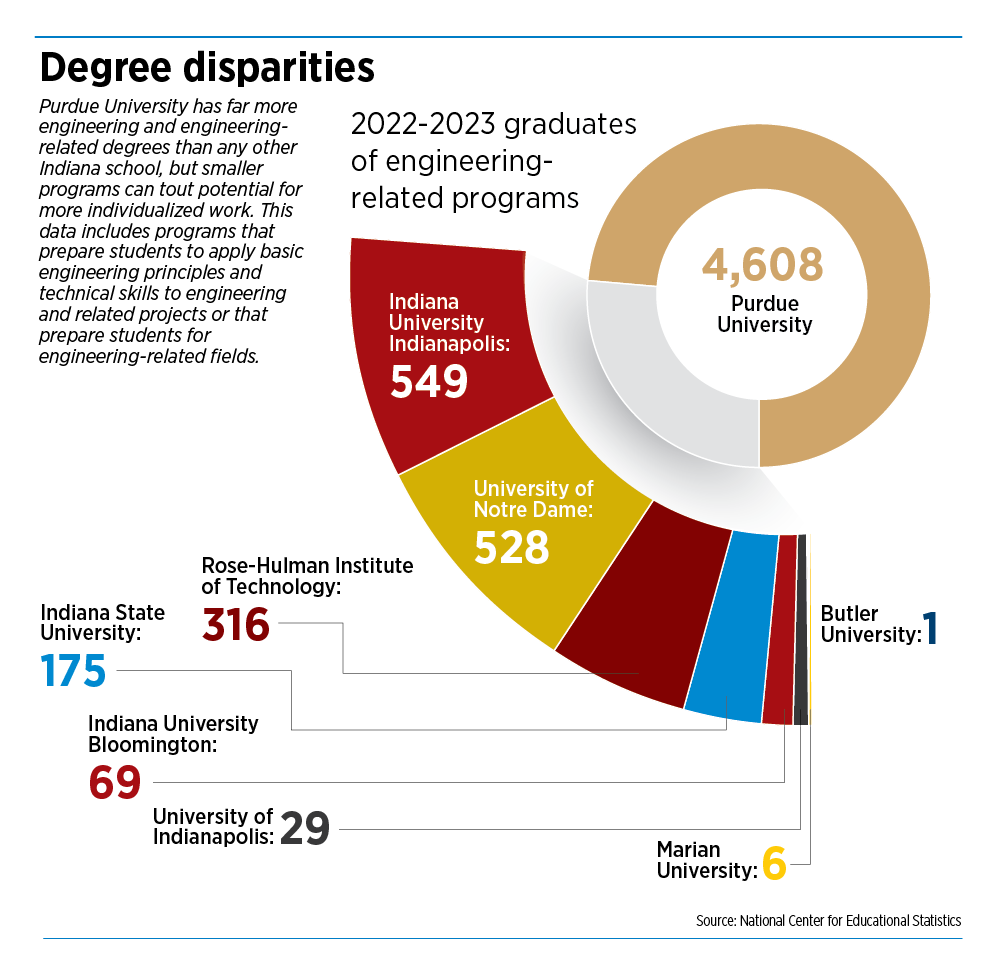
Indianapolis-based Marian University and the University of Indianapolis both have engineering programs, established in 2022 and 2016, respectively. School leaders say the universities leverage their urban location and liberal arts focus to try to offer a slightly different spin on a curriculum in which Purdue remains a powerhouse.
Purdue awards the most engineering degrees of any college in the United States, at about 3,000 bachelor’s degrees in 2025. It’s followed by Texas A&M University, which awarded almost 2,500 engineering bachelor’s degrees in 2024.
Engineering students make up 30% of Purdue’s population. And the school is selective: It accepts only 46.1% of applicants.
Ken Reid, director of the University of Indianapolis’ R.B. Annis School of Engineering, said it’s interesting that smaller schools are launching these programs in the face of industry giants like Purdue and Rose-Hulman.
Despite size disparities, Reid said, engineering graduates of big, state schools and those of small, private schools see similar starting salaries and job-placement rates.
According to a 2025 article from the American Society of Mechanical Engineers, the field of engineering is growing slowly, at a rate below 4%. With the average employee in the field around 43 years old, a wave of retirements is expected in the next few decades. The U.S. Bureau of Labor Statistics estimates that by 2032, 1.86 million engineers will be employed across all sectors.
The highlight of UIndy’s engineering school is a practical, hands-on learning experience with local employers called DesignSpine. Students are required to participate in the program during all four years of school, as opposed to a senior capstone project.
The engineering school has about 200 students. Reid said power generation and distribution, artificial intelligence, cybersecurity, robotics and racing automobile design are all growing fields with a need for engineers. And in his experience, Indianapolis companies are always looking for interns and employees, he added.
Still, it’s a huge undertaking to launch a program.
“You probably need a building, you need quite a bit of equipment, and faculty that are specialized,” Reid said. “It’s a fairly expensive addition.”
Starting a program
Marian University spent $45 million to open the E.S. Witchger School of Engineering. Funding included a $24 million gift from the Witchger family, which owns and operates Indianapolis-based Marian Inc., a provider of die-cut flexible component parts for the medical, electronics and automotive industries.
Some of that funding supported startup costs, including facilities and equipment, as well as endowed scholarships, endowed faculty positions, curriculum design and student recruitment. An additional $5 million grant from the Richard M. Fairbanks Foundation helped fund the construction of a 70,000-square-foot building and equip it with laboratories, classrooms and advanced manufacturing space.
Marian decided in 2018 to make the jump after more than a decade partnering with IUPUI on a dual-degree program much like Butler’s. Binh Tran, founding dean of the E.S. Witchger School, said students had logistical difficulties commuting from Marian to IUPUI when classes were back-to-back. They also wanted a four-year program, rather than the five-year dual degree setup.
The university is set to graduate its first class of engineering students next spring. In total, it has about 250 students pursuing engineering degrees.
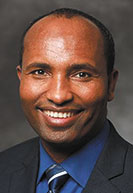
“The demand for engineering, whether it is an internship or full-time job, is sky high,” Daba Gedafa, dean of the Witchger School, told IBJ. “We are not meeting those demands, and that’s why we push very hard to increase our enrollment to meet the needs of our local industry.”
Gedafa and Tran see demand related to federal investments and incentives, like the $1.2 trillion Bipartisan Infrastructure Law and the CHIPS and Science Act of 2022. They also highlighted growth in areas like sustainability and electric vehicle infrastructure, biomedical engineering and health care.
For Marian, location also plays a big role. Students want to be in Indianapolis surrounded by things to do—like going to an Indianapolis Colts or Indiana Pacers game after classes—as well as internship and job opportunities, Tran said.
The small, Catholic private college has also seized the opportunity of creating curriculums not available at nearby schools. For example, Marian offers the only civil engineering degree program in Indianapolis, and it’s in the same city as the Indiana Department of Transportation’s headquarters.
Butler’s path to engineering
Impagliazzo is a proponent of all colleges and universities taking up engineering in the same way they seek out the sciences. However, he’s noticed in his work a “fear of engineering” among some higher education officials who liken the idea of starting an engineering school to that of creating a medical school.
He said institutions he’s worked with are often committed in the long term but are hesitant to take the first step of declaring their creation of an engineering program. He described Butler as an outlier.
“Butler looked in the mirror and said, ‘We should do this.’ And they made a positive commitment to do it, and it got done,” he said. “And miraculously, the whole thing got done within one year. In some universities, it takes one year just to put a committee together.”
More institutions are deciding to take on the investment. That’s a trend he thinks will grow.
“Over the next 10 or 15 years, you’ll see more engineering programs,” he said. “Why not? We need engineers.”
Butler is aiming to enroll about 40 students in the program, which is set to begin a year from now.•
Please enable JavaScript to view this content.
Editor's note: You can comment on IBJ stories by signing in to your IBJ account. If you have not registered, please sign up for a free account now. Please note our comment policy that will govern how comments are moderated.