
Subscriber Benefit
As a subscriber you can listen to articles at work, in the car, or while you work out. Subscribe Now
Carmel Mayor Sue Finkam’s administration introduced a $144.2 million budget this week that includes increases in funding for public safety and parks.
However, the budget also proposes cuts in funding and staffing for other departments as the city works to adjust to the effects of the state’s new property tax reform law, which was known as Senate Bill 1 before passing the General Assembly. The new law is expected to lead to steep drops in property tax revenue for Indiana local governments.
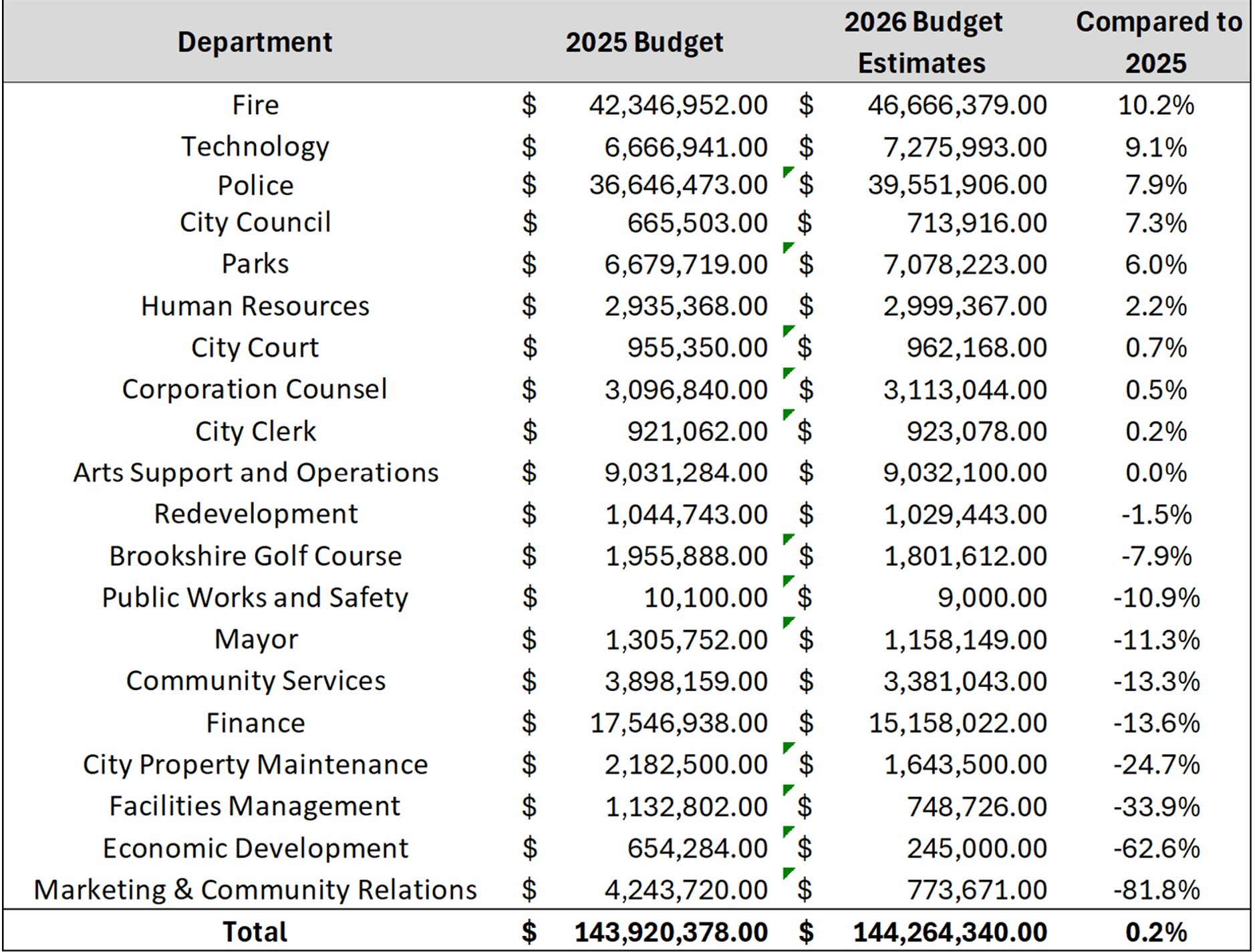
Finkam’s budget proposal includes a 10.2% funding increase for the Carmel Fire Department, a 7.9% budget increase for the Carmel Police Department and a 6% increase for Carmel Clay Parks and Recreation. However, 10 other departments could experience budget reductions ranging from 1.5% to nearly 82%.
“There’s a lot of things that are not ideal in this budget, but this is a new reality we’re facing,” Finkam told IBJ. “[The new state law] has absolutely reduced and put a governor on the growth of our budget, so we have to find new ways of doing things. Are they going to be ideal like we perfectly want to do it? No. But we’ll find ways to fund completely all of our priorities while making other things more efficient.”
The Carmel City Council will hold a pair of six-hour budget workshops from 9 a.m. to 3 p.m. on Monday and Tuesday. Councilors will continue discussing the budget at their regularly scheduled meetings next month, when a public hearing will be held Oct. 6 with a final vote on Oct. 23. The budget must be submitted to Hamilton County by Nov. 1.
(Story continues following chart)
Cutting costs
Finkam said city leaders had to manage a $10 million shortfall in property tax revenue as they worked to craft next year’s budget. To cut costs, the budget calls for the elimination of 11 city positions. Seven open jobs would not be filled, while four other positions would cut through layoffs.
“Those are hard decisions,” Finkam said. “These are people’s lives, and we take that very seriously, and we tried to get to everywhere we could without doing that, but that was one thing we had to do to make the budget work.”
Additionally, the city plans to cut costs by paying off capital leases by reallocating $5.3 million in unspent funds from this year; increasing efficiency, such as by sending one utilities department employee rather than multiple employees on an 811 call; and creating a nonprofit called Experience Carmel to manage city events and public spaces.
In May, Finkam proposed Experience Carmel, which would essentially replace the city’s Marketing & Community Relations Department. Some members of the Carmel City Council raised questions about Experience Carmel both after Finkam introduced the idea and at a budget introduction meeting this week.
Next year’s budget includes a $1.8 million grant to help launch Experience Carmel.
During the budget introduction to councilors on Monday, Chief Financial Officer Zac Jackson said about half of the department’s 15 employees would move to Experience Carmel. Four communications employees would remain with the department, while the remaining employees would be transferred to other departments within the city.
Jackson said the changes to the Marketing & Community Relations Department would save the city about $1.7 million.
Chief of Staff Nick Weber compared the concept of Experience Carmel to nonprofit organizations such as Downtown Indy Inc., which manages marketing, events and tourism in downtown Indianapolis.
“Experience Carmel can be essentially a destination marketing organization, which are all over the state of Indiana, and serve as this marketing and event resource for the entire community, not just an arm of the city,” Weber told IBJ.
Property tax reductions
Finkam said Carmel’s current tax rate of 78 cents per $100 of assessed value will not increase next year, but the flat tax rate likely cannot be sustained past 2026 due to the anticipated impact of the new law.
By 2030, the city expects to receive $38 million less in property tax revenue than was anticipated before the new law. Carmel will be especially impacted by the law because of the city’s large residential tax base and high assessed value.
During this year’s legislative session, Statehouse leaders said they worked to find a compromise that will balance widespread property tax relief with adequate funding for local governments, whose services heavily rely on property tax revenue.
Homeowners have felt the pinch after property tax bills spiked from market-driven assessed value increases during the pandemic-era housing boom. In 2023, tax bills increased by an average of 17%, according to an analysis by tax expert Larry DeBoer.
Among its many provisions, the new state property tax law allows homeowners to claim up to a $300 tax credit and limits how much local governments can raise their property taxes.
To compensate, cities and towns with more than 3,500 people will be able to implement a 1.2% local income tax in 2027. Indiana’s roughly 350 cities and towns that have fewer than 3,500 residents will be reliant on their counties, which can also put a 1.2% local income tax in place.
Finkam said she has talked with legislators, and she expects changes will be made to the new law due to concerns over its impact on local governments.
“We’re kind of just focused on 2026 right now because the state legislators I’ve met with this fall have all indicated there’ll be changes coming, so I’m not sure how much we can really lean on our estimates moving forward past 2026,” she said. “We’re just focusing on what we’ve got to do to make ourselves successful next year.”
Please enable JavaScript to view this content.
Please note that the proposed spending for 2026 is still higher than 2025, though the increase is very small. Only in government is having a smaller budget increase considered a cut.
Ha. So true
Inflation means this budget buys LESS than it did last year.
Citizenship in the city increased more than the budget did year over year…. Moot argument when the budgets is less to do more