
Subscriber Benefit
As a subscriber you can listen to articles at work, in the car, or while you work out. Subscribe NowMunicipal government leaders across Indiana are going pale in the face while they review budget forecasts for the next few years as a sweeping property tax relief law takes effect.

In Carmel, for example, Mayor Sue Finkam said her city will face a $10 million shortfall in property tax revenue next year due to Senate Bill 1, which went on the books Tuesday.
The primary function of the new law, a top priority of Gov. Mike Braun, will be to remove property taxes as the primary funder of local governments, public schools and other government units in Indiana and give local officials more authority to replace them with local income taxes.
Carmel’s property tax revenue loss is likely to double to $20 million in 2027. By 2031, when the law is fully implemented, the city is projected to take a $30 million hit. Carmel will be especially impacted by the law because of the city’s large residential tax base and high assessed value.
“It’s a rough cut, and it’s especially frustrating because we’re still very much a growing community,” Finkam said. “I’m not losing sleep yet because we’ve got a really talented team here working really hard to find some solutions, but I worry about the long-term competitiveness of the state of Indiana.”
Finkam said the city put austerity measures in place earlier this year when she and other city officials “got the tone and tenor from the state Legislature” as legislators spent months negotiating the bill.
During this year’s legislative session, Statehouse leaders said they worked to find a compromise that will balance widespread property tax relief with adequate funding for local governments, whose services heavily rely on property tax revenue.
Homeowners have felt the pinch after property tax bills spiked from market-driven assessed value increases during the pandemic-era housing boom. In 2023, tax bills increased by an average of 17%, according to an analysis by tax expert Larry DeBoer.
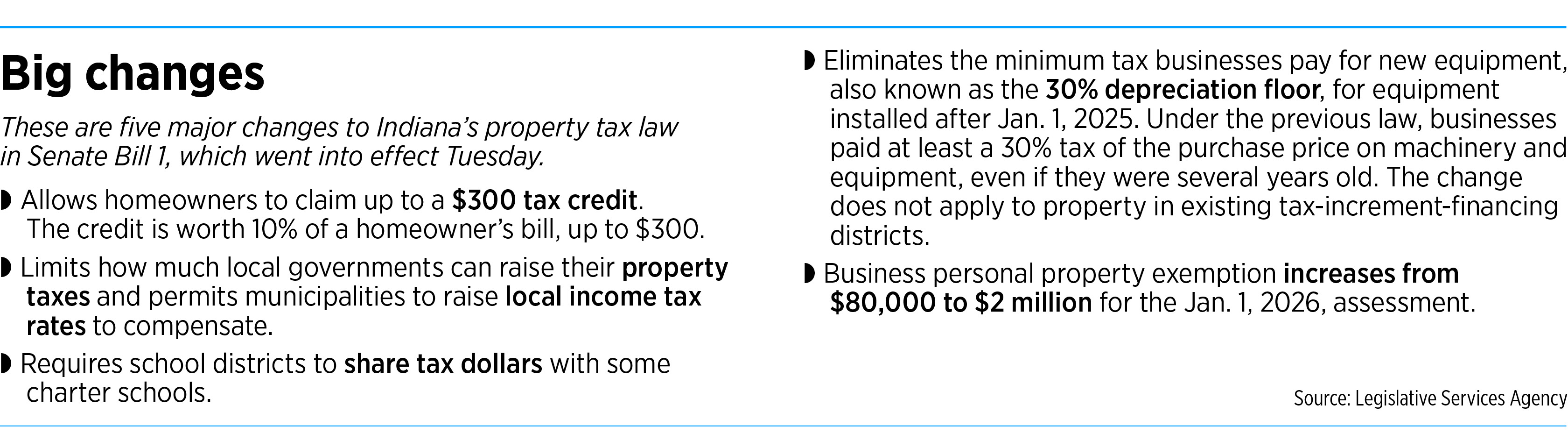
Among its many provisions, SB 1 allows homeowners to claim up to a $300 tax credit and limits how much local governments can raise their property taxes.
To compensate, cities and towns with more than 3,500 people will be able to implement a 1.2% local income tax in 2027. Indiana’s roughly 350 cities and towns that have fewer than 3,500 residents will be reliant on their counties, which can also put a 1.2% local income tax in place.

Matt Greller, CEO of AIM, an association of Indiana cities and towns, said the full impact of SB 1 will not be known until 2031, when all the property tax credits and deductions in the law go fully into effect.
“This is an extremely complex bill,” Greller said. “I don’t think there’s a single person in the state of Indiana that can honestly say they understand all the nuances and how everything works together.”
Finding a way
Mayors in the northern suburbs who spoke with IBJ expressed concerns about the law that ranged from questioning their ability to fund services, staff newly constructed buildings and have the economic development tools needed to attract companies to town.

“It’s going to make operating very difficult,” Zionsville Mayor John Stehr told IBJ. “It’s not like we have a lot of fat in our budget.”
When Carmel department heads propose their budgets later this summer, they will have to defend their staffing and programs. Already, the city has not filled multiple positions vacated by employees who left for new jobs. People have also not yet been hired for six positions approved last year by the City Council.
Other investments will remain on hold, such as a long-needed replacement for a $14 million chiller, which is a refrigeration unit that uses hot and cold water to create heating and air conditioning for City Hall, the Carmel Police Department headquarters, Fire Station 41, the Payne & Mencias Palladium performing arts hall and the Tarkington theater.
“I will not have $14 million sitting around to make that investment,” Finkam said.
She also worries about the impact of raising the local income tax rate and the potential of losing high-income residents who own businesses to states like Florida, Tennessee and Texas that do not have a state income tax for individuals.
“It’s a huge problem for Carmel,” she said. “And it should be a warning signal for the state of Indiana that if we lose investment and those that drive investment, we’re not going to be as competitive as we could be.”

Noblesville Mayor Chris Jensen said the city has a hiring freeze in place for any unbudgeted positions. Department heads have been told to expect funding for next year that is either in line with this year or less than 1% more.
Noblesville stands to lose $7 million annually in property tax revenue over the next four years. That might delay the city’s ability to follow through on a 10-year capital improvement plan that has been in the works for years, Jensen said.
“All those projects that are on that capital improvement plan are necessary. They need to be done,” he said. “It’s just obviously going to be a timing conversation now about when they can be done.”

Fishers Mayor Scott Fadness said he is focused on keeping city staff count low and being efficient. However, he said efficient communities are at a disadvantage right now.
“If the inefficient communities need to cut millions of dollars of their budget, they probably have a more target-rich environment,” he said. “Those communities who have really tried to focus on being as efficient as humanly possible, when you come back around to them and say, ‘Hey, I need you to cut X millions of dollars, that can be more painful.”
Fadness expects Fishers will have a $3 million per year reduction in revenue under SB 1.

Hamilton County Commissioner Mark Heirbrandt has spent time meeting with local elected officials from around the state who want legislators to continue making adjustments to the law next year.
Heirbrandt said Hamilton County expects to lose at least $6.4 million in property tax revenue in 2026, $8.6 million in 2027 and $11.5 million in 2028. The losses will impact the county’s ability to provide services for employees, including child care.
“A lot of county commissioners are right now in the process of starting to put these numbers together,” he said. “Legislators are going to be challenged to really look [at solutions]. One of their solutions is not going to be a solution for everyone. It’s just not, and it’s not like one-size-fits-all. Everybody’s different.”

In Westfield, one of the fastest-growing cities in the state, the city is building two new fire stations. But the ability to staff the stations is now in question. Fire Station 84 is expected to open next summer, while Fire Station 85 received development plan approval in April.
“I have no money to staff either of those,” Mayor Scott Willis said. “So, $2.5 million for Station 84, $2.5 million for Station 85—that’s a $5 million gap I’ve got to find a way to cover. That’s not including roads, infrastructure, all the other things that we’ve got to do to keep up with this population growth. We’re going to have to find a way to pay for that, and we will.”
Impacting economic development
In a 345-page bill, there are going to be obscure provisions that can have a major impact.
Jensen noted that changes in how tax-increment financing is calculated has delayed some projects that were announced last year, such as The Granary, a $67 million apartment development at a former milling site.
“We’ll have to go back to the drawing board to understand what those impacts are before we move forward,” he said.

Lebanon Mayor Matt Gentry said his city is in a better position than most to withstand budgeting challenges created by SB 1 due to the community’s large commercial tax base along Interstate 65.
A state constitutional amendment that voters approved in 2010 caps property tax bills at 1% of assessed value for owner-occupied homes. Property taxes on commercial development are generally capped at 3% of assessed value.
However, Gentry said a lesser discussed provision in SB 1 is changing the city’s economic deals.
As part of SB 1, lawmakers voted to change the rule called the 30% depreciation floor that required businesses to pay property taxes even on their oldest equipment. Under the former rules, the value of equipment for the purposes of taxation could never fall below 30% of its original purchase price, even if the equipment had no real market value.
The new provision eliminated the minimum tax businesses pay for new equipment installed after Jan. 1, 2025, which will mean tax savings for businesses as that equipment ages but fewer dollars for local governments.
Gentry said the 30% floor was helpful for long-term planning. Its absence now is changing the way Lebanon makes economic development deals. He pointed to a recent deal with Fort Worth, Texas-based Caterpillar in which the city pulled back on incentives for a $60 million expansion of its logistics facility.
Lebanon and Caterpillar ultimately agreed to a four-year, 30% personal property tax abatement on a $35 million personal property investment. The abatement is projected to save the company $359,767.
The city also finalized a four-year real property tax abatement on a $25 million investment by Cabot Properties, the owner of the facility, that would save the company an estimated $761,250. The four-year abatement would provide abatements at 50% for each of the first two years and 25% abatements for the final two years.
“I wasn’t willing to give any more incentives in the negotiation process,” Gentry said. “It is changing a lot of our economic development deals because in the past, we would count on the 30% depreciation floor for the business personal property tax. We’re kind of in a little bit of a new frontier when it comes to economic development.”
During SB 1 negotiations last year, Gentry said he “raised a little bit of a red flag” to state leaders to alert them that eliminating the 30% depreciation floor would impact the state’s 9,000-acre LEAP Research and Innovation District where Indianapolis-based Eli Lilly and Co. is building a $13.5 billion manufacturing campus.
“I said, ‘Hey, you know, you guys have a lot of business personal property tax that’s about to go into LEAP. Are you sure you want to completely eliminate that that?’” Gentry said. “Absolutely, it will certainly impact some of the state’s property tax collections in the LEAP district.”•
Please enable JavaScript to view this content.
A classic case of “trickle down” economics caused by the state meddling in the financial affairs of the counties, cities, and town which should have the ability to decide what types of revenue make the most sense for their jurisdictions.
Typical bureaucrats who moan and complain about what they have to spend. The truth is, We the People are telling you to spend less and get over it. Budgets have been fat for years while our property taxes take on the likes of a second mortgage. Our lawmakers solution…give the people a $300 credit. How laughable! Too much money is being spent on education and all property tax revenue should be deducted from the education pot and let these brilliant educators figure it out.
Notice, they only interviewed suburban mayors. I’m pretty sure cities like Indy and Ft Wayne haven’t seen a fat budget in decades.
Towns in Texas needed basic safety systems and the state denied grant applications for 8 years running. Take a look at the bigger picture. You get what you pay for.
The state wants to go bankrupt, and it’s not even trying to fix its problems. We’d all be far more wealthy if the state spent its money to improve road, rail, bridges, busses, and schools – instead of stealing the money to give to scammers, charters, and giant tech companies.
I’d rather have higher taxes if it means better roads, parks, and schools.
Since Mitch Daniel’s property tax caps, the State has taken greater control of county, township, and municipal matters. We need to stop the State from limiting the decision-making ability of local elected leaders.
Work to a REAL budget. These people spend more time figuring out what they can put a tax on and how much they can “incentivise” a company to move to their town.
Do your JOB – work and quit stealing! 250 years ago the same scheme was taking place.