
Subscriber Benefit
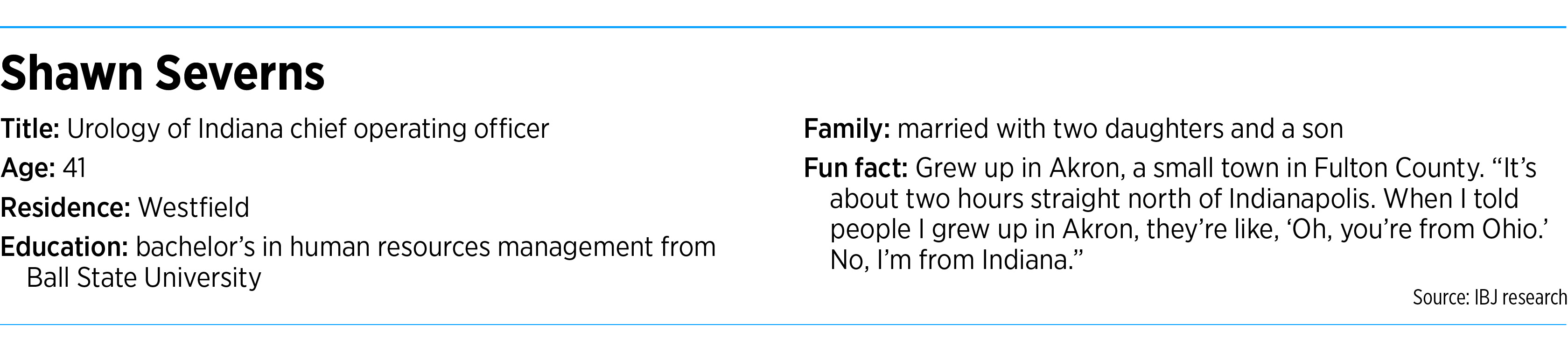
As a subscriber you can listen to articles at work, in the car, or while you work out. Subscribe NowShawn Severns used to work for a law firm, thinking health care wasn’t the field for him. Then about nine years ago, he had the chance to join Urology of Indiana, one of central Indiana’s most widely known physician practices.
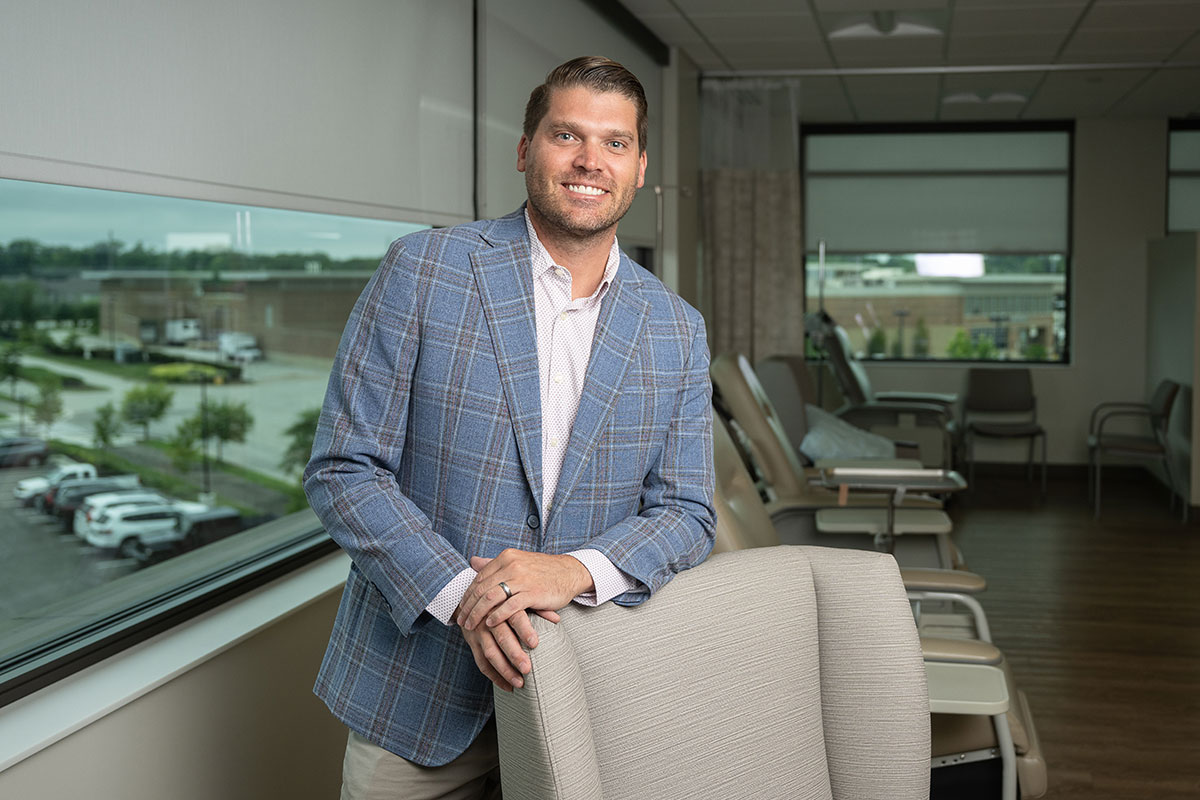
As chief operating officer, Severns oversees 14 offices at 11 sites, including the new Carmel facility on Illinois Street, that treat roughly 900 patients a day.
IBJ talked with Severns about how he balances it all. The interview has been edited for length and clarity.
What was the driving force behind building a new Carmel location?
Our strategy is creating what we call centers of excellence, having a one-stop shop with a multipurpose focus right here in the same building. We’ll have imaging with Northwest Radiology. We have radiation downstairs with [Integrated Cancer Care]. We have men’s health and women’s health. We have oncology here. So it’s not just the urology focus, but it’s spreading out into some of those other subfocal points.
What is the size and reach of Urology of Indiana? Is the new Carmel office considered the practice’s flagship location?
This now is our flagship. Greenwood used to be kind of the flagship. It was a corporate office. That’s where our largest office was that probably had the largest reach at that point, but I think it’s shifted up here to the north side with this new facility. It’s 33,000 square feet, so we can house up to 22 doctors at one time. It allows us to do a lot of things that we haven’t previously done. We have done procedures like MonaLisa Touch [vaginal laser therapy]. We do Xiaflex [treatment] for Peyronie’s disease. We have a procedure suite here that allows us to be very efficient to really work through a number of in-office procedures that we do daily. It was more efficient and bringing everything under one roof.
Does Urology of Indiana own this building?
The doctors of Urology of Indiana own this building, so it’s a separate entity. It’s a real estate entity that only physicians of Urology of Indiana are part of.
How many physicians and advanced care providers [nurse practitioners and physician assistants] practice at Urology of Indiana, and about how many patients do they see each day?
We have about 65 providers. … We’re seeing about 900 patients a day.
What is the profile of your patient base? People typically think of middle age or older men when they think of urology, but give the scope of the conditions you treat.
The general census is probably still correct that it’s 50-plus generally male. We have a very large women’s health presence with overactive bladder, with a lot of urogynecology studies and research that we’re doing to focus on not just that traditional male patient but really getting into the women’s health, as well, and then even into sexual medicine with men’s health, as well, dealing with erectile dysfunction, low testosterone, a number of other factors as well.
Is the men’s health side growing with much in the media about low testosterone?
It’s exploding. It’s something that, I think, has gone kind of unrecognized in the past. Men just felt like, “Hey, you age. This is what you deal with.” I think that there’s a new focus that there’s things that I can do to prevent this. We have a very large men’s health practice that’s predominantly here and down at our Greenwood office.
A few years ago, your practice joined the U.S. Urology Partners network, or USUP. What was the reason behind that move?
We were trying to do a lot. We were expanding quickly. The acquisition happened in December 2022. That was a big help for us. They’ve been great partners. We wanted a mobile PET CT unit. There were other practices under the USUP umbrella that were already doing that, so it helped us with best practices that we basically mimicked. It’s kind of like getting a playbook slid over to you.
Are those sorts of agreements and acquisitions necessary for physician practices to thrive today?
I think so. Recruiting is tough. There’s not a lot of urologists out there. In order to be effective and efficient, you’ve got to play with some of the big partners. There’s a lot of competition out there, particularly with hospitals that have the ability to go out and effectively recruit. This gave us a little bit of a leg up.
What is your relationship with the large local hospital systems around central Indiana?
Finding urologists is tough. It’s one of those specialties where a lot of hospitals are reaching out. We get contacted all the time. We’ve had other smaller [hospitals in the] suburbs reaching out regularly looking for help. We’re in with all big four [Indiana University Health, Ascension St. Vincent, Community Health Network and Franciscan Health]. We’re now in Kokomo as of January of this year, and then we had an acquisition with Summit Urology in Bloomington last year.
You mentioned that there’s a shortage of urologists. How are you dealing with that? Are you working with the IU School of Medicine or others? Are you increasingly looking for more nurse practitioners and physician assistants?
We are trying to align with the number of schools in the surrounding area. When you start recruiting a urologist, you don’t just wait until they graduate from a residency or from their fellowship. A lot of these folks, we’re contacting three or four years in advance trying to create that pipeline and making sure that they’re aware of what it looks like in a private practice like this.
A lot of our recruitment has shifted knowing that [advanced practice providers] are a strong part of the future. We’ve hired nine new APP positions across our offices and have two more that will be filled very soon.
Many of the conditions you treat are private in nature with some, perhaps, hesitant to talk with a physician about them. How does this influence your messaging and marketing efforts?
As far as outreach, that’s difficult, right? As you said, it’s sensitive. We do a lot of Google pay-per-click. We do some radio ads just to make sure that people feel comfortable and understand that they’re not alone. People feel, “I’m one of the few out there.” But as I mentioned, we’re seeing 900 patients a day. I promise you that there’s a lot of other folks out there that are dealing with the exact same issues. Our physicians are used to dealing with these kinds of sensitive situations.
Urology of Indiana also seems to do regular webinars on topics such as men’s health.
That’s something that we do quite a bit, not just with men’s health. We recently hosted one on overactive bladders for women. Those are typically virtual. Everybody has the ability to simply dial in. Nobody knows who you are, and you can get your answers.
Previously you worked at a law firm and have a real estate license. Did you imagine working in urology?
I really didn’t. My mom was a nurse. I saw health care, and I thought, “That’s not something that I will ever end up doing.” But you never know how life ends up. I had a common connection with Britt Moster, who was the CEO at the time [and now is chief development officer for US Urology Partners], and she gave me a call one day and said, “You know, hey, we have an opening as the director of HR. Would you be interested?”
What are some of the common reactions from people when they find out where you work?
Urology of Indiana is a lot more well-known than I thought. When I say Urology of Indiana, almost everybody immediately knows what it is. I was at church and had a Urology of Indiana Yeti to carry my coffee, and I had a number of people say, “Hey, I’ve been there.”•
Please enable JavaScript to view this content.
Editor's note: You can comment on IBJ stories by signing in to your IBJ account. If you have not registered, please sign up for a free account now. Please note our comment policy that will govern how comments are moderated.