
Subscriber Benefit
As a subscriber you can listen to articles at work, in the car, or while you work out. Subscribe Now
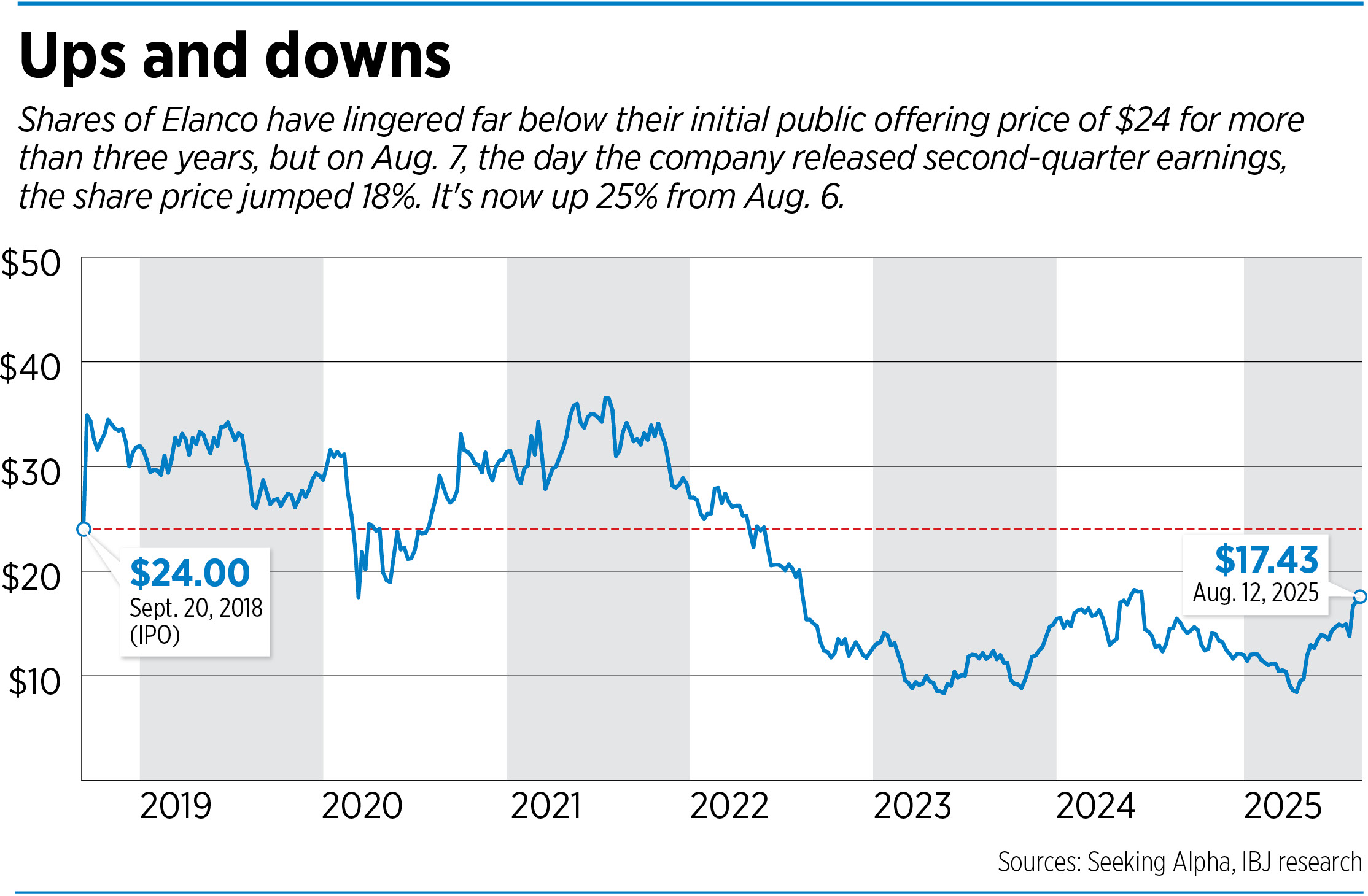
Elanco Animal Health last week released what CEO Jeff Simmons called its best quarterly earnings since its 2018 spinoff from Eli Lilly and Co. Investors are now rewarding the company with a rising share price—up 25% four days after the announcement.
Analysts, too, have reacted positively to news that some of Elanco’s latest products—animal medicines that the company projects will become blockbusters—have had strong sales out of the gate. For the quarter, the company beat analyst expectations and raised its full-year outlook.
As a result, at least two of those analysts have raised their stock price targets. And 10 analysts—up from eight three months ago—have rated Greenfield-based Elanco as a buy, according to The Wall Street Journal.
“This is a long-awaited moment in our strategic trajectory, and I have never been more confident in Elanco’s opportunity to deliver long-term shareholder value and transform animal care,” Simmons told investors during an Aug. 7 call to discuss its second-quarter financial report.
Simmons used the term “long-awaited” in part because Elanco—which makes animal vaccines, antibiotics and other health products for pets and farm animals—has been on a bumpy ride since it became a stand-alone public company.
Elanco has posted more quarterly losses (18) than quarterly profits (12) in its seven-year history and from 2020 to 2023 posted four straight years of annual losses, totaling $2.37 billion.
Elanco’s stock price likewise languished. Priced at $24 at its initial public offering, the stock soared as high as $36.50 a share in July 2021. The price has tumbled since and has remained below its IPO price since mid-2022.
But through the turmoil, Simmons has maintained that the company’s product pipeline would prove successful. And in fact, the company returned to profitability in 2024, posting full-year profit of $338 million.
The good news comes as Elanco prepares to move into a new corporate campus. On Oct. 1, the company will officially open its $200-million-plus campus, which has been under construction since 2022 on the west side of downtown Indianapolis.
The three-building campus includes a six-story administration building along with separate two-story buildings—one devoted to lab space and one for a collaborative space Elanco calls its “crossroads” building.
The campus move-in will mark the official shift of Elanco headquarters from Greenfield to Indianapolis. More than 725 employees will regularly report to downtown Indianapolis rather than Greenfield, Simmons said.
The Elanco campus is an anchor of the planned OneHealth Innovation District, announced in May 2024 as a partnership between Elanco, Purdue University and the Indiana Economic Development Corp. The proposed district aims to be a research and innovation hub for human, animal and plant health sciences.
“We want to create an ecosystem that drives innovation, drives employers and drives the economy of Indiana,” Simmons said of the OneHealth Innovation District.

Potential blockbusters
In Elanco’s second-quarter financial report, Simmons told investors the company now expects to bring in more revenue than it previously predicted.
Elanco’s stock price rose dramatically following that earnings report: Its closing price Aug. 7 was $16.48, up 18% from its $13.95 closing price the previous day. On Tuesday, the last close before IBJ went to press, the price was $17.43.
Elanco’s newest products—including several recently launched in the United States and others expected to launch soon both here and abroad—are a big part of the reason for Simmons’ optimism.
Within what the company calls its “innovation portfolio,” or its group of recently launched products, Elanco has identified six as potential blockbusters. In the veterinary world, a blockbuster is a product that generates at least $100 million in annual sales. (The bar is higher in human health, where “blockbuster” means $1 billion or more in annual sales.)
In the pharmaceutical world—both for veterinary products and those for humans—having blockbusters is important.

George Telthorst, director of Indiana University’s Bloomington-based Center for the Business of Life Sciences, said drug development is expensive by nature because researchers investigate so many prospects that show early promise but don’t pan out in the long run.
So having blockbusters helps subsidize that process, Telthorst said. “It generates revenue that they can reinvest to keep filling their pipeline going forward,” he said.
Among Elanco’s potential blockbusters are Credelio Quattro, a chewable tablet that protects dogs from six types of parasites. The product launched in January and by June had gained 14% of market share from sales through veterinary clinics.
The company said it’s also seeing good results from another potential blockbuster: Zenrelia, a dermatology treatment for itchy dogs. The product launched last September and had captured 4% of U.S. market share by June, up from 2% in March, with U.S. sales of the product more than doubling from the first quarter of this year to the second quarter.
Part of what makes these products so promising, Simmons said, is that they treat common problems. “It’s not like these are niche products in rare disease areas,” he said. “These are in big areas.”
Based in large part on the success of its innovation products, Elanco last week raised its full-year 2025 revenue guidance.
The company said it expects to earn $720 million to $800 million in innovation revenue this year. That’s an increase of $60 million from the guidance it issued in May, when its expectation was for $660 million to $740 million in innovation revenue.
Elanco was much more modest in its upgraded guidance for overall revenue. The company said it now expects full-year revenue of $4.57 billion to $4.62 billion, up about 1% from the guidance it issued three months ago.
Analysts’ reactions
Some analysts appear to also see Elanco as a company on the upswing.
“This business clearly has momentum at a time when pet owners appear to be devoting more wallet share to animal health,” Jefferies analyst Keith Devas wrote in an Aug. 8 report.
According to the American Pet Products Association’s 2025 State of the Industry Report, 94 million of the country’s households own at least one pet—an increase of 15% over 2023. Pet owners are expected to spend $157 billion on their animals this year, up from $147 billion in 2023. The spending figures include everything from food and supplies to veterinary care, medicines, grooming and other expenses.
Nearly half of Elanco’s $4.4 billion in revenue last year, or 48%, came from its pet health products.
Devas increased his price target on Elanco’s stock to $19, up from his previous target of $18.
Stifel Financial Corp. analyst Jonathan Block also raised his price target on the stock last week by $1—from $17 to $18—and noted in his report that “the stock remains our favorite in animal health.”
“Even with the recent stock appreciation, valuation remains compelling,” Block wrote.
He is forecasting a 2026 mid-single-digits percent increase in the company’s revenue and a low-double-digit percent increase in per-share profit. Block also noted, however, that aside from its innovation products, Elanco expects its base business revenue to be in the range of flat to a 1% drop for the full year.
In his report on Elanco last week, J.P. Morgan analyst Chris Schott also noted the company’s newest products as bright spots for the company.
Schott wrote that he was “somewhat cautious” about Zenrelia but more positive on both Credelio Quattro and on Elanco’s portfolio of products for farm animals. “And net-net, we see revenue growth at Elanco accelerating in the coming quarters, which should be well received by investors,” Schott wrote.

Some headwinds remain
Elanco does still face challenges.
The company has been working to reduce its debt in recent years. As of June 30, Elanco had $3.4 billion in net debt and a net leverage ratio of 4.0x. The company calculates its net leverage ratio by dividing its debt by its adjusted earnings before interest, taxes, depreciation and amortization, also known as EBITDA.
Elanco said it aspires to reduce its leverage ratio to below 3.0x over time.
The company’s debt situation is markedly improved from two years earlier, when it reported net debt of $5.8 billion and a net leverage ratio of 5.9x.

“It appears that they are working through their debt—and that’s positive because that frees up more money to do other things,” said David Farber, an associate professor of accounting at the Indiana University Kelley School of Business in Indianapolis.
But several analysts noted that if Elanco can’t further reduce its leverage, the debt represents a risk for the company.
Analysts also noted risk factors related to the potential for regulatory restrictions or delays in launching products, competitive risks from other companies and macroeconomic uncertainties, including tariffs.
In last week’s earnings call, Elanco said it is projecting $15 million in potential benefit from foreign currency exchange rates this year, which would offset potential risk of tariff escalation and an economic slowdown.
Another risk for Elanco, Farber said, is the same one all publicly held companies face: constant scrutiny from analysts and investors who want to see revenue growth.
This scrutiny can be especially tough for pharmaceutical companies like Elanco, Farber said, because of the long-term nature of the development process.
“You’re making big investments in research and development that won’t pay off for many, many years,” he said. “Developing drugs is really, really hard.”•
Please enable JavaScript to view this content.
Editor's note: You can comment on IBJ stories by signing in to your IBJ account. If you have not registered, please sign up for a free account now. Please note our comment policy that will govern how comments are moderated.