
Subscriber Benefit
As a subscriber you can listen to articles at work, in the car, or while you work out. Subscribe NowElanco Animal Health CEO Jeff Simmons is getting settled into his unadorned cubicle on the second floor of the company’s just-opened downtown Indianapolis headquarters campus following its move from Greenfield.
The office is simple, Simmons says, because he doesn’t believe in big executive offices or reserved parking spots. “We don’t run around with the org charts and big titles,” he said of the maker of medicines for pets and farm animals.
Yet Simmons, CEO since 2018, is clearly the top dog at Elanco.
He navigated Elanco’s spinoff from Eli Lilly and Co. to become an independent public company. Then in 2020, Simmons guided the expensive acquisition of Bayer Animal Health. And following a bidding round among states, Simmons made the call to keep Elanco in Indiana and develop what he hopes will be an animal health and life sciences hub on the former General Motors stamping plant site.
He sat down in Elanco’s new headquarters to talk with IBJ about the company’s strategy and its battle through a falling stock price (which is up 150% since its low but still 40% lower than its high) as well as his youth in the rolling vineyards of central New York. This conversation has been edited for length and clarity.

What does it mean for Elanco to be moving into your new downtown campus?
We said the day that we put the shovel in the ground, “It’s not about the building, it’s what we’re building,” and I really believe it’s a convergence of 70 years of history with probably the most exciting next chapter in our company’s history. This building symbolizes one of the most [historic] moments of our seven decades.
It isn’t as much about, “Oh, we got a headquarters,” as much as to all our 9,500 employees, what we’re doing and where we are as a company.
Given this long history and Elanco’s struggles since its IPO, where is the company in its turnaround effort?
We are breaking through. There is no question since our IPO, we were determined, coming out of Lilly, to be an independent animal health company that can reach the world’s animals and do it in a way that nobody else can do. That vision has never disappeared. It has truly been our vision for the seven years that we’ve been an independent company, and it’s gotten us through three pandemics—COVID, African swine fever and bird flu—recessions and challenges on interest rates. The entire Elanco body has been focused just on that saying: “We can make animals’ lives better.” We touch almost every life every day, between pets, protein, the planet.
We’re just finishing our fifth five-year plan. … The clock on the wall is 97 days to go in this five-year plan. This is about growth, innovation and cash. Our second-quarter earnings that we reported just recently [were] the best demonstration. We’ve had eight quarters of growth, 8% growth. Growth is accelerating.
Innovation is really the story out on Wall Street right now—six blockbusters [Elanco medications totaling more than $100 million in sales after discounts, returns, etc.]. There’s only three to four dozen blockbusters in the entire industry history. We probably only put seven or eight blockbusters up in our seven years. We’ve got this basket of innovation that’s contributing $720 million, $800 million to our company, and will drive the next few years of really accelerating growth and then cash.
We needed to pay down the debt from the Bayer acquisition. And we’ve accelerated debt paydown.
We’ll open this building, and we’ll transition from Elanco 2025 to our sixth five-year plan, Elanco 2030. We’re extremely excited about the relevance of the company.
How do you expect the move to change the company’s profile and its culture … including the OneHealth Innovation District partnership with Purdue University and places for startup-business incubation?
We want this to be a place where people come and can have the flexibility … can have the connectivity and create what we think is one of the greatest cultures of any company, definitely in our industry. Our goal is to be a pillar company in Indiana that creates great opportunities and jobs but creates a culture that people run to.
We talk about three P’s. I talked to every new employee class. I talked to 22 new employees on Monday. It’s the people. People have got to want to be here. They love the industry, and they love animals.
It’s potential. I say you get development in dog years: What you get here in one year, it takes seven years in other companies. People are given more responsibility sooner, and you develop faster.
The other is purpose. When you serve farmers, vets, when you’re in the protein business and the pet business, you’re talking about food and companionship and better nutrition.
What we’re going to do is create an innovative ecosystem, with Purdue University moving here, with a scale-up lab, with a vet clinic that we’ll have on site, with an incubator that will be here, with a fund that will invest innovators.
What is Elanco’s work-from-home policy? Have you tried to get more people back in the office with the new headquarters?
We need to enable and allow flexibility, and we need connectivity. We know when we create community and connectivity, ideas percolate. People get more engaged.
Over 35% of this organization is under 35 years of age. We’re a young organization, and we believe this earlier generation needs community.
But at the same time, we know that we need flexibility. Someone based here in Indiana, we want you to be in [the office] around 30 days a quarter.
Elanco’s Credelio Quattro recently hit blockbuster status in record time. Did that performance surprise you? What does it say about the potential growth areas for the company?
I’ll point to the building over here [he gestures to one of the new buildings]. This will be our Global Center for Innovation, and this will incubate new ideas. It will develop drugs all the way to putting them in a box.
Cordelia Quattro is the best example of giving a customer, a pet owner, something that they don’t have. This is one of the broadest spectrums, most effective products in the biggest animal health market, which is the oral parasiticide for dogs and the cat market. … Palatability of pills is very important for animals. That’ll be done here. We’re going to have a lot of Cordelia Quattro come out of this lab right here that are going to serve 100 countries and 20 species of animals.
Where do you see future opportunities for Elanco?
On the livestock side—ultimately, this is about protein. Whether it’s what’s going on in Washington or everywhere in the world, carbs are down, sugars down, processed foods are down. What’s up? It’s animal protein: meat, milk and eggs. Cottage cheese is up 50% over the last five years. That’s our customers’ product.
We do it with productivity, with food safety and [are] doing it with less environmental footprint. This next generation that’s coming back to animal protein wants to make sure the animals are taken care of, and the environment is taken care of. That’s the sweet spot for Elanco.
The blockbuster before Cordelia Quattros was a product called Xperia [a medication to reduce ammonia gas emissions from cattle]. It helps the environment, and it creates more affordable [beef] and more accessibility to beef as an example.
Have you tested GLP-1s [a class of obesity medicines used in humans] in dogs? Golden retrievers?
As I said, the same problems for humans are the same opportunities for pets.
But is that something that’s in your pipeline?
We haven’t disclosed a lot of details, but you can assume we’re chasing and targeting certain things that are critical to that aging path.
Switching gears, you grew up on a wine-producing vineyard on Keuka Lake in upstate New York. What was that like?
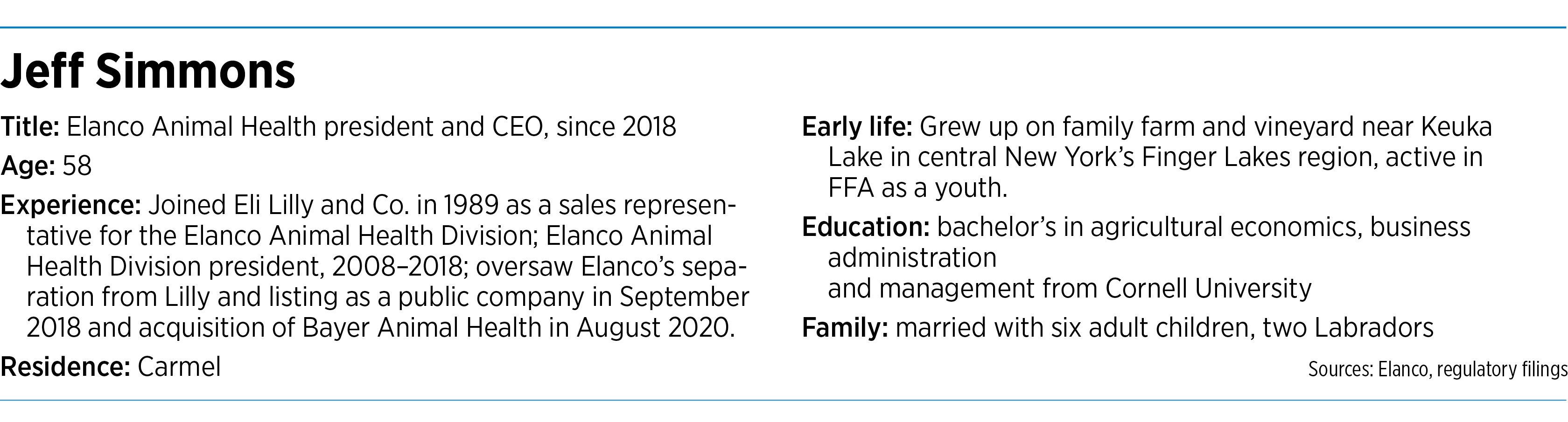
The Simmons family had many generations of dairy and … my dad left a dairy farm and started a grape vineyard. But we always had animals. I spent my entire life as a farmer—kind of a poor, struggling, challenging farmer but in love with the land and animals.
My dad said everybody has to leave for two years, and you can come back. I went to Cornell, studied agriculture and said, “All right, I’m going to do my two years.” I chose Elanco. What a blessing. I fell in love with this company.
You studied agriculture at Cornell University. What impacted you most in your time in Ithica, New York, especially related to agriculture and your career?
There’s no question, the power of science and the significance of science … in agriculture, whether it’s plants or animals, can highly impact the world. I’m a big believer that without science, you have no real North Star.
What is your daily routine? Is there time to exercise or unplug?
We really encourage this. In this facility, we’re going to have a wellness center with a gym and with a community exercising and a nutritionist … a whole life approach. We’ve got [employee resource groups], even on the spiritual side.
I’m a big believer to say if it’s six o’clock in the morning, I’ve got a drop of sweat dropping into my Bible, I think it’s going to be a good day. Exercise. Get up early, being able to have a little personal time, a little reflection time, preparation time, spiritual time, and it’ll be a good day.
You’ve been CEO during some tough times. Elanco’s stock price, while up recently, has way underperformed the S&P 500 over the last five years. Have you taken any lessons from past struggles?
The lesson learned is, realities can compound. Nobody predicted COVID. Nobody predicted high interest rates when we bought Bayer. The biggest decision was right after IPOing, we did a leveraged buyout of Bayer, and we knew that was going to create a lot of doubt. We knew we had to do that—we wouldn’t be here today if we didn’t do that. It was a tough decision that created a lot of headwind.
The lesson I’ve learned is, we’ve got to expect that the realities can be harder than you do expect, and you need to plan accordingly and promise accordingly.
Last question: Do you have pets?
Laken (yellow Lab) and Lilly (black Lab)! They’re users of Cordelia Quattros, and the yellow lab is one of the best Zenrelia case studies. We had an itching dog for four years, and really it’s been the happiest dog since.•
Please enable JavaScript to view this content.
Editor's note: You can comment on IBJ stories by signing in to your IBJ account. If you have not registered, please sign up for a free account now. Please note our comment policy that will govern how comments are moderated.