
Subscriber Benefit
As a subscriber you can listen to articles at work, in the car, or while you work out. Subscribe NowSister Rosetta Tharpe already had written and recorded “Strange Things Happening Every Day,” arguably the first rock ’n’ roll song, when she recruited Marie Knight as a singing partner in 1946.
“Strange Things Happening Every Day” crossed over from its gospel roots to the R&B chart in 1944, but no one was crediting Arkansas native Tharpe as the “godmother of rock ’n’ roll”—a title that wasn’t cemented until her induction into the Rock & Roll Hall of Fame in 2018.
In the mid-1940s, Tharpe worked to keep pace with gospel icon Mahalia Jackson. Tharpe viewed Knight as someone to help in that effort, and the play “Marie and Rosetta,” which opens Oct. 28 at the Indiana Repertory Theatre, depicts their first rehearsal in advance of a tour.
“The focus of this play is the relationship between the two musicians and how they found that collaboration that was so electric for both of them,” said Cara Hinh, associate artistic director at the Indiana Repertory Theatre. “The play focuses on navigating how to be not only musicians but collaborators, period.”
Tharpe and Knight applied vocal harmonies and call-and-response excitement to signature tunes such as “Didn’t It Rain” (1947) and “Up Above My Head, I Hear Music in the Air” (1948) across a handful of years working together.
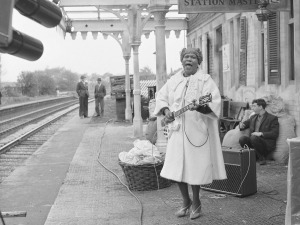
 Modern interest in Tharpe, who died in 1973 at age 58, is high. Earlier this year, Amazon MGM and Live Nation Productions announced separate films to tell her story. The Amazon MGM version unveiled singer-rapper Lizzo in the role of Tharpe, while the Live Nation version will be written by actress Aunjanue Ellis-Taylor (known for “King Richard” and “Nickel Boys”), with Mick Jagger serving as a producer.
Morgan Stevenson, music director for the IRT’s production of “Marie and Rosetta,” said appreciation for Tharpe is overdue.

“She is definitely one of those unsung heroes, as well as Marie Knight,” Stevenson said. “I have two degrees in music education, and I’ve never seen Sister Rosetta Tharpe’s name in a book that we had to learn from. And one of the schools I went to for undergrad is a historically Black college and university.”
I Made Rock ’n’ Roll is an initiative founded by Indianapolis-based creative advocacy agency GangGang to elevate awareness of rock music’s Black architects. Among towering talents Little Richard, Chuck Berry, Bo Diddley and Fats Domino, the contributions of Tharpe are likely the most overlooked.
GangGang co-founder Alan Bacon said an “erasure” of history has kept Tharpe out of mainstream consciousness, echoing a question asked in 2019 by NPR essayist Caryn Rose: “Why is her influence minimized to the point that it’s barely allowed to exist?”
“It was a time of society when a lot of things were being appropriated, and she just was not in the best position to really maintain her level of credibility,” Bacon said. “On the flip side, she was able to maintain credibility and be celebrated for her contributions to gospel.”
Stevenson said Tharpe was squeezed out of the rock history narrative because she wasn’t white and she wasn’t a man.
‘Sublime and splendid’
The recording most often cited as the first rock ’n’ roll song is 1951’s “Rocket 88” by Mississippi-based Jackie Brenston and his Delta Cats. Brenston said the song was more or less a rewrite of “Cadillac Boogie,” a 1948 tune by California’s Jimmy Liggins and his Drops of Joy.
Both songs arrived years after Tharpe’s “Strange Things Happening Every Day.”
Tharpe was 6 years old when she first sang and played guitar in Chicago churches with her mother, gospel artist Katie Bell Nubin.
“If you think about guitar playing, it can be very percussive,” said Stevenson, the play’s music director who’s based in Chicago. “She was like a one-man band, to be honest. Whether she had a guitar with her or a piano there, she was always able to kind of bring the spirit in the room.”
The internet is home to ample video evidence of Tharpe performing for concert audiences and on TV shows. Bacon said her flair and showmanship influenced countless rock stars.
“You can see the author of some of the things we love most about rock ’n’ roll,” he said.
Berry, known for signature tunes such as “Maybellene” and “Johnny B. Goode,” is widely reported to have said his entire career was “one long Rosetta Tharpe impersonation.”
Bob Dylan offered this description of Tharpe on his “Theme Time Radio Hour” show that aired on the SiriusXM satellite platform from 2006 to 2009: “She was a big, good-lookin’ woman and divine, not to mention sublime and splendid. She was a powerful force of nature. A guitar-playin’, singin’ evangelist.”
A cultural movement
“Marie and Rosetta” will be presented Oct. 28 to Nov. 23 on the upstairs Janet Allen Stage at the IRT, 140 W. Washington St.
The theater is about a six-minute walk from Hilbert Circle Theatre, 45 Monument Circle, where Tharpe performed in 1943 as a featured member of Lucky Millinder’s R&B orchestra. The other vocalist in Millinder’s ensemble was Trevor Bacon, who grew up in Indianapolis and was a great-uncle of GangGang’s Alan Bacon.
The Ink Spots, the popular vocal group founded in Indianapolis in 1934, headlined the show.
“There’s a lot of our Indiana history that’s woven into this greater tapestry of a story we keep uncovering,” Bacon said. “You can see how we’re connected, with degrees of separation, to one of the biggest cultural movements ever recorded: rock ’n’ roll.”
Although “Marie and Rosetta” was written by Cleveland-based playwright George Brandt, the story has an Indiana connection. Brandt traveled to southern Indiana in 2015 to develop the play as part of the New Harmony Project workshop series. The show premiered at New York’s Atlantic Theatre Company in 2016.
Hinh, an Indianapolis native who was hired by the IRT in 2024, said the company hired a casting director and auditioned dozens of people for the roles of Tharpe and Knight.
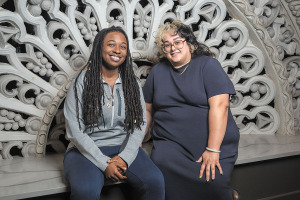
Dallas-based actor Cherish Love portrays Tharpe, while Knight is played by New York-based actor Jaela Cheeks-Lomax.
Casting “was the hardest thing,” Stevenson said. “Everyone can be amazing individually. But what does that pair look like? It was, ‘OK, let’s see how these two can work off of each other.’”
A special relationship
Hinh said the chemistry experiment between actors Love and Cheeks-Lomax is succeeding during rehearsals.
“I feel like the play is very charming,” Hinh said. “It captures the thing of Sister Rosetta being the entertainer who’s able to charm the room. It’s great to find Cherish being able to charm Jaela, with Jaela showing that spark of meeting her Beyonce of the time. Finding that was really important and special.”
Knight, who died in 2009 at age 89, reached the Top 40 of Billboard magazine’s R&B chart with a solo recording of “Cry Me a River” in 1965.
In a 2007 biography of Tharpe titled “Shout, Sister, Shout!: The Untold Story of Rock‑and‑Roll Trailblazer Sister Rosetta Tharpe,” author Gayle Wald wrote that Tharpe and Knight had a romantic relationship.
Hinh said that aspect of their lives doesn’t dominate the “Marie and Rosetta” script, but it’s present.
“The play touches on the fact that this was an incredibly special relationship, and it was singular,” Hinh said. “And it’s a little gay.”
“Marie and Rosetta” follows IRT productions of “Nina Simone: Four Women” during the 2024-2025 season and “Fannie: The Music and Life of Fannie Lou Hamer” during the 2023-2024 season.
Hinh said the productions devoted to Tharpe, soul singer Simone and civil rights activist Hamer aren’t coincidental.
“The IRT wants to be a space where we can honor people whose stories maybe didn’t get lifted,” Hinh said. “It’s become important to us to be able to give flowers to people, especially Black women, who have been overlooked in history.”•
Please enable JavaScript to view this content.

Editor's note: You can comment on IBJ stories by signing in to your IBJ account. If you have not registered, please sign up for a free account now. Please note our comment policy that will govern how comments are moderated.