
Subscriber Benefit
As a subscriber you can listen to articles at work, in the car, or while you work out. Subscribe NowEli Lilly and Co. this month launched a public awareness campaign called Brain Health Matters, which features actress Julianne Moore urging people to be proactive as they age to lower their risk of dementia, including Alzheimer’s disease.
Moore won an Oscar for her portrayal of a middle-age professor stricken with early-onset Alzheimer’s disease in the 2014 movie “Still Alice.” Now, she’s the face of a campaign encouraging people to ask their doctors about risk factors for dementia and to build a cognitive health plan.
Lilly featuring her in a public campaign is the latest example of big drug companies using their clout to promote health messages to targeted audiences in the public and health care industry. Its advice aligns with that of health care professionals and advocates focused on dementia, and the campaign comes as the drugmaker seeks to expand its own treatments for Alzheimer’s.
The subject of brain health and the central Indiana resources focused on it will be discussed at an IBJ Power Breakfast on Wednesday.
While Lilly’s campaign makes no mention of the Indianapolis-based company’s new Alzheimer’s disease drug, Kisunla (donanemab-azbt) is FDA-approved for the treatment of early symptomatic Alzheimer’s disease and has ongoing clinical trials focused on early treatments. According to clinical data released in July, Kisunla showed growing benefit over three years in early symptomatic Alzheimer’s disease.
Brain Health Matters (at brainhealthmatters.com) includes TV, digital video, cinema, display advertisements and social media as well as an information campaign that targets health care professionals. The company declined to say how much it is spending on the campaign.
The campaign underscores the current limits of available treatments, the proactive care people who are starting to experience cognitive problems can take and the importance of providing resources for primary caregivers.
“Lilly has really been at the forefront of Alzheimer’s research, and so this campaign is truly built on that legacy,” said Laura Steele, senior vice president of Lilly’s U.S. Neuroscience Business Unit. “It’s shifting the focus toward early intervention and proactive brain health.”
She described the campaign as a “timely call to action,” which focuses on encouraging people to adopt healthy lifestyles, undergo cognitive assessments and discuss brain health with their doctors. In the campaign, Lilly notes that Alzheimer’s disease can begin as early as 20 years before symptoms appear.
“As our population ages, the need to prioritize brain health has really never been more urgent,” Steele said. “The goal is empowerment through education.”
Lilly’s campaign has already attracted significant media attention, being featured by People magazine and on NBC’s “Today” show.
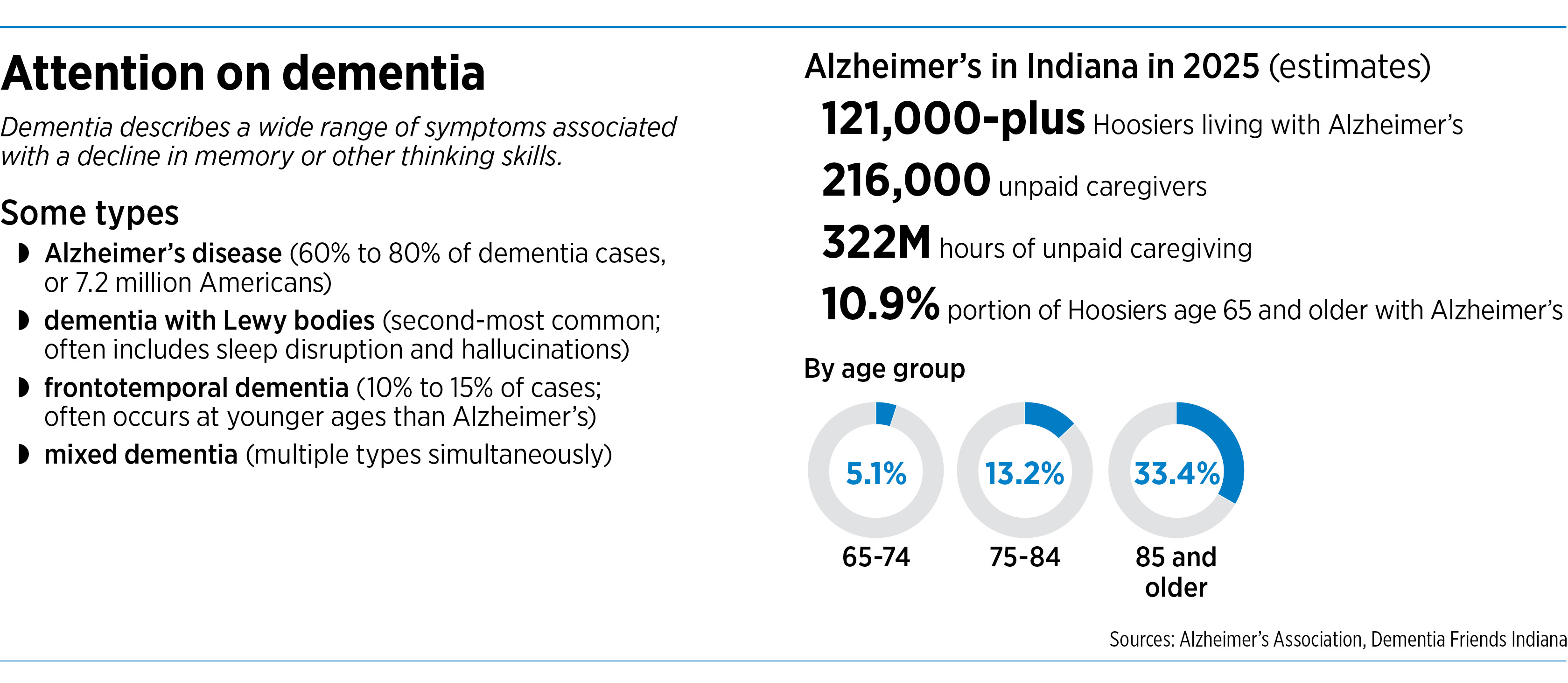
More than 7 million Americans are living with Alzheimer’s, with the prevalence projected to increase to almost 13 million by 2050, according to the Alzheimer’s Association, a Chicago-based nonprofit focused on support, research and care related to Alzheimer’s. In Indiana, more than 121,000 people age 65 and older are living with Alzheimer’s.
Lilly said the campaign particularly seeks to increase awareness and action among women, who account for almost two-thirds of Alzheimer’s disease diagnoses.

Dr. Jennifer Carnahan, a geriatrician who focuses on primary care, estimated that about 60% of her patients have some form of cognitive impairment.
But scientific advancements—such as Lilly’s drug—have given her more optimism for effective treatments than she had a decade ago, she said.
“Absolutely, there’s been progress,” said Carnahan, associate professor of medicine at the Indiana University School of Medicine and a researcher with the IU Center for Aging Research at Regenstrief Institute. “It’s exciting that there’s something that seems to be making some difference. It’s not a cure.”
But she added that most of the treatments available now focus on Alzheimer’s.
“There’s all these other types of dementia that we still don’t have great treatments for,” Carnahan said.
The behaviors the Lilly campaign promotes include staying physically active, eating a heart-healthy diet, maintaining an active social life and exercising the brain.
While Lilly is urging people to engage in those activities to prevent or delay the onset of dementia, Carnahan said they’re also important for patients already experiencing it.
“Things that are healthy for your heart are healthy for your brain,” she said.
Her dementia patients are often determined to live at home as long as possible.
“It’s really important to have this ‘use it or lose it’ mentality,” she said. “The best way to stay independent is to make sure you stay active.”
She recommends that her patients with mobility problems use a cane or rolling walker. Factors such as hearing loss need attention, she added, because they can cause patients to perform poorly on cognitive evaluations.
The Dementia Friends Indiana initiative, which is administered by Indianapolis-based nonprofit CICOA Aging and In-Home Solutions, offers programs such as Memory Cafe gatherings around the state. The events are designed for dementia patients living at home and their caregivers to gather for activities in a safe and comfortable atmosphere.

“There’s always an education piece with it. The community can be invited in so that they’re educated and can interact with the folks to hopefully reduce the stigma that these are [not] regular people,” CICOA CEO Lisa Schneekloth said. “We don’t identify them by their disease.”
The Dementia Friends website also encourages people to talk with their physicians about brain health, such as asking for “a cognitive assessment to help establish a baseline of my cognitive health.”
One marketing expert said corporations, especially drug manufacturers like Lilly, face a balancing act when raising awareness for health.
“It’s actually a pretty thin line, and it’s really hard to walk,” said Sarang Sunder, associate professor of marketing at the Kelley School of Business at Indiana University. “Obviously, there are bottom-line implications to this whatever the advertising campaign is, but you want to also be authentic toward whatever the cause you are marketing.”
Lilly’s Steele emphasized that Brain Health Matters is not about promoting a product.
“It’s about raising awareness and breaking the stigma that exists with Alzheimer’s disease, and it’s about helping people understand that brain health is just as important as heart health or physical fitness,” she said.•
Please enable JavaScript to view this content.
Editor's note: You can comment on IBJ stories by signing in to your IBJ account. If you have not registered, please sign up for a free account now. Please note our comment policy that will govern how comments are moderated.