
Subscriber Benefit
As a subscriber you can listen to articles at work, in the car, or while you work out. Subscribe Now The Pacers wrap up another preseason schedule on Friday in San Antonio, which will bring roughly equal amounts of relief, frustration and anticipation. They’ve played well enough to provide optimism for the regular season, and some of their younger players are showing progress. But questions remain. Oh, and they’ve lost a player to injury.
In other words, a typical preseason experience.
NBA preseason schedules have come a long way. A long way closer to extinction, to be exact. Teams once played about as many exhibition games as they wanted. The Cincinnati Royals, for example, played 14 of them in 1966, starting in Duluth, Minnesota, winding through the West and finishing in Honolulu. It was a way to earn desperately needed income and expose fans in remote outposts to the league’s product.
There’s less motivation to get out and spread the gospel today. Virtually every NBA game is available on television if a fan wants to see it badly enough, and teams prefer to stay closer to home for the sake of convenience and cost-saving. Teams play just four games now, and starters usually sit out some of them.
The Pacers’ preseason history is full of drama, pleasant and otherwise, with weird and wonderful occurrences. Their overall record in the games that don’t count but sometimes matter was 213-188 heading into this season, including a 29-40 mark in the ABA. One certainty is that a preseason record doesn’t necessarily predict the future. The Pacers’ three ABA championship teams in 1970, ’72 and ’73 had a combined preseason record of 8-18. The team that went 26-56 in the 1983-84 season was 5-3 in exhibition games, offering a ray of hope that faded quickly.
Let it be known the first preseason game in franchise history was played in 1967 at St. Joseph’s College in Rensselaer, where the Pacers had conducted their training camp. They followed with games in high school gymnasiums in New Castle, Lebanon (the old one, opened in 1932), Nappannee, Scottsburg and Madison. In later ABA seasons, they played at Southport High School in Indianapolis, Shelbyville, Lebanon (the newer gymnasium still in use), Kokomo, Orleans, Gary, South Bend, Muncie, Columbus, Seymour, Lafayette (at Jeff High School), West Lafayette (Purdue’s Mackey Arena), Evansville, Fort Wayne, Anderson, Marion, Terre Haute, Vincennes, Bloomington and Carmel High School.
It might seem bizarre now, but future Hall of Famers such as Connie Hawkins, Rick Barry and Louie Dampier played competitive professional games in Indiana high school gyms.
“We enjoyed doing all that,” ABA Pacers guard Freddie Lewis recalls. “It was a way of communicating with the people in those towns. That’s how we got the fans.”
Rick Mount, who played two games as a professional in his former high school’s gymnasium, agrees.
“We didn’t care,” he said. “We were getting paid. We had to do what they said.”
For some high schools, the affairs were a fundraising opportunity, a step up from donkey basketball or a bake sale. The Pacers’ game against the Kentucky Colonels at Orleans High School on Oct. 10, 1968, for example, was sponsored by the local Jaycees who wanted to improve the local Little League fields. An announced crowd of 2,233 watched the Pacers win, 117-99, so hopefully there was enough profit to buy a rake or two.
The NBA grew out of high school gyms in the 1980s, but teams did have to venture far and wide for a couple of more decades. Rik Smits, for example, played exhibitions in Charlottesville, West Virginia; Wichita, Kansas; Tampa, Florida; Pensacola, Florida; Indianapolis, Cincinnati and Oklahoma City as a rookie in 1988.
“I didn’t even realize that,” he says today. “I don’t remember any of those cities.”
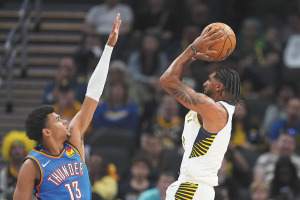
Quite a show
Some of the Pacers’ preseason games, no matter where they were played, were significant beyond the result, either financially or on the scoreboard.
Barry, who had to sit out the first ABA season after jumping from the NBA’s Golden State Warriors, made his league debut for the Oakland Oaks in a preseason game against the Pacers at the Fairgrounds Coliseum on Oct. 3, 1968. He made a favorable first impression by scoring 51 points and grabbing 15 rebounds, but the Pacers won, 141-131, before 7,889 fans, a record for an ABA exhibition.
Lewis scored 44 points for the Pacers, hitting 17 of 30 field goal attempts. That remains the franchise single-game preseason scoring record, unlikely ever to be broken because established players haven’t played more than a couple of quarters in preseason games for decades. Bennedict Mathurin, for example, was on a roll in the Pacers’ preseason game with San Antonio on Monday, scoring 31 points in 23 minutes, but none of the starters played more than 24 minutes, as usual. Unless a Pacer can score more than 44 points in two quarters, Lewis’ record is safe.
The Pacers and Oaks played again the following night at New Castle High School. Barry scored 42, and the Oaks won. They met a third consecutive time the following night at Shelbyville High School, and Barry scored 48 in a 147-138 Oakland victory. He averaged 47 points on the three-game swing, hitting 45 of 46 free throws.
Three years later, the Pacers played the most anticipated preseason game in franchise history against the New York Knicks. Any preseason game against an NBA team was a big deal at the time for ABA fans, an opportunity for the upstart league to tweak big brother’s nose. More than that, the Pacers and Knicks had won league championships in 1970, so it was viewed as a sort of basketball World Series, although a year delayed.
The game drew 9,479 fans to the Coliseum at the Indiana State Fairgrounds, a few hundred beyond its capacity even though the game was televised by Channel 13. The coaches and some of the players didn’t share the fans’ enthusiasm, however. Rather than a showdown, a game to prove a point, it came off as just another exhibition. Both Pacers coach Bob Leonard and New York’s Red Holzman played their starters the first and third quarters and let the reserves handle the rest of the game, although Holzman fudged on that in the end to get the win.
The Knicks led by 11 points early in the fourth quarter, but the Pacers bench—including Don Sidle (who finished with 17 points), Mount (16), Darnell Hillman, Earle Higgins and Marv Winkler—produced a comeback that convinced Holzman to play future Hall of Famers Walt Frazier, Willis Reed and Dave DeBusschere for the final three minutes to pull out a 98-96 victory.
Some Pacers fans were screaming for Leonard to return his starters as well, but he stuck with the reserves who made the game close. Afterward, Frazier was generous, praising Mount’s defense and Bill Keller’s quickness.
“I don’t see any reason why the Pacers couldn’t be a great NBA club,” he said. “We knew they were good, and they proved it.”
Which was exactly the sort of confirmation fans were hoping to get out of the game.
The first game played at Market Square Arena, on Sept. 28, 1974, was memorable, as well. A capacity crowd of more than 17,000 watched the Pacers defeat Kareem Abdul-Jabbar and the Milwaukee Bucks, 118-115, in the preseason opener—the largest crowd ever to watch a basketball game in the city.
Another capacity crowd turned out a year later at MSA as the Pacers prepared for what turned out to be the final ABA season. George McGinnis, coming off a season in which he shared league MVP honors with Julius Erving, had jumped from the Pacers to the Philadelphia 76ers, tripling his salary. His return as a 76er was an emotional occasion for all concerned. According to newspaper reports, 99% of the fans gave him a standing ovation in appreciation of all he had accomplished with the Pacers and understanding the logic of his business decision. The other 1% booed him for bailing on his hometown.
Philadelphia, playing its third game in three nights, won in two overtimes.
“It’s hard to explain the way coming back felt,” McGinnis said after contributing 27 points, 22 rebounds, six assists and three steals in 44 minutes. “It was a strange feeling that I can’t describe. I’m not a Pacer anymore, but I’m still a Pacer fan.”
The last game played at MSA was an exhibition, as well. With a new fieldhouse, then called Conseco, undergoing final preparations to host the regular- season opener, the Pacers played Utah on Oct. 22, 1999, before a sellout crowd.
The Pacers won, 97-65. Jeff Foster scored the last basket, a breakaway dunk with 6.8 seconds left. Larry Bird, aware his friend Leonard had coached the first Pacers game in the arena, took note of the symmetry of it all.
“A hillbilly coached the first game here and a hillbilly coached the last,” he said.
Preseason mishaps
Weird things once happened with regularity in the preseason, a contrast to today’s rather mundane affairs. A major fight broke out during a game at Lebanon in 1969 between the Pacers’ newly acquired Spider Bennett (who was cut before the season began) and Carolina’s Randy Mahaffey while they were lined up for a free throw attempt. Eight technical fouls were called, and four participants, including Leonard, were ejected.
“It would have to be regarded as the most unique exhibition game in the American Basketball Association’s short history,” The Indianapolis Star reported. Carolina won, by the way.
Leonard was ejected when the two teams met the following night in Gary, too. Which wasn’t all that unusual. Chicago Bulls coach Dick Motta and guard Jerry Sloan were kicked out during the first quarter of a game at the Coliseum in 1973. Later in that preseason, Boston coach Tommy Heinsohn was ejected in the third quarter but refused to leave. He sat in a row behind the bench and coached from there.
“What can we do?” referee Joe Bavetta said afterward. “Keep calling technicals until he leaves or forfeit the game? That would make a farce of it.”
The worst that can happen in the preseason, however, is a major injury. The Pacers have suffered their share of those.
Guard Kevin Joyce had what turned out to be a career-ending injury in the second quarter of a preseason game in Fort Wayne when he tore ligaments in his left knee in 1976.
Rookie Austin Croshere broke his left hand in his first preseason game in 1997 when he was smacked while going up for a rebound basket against Cleveland in Columbus, Ohio.
Rookie Jonathan Bender broke his left hand in his first preseason game against Denver two years later.
Anthony Johnson broke his right hand in the seventh preseason game against Memphis in 2004. Afterward, Reggie Miller vented his frustration with the length of the exhibition schedule.
“I don’t know why we play eight games,” he said. “It’s ridiculous. It’s stupid. I know it generates revenue, but it’s too many games.”
The preseason gods must not have been pleased, because Miller broke his left hand in the eighth and final exhibition against Denver three nights later.
The NBA continued playing eight preseason games for the next four years, then gradually pared the schedule. It has played four since 2021 and is likely to play fewer in seasons ahead.
But that won’t necessarily limit injuries. Just ask T.J. McConnell, who pulled a hamstring in the Pacers’ first preseason game last week. It only takes one.•
__________
Montieth, an Indianapolis native, is a longtime newspaper reporter and freelance writer. He is the author of three books: “Passion Play: Coach Gene Keady and the Purdue Boilermakers,” “Reborn: The Pacers and the Return of Pro Basketball to Indianapolis,” and “Extra Innings: My Life in Baseball,” with former Indianapolis Indians President Max Schumacher.
Please enable JavaScript to view this content.
Editor's note: You can comment on IBJ stories by signing in to your IBJ account. If you have not registered, please sign up for a free account now. Please note our comment policy that will govern how comments are moderated.