
Subscriber Benefit
As a subscriber you can listen to articles at work, in the car, or while you work out. Subscribe Now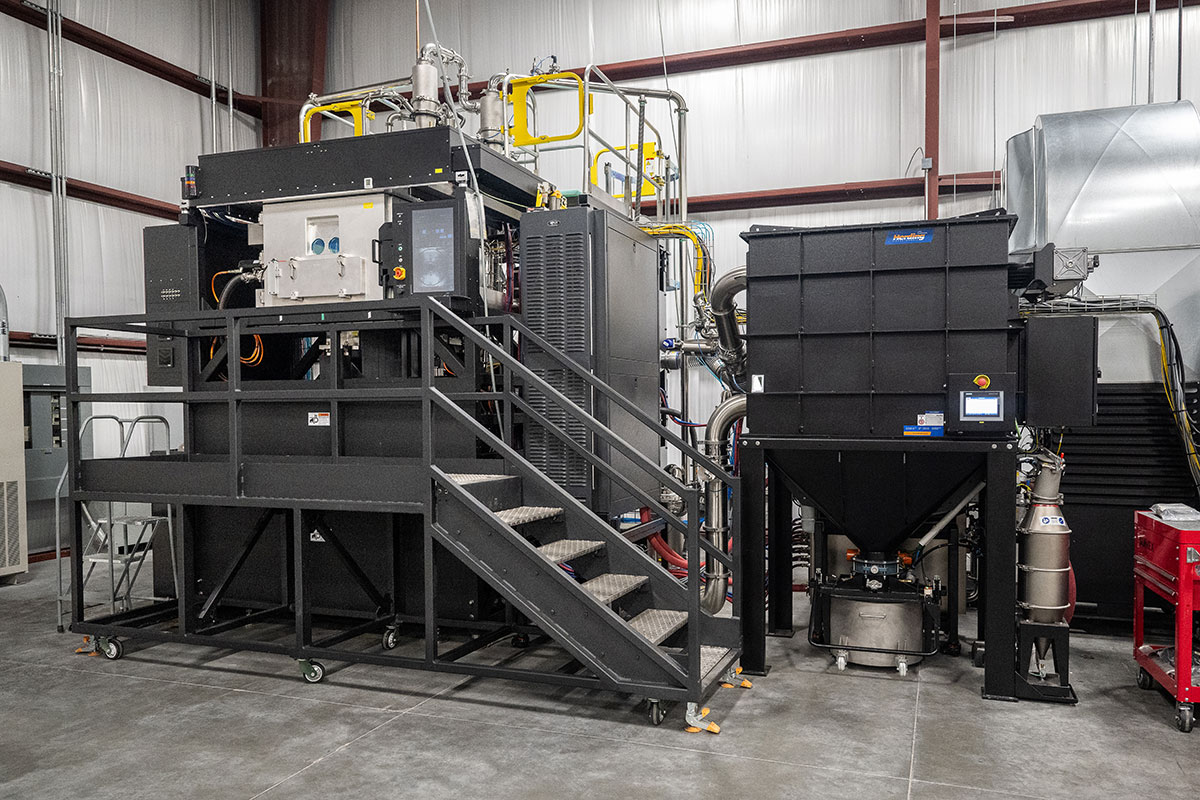
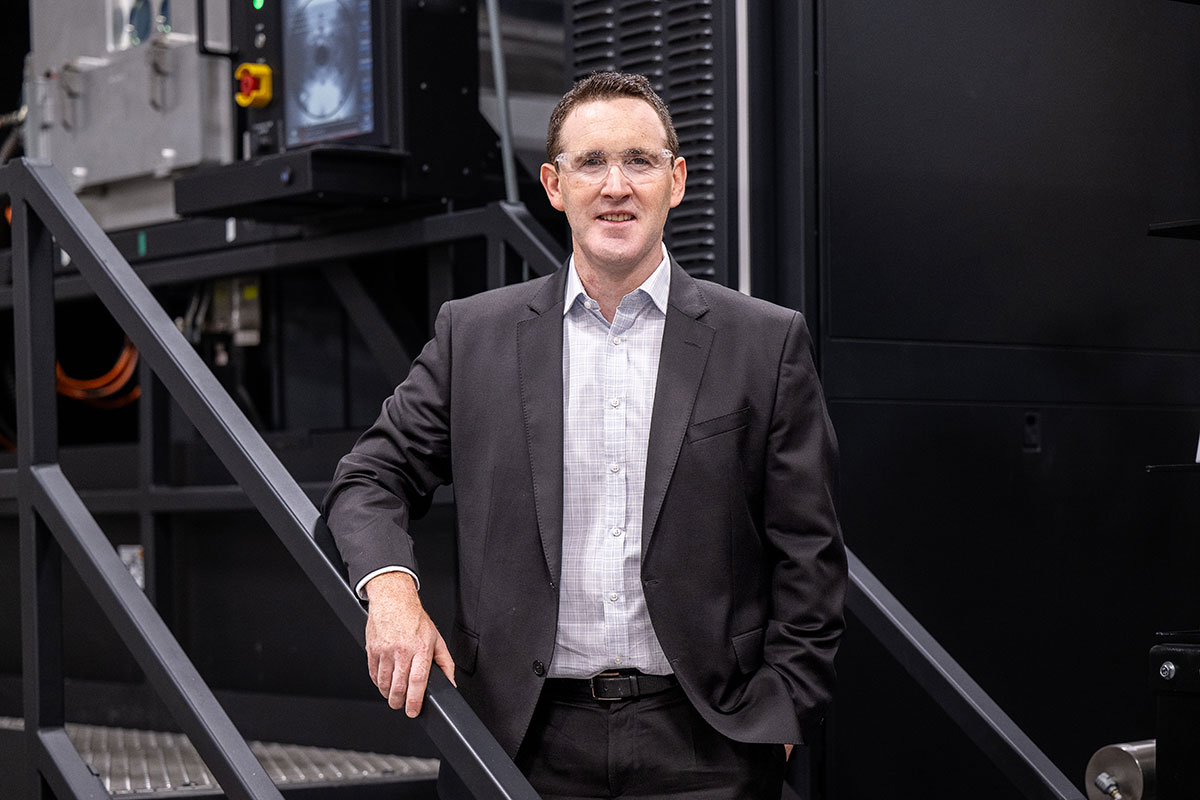
“has massive implications on lots of different industries,” says CEO James Lloyd. (IBJ photo/Chad Williams)
Avon-based Mears Machine Corp., which has invested millions of dollars in 3D metal printers since last year, sees the technology as a key that could unlock massive growth for the company in the coming years.
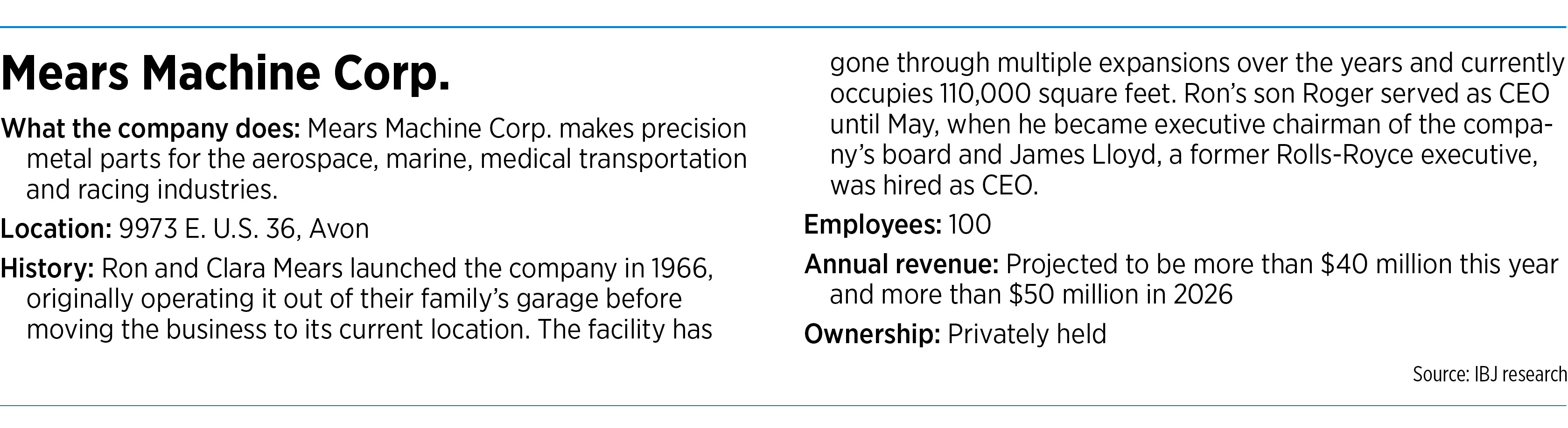
Founded by Ron and Clara Mears in 1966, Mears Machine makes precision metal parts for the aerospace, marine, medical, racing and transportation industries. It currently has about 100 employees, has seen compound annual revenue growth of more than 10% each of the last five years and expects to bring in more than $40 million in revenue this year.
But James Lloyd, who became the company’s CEO in May, said the company has several opportunities ahead of it, any one of which could lead to transformational growth.
All of these opportunities are related to 3D metal printing, which creates metal parts from thin layers of powdered metal that are fused together by lasers. The technology is capable of making metal parts more quickly—perhaps taking a day or less to make something that would have required weeks using traditional metalworking techniques.
The use of 3D printing also allows for the creation of objects that are more complex and more reliable than is possible with traditional manufacturing techniques. (The term “additive manufacturing” is also sometimes used to refer to the process of 3D printing.)
Since last year, Mears Machine has purchased four 3D metal printers. One of the printers is already up and running, and the others are expected to be in place at the company’s 120,000-square-foot facility over the coming months.
By having multiple machines, each devoted to a specific type of metal, the company has the capability to make a wider variety of parts, either out of aluminum or a particular type of metal alloy.
Including the printers themselves and the ancillary equipment that goes with them, Lloyd said the investment adds up to “well over $15 million.”
It’s new territory for Mears Machine, which until now had not had any metal 3D printing equipment.
Lloyd came to Mears Machine following more than 20 years at aerospace manufacturer Rolls-Royce. A native of the United Kingdom, Lloyd worked for Rolls-Royce in various locations around the world, including Indianapolis, the U.K., China and Canada. One of Lloyd’s tasks at Rolls-Royce was to bring additive manufacturing into the company’s North American operations.

“It was just a great fit to bring him on, because he knew so much about [additive manufacturing] and we did not,” said Mears Machine Executive Vice President Jenny Mears.
Having 3D printing capabilities gives a company multiple advantages, said Bryce Carpenter, chief operating and strategy officer at Indianapolis-based Conexus Indiana, a nonprofit organization that works to grow Indiana’s advanced manufacturing and logistics industries.
One such advantage, Carpenter said, is that 3D printing allows a company to be more nimble. For example, a traditional foundry that’s set up for large-scale production typically can’t also produce small-scale batches of product. If a foundry is working with a customer to come up with a new product or design, that foundry will likely have to engage with a company that is set up for small-scale production.
But that’s not necessary for a company with 3D printing capabilities, Carpenter said.
“If you’ve got a printer, you can do it in-house,” he said.
Growth paths
Lloyd said Mears’ investment in 3D printing was one of the things that attracted him to the job.
“I felt that they were buying the state-of-the-art capability that we could then be successful with,” Lloyd said.
That success could take one of a few different paths, Lloyd said.
One of those paths involves a patent the company is seeking for a manufacturing process involving 3D printing. If granted, it would be the first patent granted to Mears Machine.
Lloyd was reluctant to share details at this stage, since the application is still in-progress. But if things go as hoped, he said, “it has massive implications on lots of different industries” and could lead to huge growth opportunities for Mears Machine.
Other growth opportunities come from two specific parts that Mears Machine is working on for customers. (Mears Machine declined to identify its customers)
One of those customers is currently working with Mears Machine to test 3D printing of an aluminum component. If things go as hoped, Lloyd said, the customer anticipates huge demand for that component—and a huge opportunity for Mears Machine to satisfy that demand.
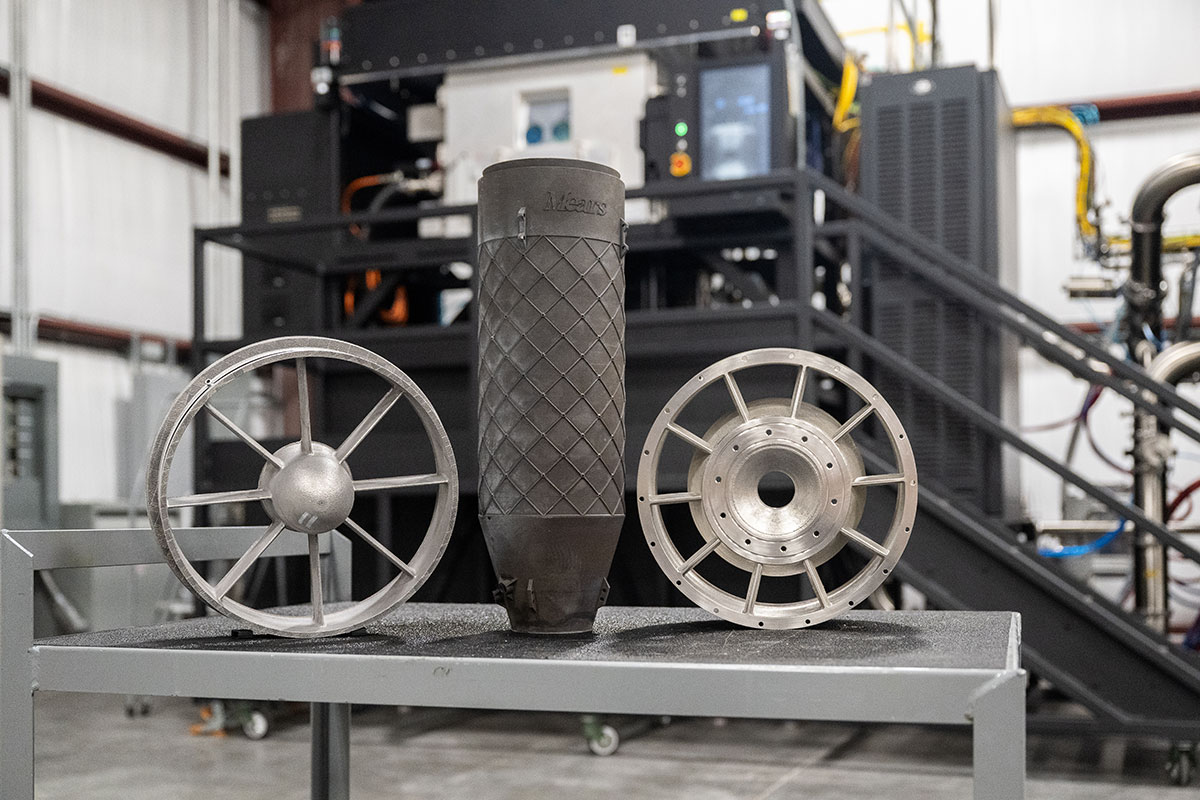
Another customer is working with Mears on a 3D printed microturbine for a brand-new product. Once the customer announces the product, demand is expected to be very high, Lloyd said.
The 3D metal printing industry is expected to grow significantly over the next decade, according to Precedence Research, a research and consulting firm based in Canada and India.
In 2024, the 3D metal printing market accounted for $9.7 billion and is expected to hit $12 billion this year and approximately $87.3 billion by 2034, Precedence said in a report issued in April.
As a way to quantify the growth that Mears could see, Lloyd said additive manufacturing will represent less than 5% of the company’s business this year. If demand pans out as expected, Lloyd said, additive manufacturing could represent more than 50% of the company’s revenue within the next 18 months or so.
In 2024, Mears earned revenue of $40 million. This year, the company expects that number to top $40 million and to reach more than $50 million next year, Lloyd said. Even faster growth could follow.
“Beyond 2026, we could be looking at growth in excess of 100%,” he said.
Lloyd said Mears is currently working with customers on validation products—test products before full production launches—and those products have the potential to bring in additional revenue that exceeds Mears’ current total revenue.
Though Mears has only one of the 3D printers at its Avon shop now, it’s already mapped out space for the three others that are on their way, and five additional machines that the company would add next year if demand grows as expected. And the company projects the need for a total of 20 3D printers over the next few years if demand grows at the current projected rate.
Lloyd said 3D printers are also driving demand for Mears’ machining services—the precision shaping, polishing and finishing that’s required to meet customers’ specifications.
“We’ve actually got a couple of customers who never would have approached us if it wasn’t for the additive side of the business, and they have now gone and asked us to do machined product for them,” Lloyd said.
Technology adoption
Additive manufacturing using metals is not new—Lloyd said he saw demos of 3D metal printing in Europe in the early 2000s—but it’s only been in the past several years that the technology has become commercially viable and companies have started adopting it.
Particularly for the larger-sized machines that Mears has purchased, Lloyd said, “I think we are at the front end of the commercialization, especially for a company our size.”
Carpenter, the Conexus executive, said there’s an expected lag between when a new technology emerges and when that technology becomes commercially viable. That’s because it takes time for companies to learn about the new technology, determine a use case and figure out what the return on investment will be. Then, once a company finds a customer who is interested in that technology, the customer will need to do its own process of testing and validating the products that are made with that new equipment.
“It’s so different from the original practices that I think it’s taken a little bit longer,” Carpenter said of 3D metal printing.•
Please enable JavaScript to view this content.
Editor's note: You can comment on IBJ stories by signing in to your IBJ account. If you have not registered, please sign up for a free account now. Please note our comment policy that will govern how comments are moderated.