
Subscriber Benefit
As a subscriber you can listen to articles at work, in the car, or while you work out. Subscribe NowAs a pre-teen, Indianapolis resident Frank Grunwald survived imprisonment in a series of harrowing concentration camps: Theresienstadt in his home country of Czechoslovakia, followed by Auschwitz in Poland and an Austrian trio of Mauthausen, Melk and Gunskirchen.
While working on a new film documentary based on Grunwald’s experiences during the Holocaust, Fishers-based director Philip Paluso wondered, “How was this little kid able to make it through all of that?”
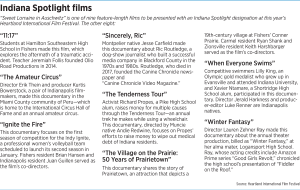
The documentary, “Sweet Lorraine in Auschwitz,” will share the answers at this year’s Heartland International Film Festival, beginning with a world-premiere screening Oct. 12 at Newfields.
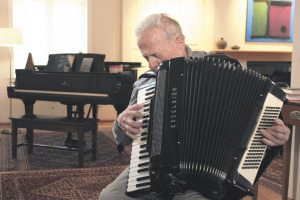
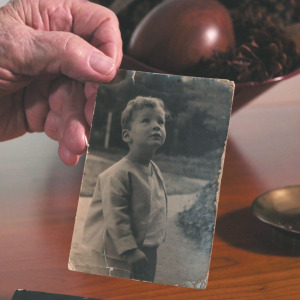
Grunwald, who died in 2023 at age 90, endured World War II and Nazi atrocities partly because of a kind gesture after he received a death sentence from Dr. Joseph Mengele at Auschwitz. But much of Grunwald’s resilience stemmed from his love of American songs from the Jazz Age.
The film’s title refers to “Sweet Lorraine,” a 1928 composition by Connecticut-based pianist Cliff Burwell. Grunwald and his older brother, John, vocalized the melody of “Sweet Lorraine” and other hit songs to pass time and mentally escape a setting constructed for the genocide of Jewish people.
“He was able to transcend the frightening circumstances where he was in that present and also wall that off by remembering this music that put him in a place where he found comfort and solace,” said Paluso, who made “Sweet Lorraine in Auschwitz” with writer and producer Amber Maze.
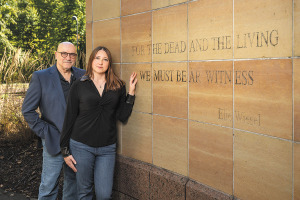
Paluso and Maze, who grew up in Westfield, traveled to present-day Poland, Austria and Czechoslovakia to capture film footage retracing Grunwald’s journey.
Tragically, the lives of his brother and mother, Vilma, ended in Auschwitz. Mengele, known as the “Angel of Death,” visually examined Frank and John—who was born with one leg shorter than the other and deemed disabled—before waving them toward extermination by Zyklon B pesticide gas.
However, Frank had an adult acquaintance, Willy Brachmann, who was an Auschwitz prisoner serving as a barracks supervisor. Before Frank headed to a gas chamber, Brachmann grabbed the 11-year-old and pushed him toward safety in a group of older children.
Without John, Frank Grunwald relied on memories of songs he kept to himself.
In the film, Galit Gertsenzon, director of the Benjamin and Bessie Zeigler Jewish Studies Program at Ball State University, said she frequently asked Grunwald about his inner listening to music and how it made him feel.
“He would say, ‘It made me feel that I was in a different place, with different people, in a place that was full of hope,” Gertsenzon said.
The promise of ‘Soon’
Grunwald learned to play the accordion before Nazis imprisoned his family, and he continued to play the instrument as an adult.
The idea for the “Sweet Lorraine” film originated with a 2021 concert Grunwald organized to raise funds for the Indianapolis Jewish Community Relations Council and its “Stand Up! Speak Out!” initiative to combat antisemitism in schools.
Grunwald performed a selection of his 20th-century jazz favorites at the Indiana History Center, accompanied by guitarists Joe Filipow and Patrick Wright.
Wright said Grunwald displayed affection for the song “Soon,” a 1927 composition by George Gershwin with lyrics by Ira Gershwin.
Although the song focuses on a romantic relationship, it’s not difficult to imagine Grunwald grasping “Soon” as a general wish during his days in concentration camps.
“Soon a little cottage will find us
Safe with all our cares far behind us
The day you’re mine this world will be in tune
Let’s make that day come soon.”
Wright said he and Filipow rehearsed four or five times at Grunwald’s home in advance of the concert.
“He was a pleasure to work with,” Wright said of Grunwald. “His story was really captivating when you’re actually sitting there with him. It was something special.”
Filmmaker Maze said the concert audience reacted in a similar way.
“It was a sold-out audience, and what we heard from people afterward was that they wanted to know more about Frank’s story, and they wanted to hear Frank play more jazz tunes,” said Maze, who serves as director of strategic outreach and communications for the Jewish Community Relations Council. “As the JCRC, we immediately realized the educational impact the story could have.”
The organization produced “Sweet Lorraine in Auschwitz” in partnership with Maze and Steve Jacobs, co-founder of Jacobs Home, a residence for developmentally disabled adults.
Maze, who studied anthropology at Ball State before receiving a master’s degree in Holocaust and genocide studies at Stockton University in New Jersey, said Grunwald gravitated to the accordion because it wasn’t an obvious instrument to play.
“Both of his parents were classical pianists, very talented, and his older brother picked up the piano,” Maze said. “Frank wanted to differentiate himself in some way. His parents sort of nudged him toward the piano, and he played it. But the accordion was a way to be slightly defiant.”
Guitarist Wright, who performs in the band of Indianapolis-based drummer Gene Markiewicz, had not collaborated with an accordion player before Grunwald.
“There’s something about the accordion where you can hold out a note like a singer, more than you can on piano,” Wright said. “I think that’s one of the things Frank liked about the accordion. He was able to express that voice he had inside him through the accordion.”
Extraordinary document
In 2012, Grunwald donated a one-of-a-kind letter to the U.S. Holocaust Museum in Washington, D.C.
The letter was written by Grunwald’s mother, Vilma, to her husband and Grunwald’s father, Kurt Grunwald, shortly before her death at Auschwitz. Vilma asked a Nazi guard to deliver the handwritten message. Although odds were against such a delivery, the guard made it happen.
“I think Vilma’s whole point was, ‘If I can get this message to my husband, I can give him a will to go on and give him some sort of closure,’” Paluso said.
Vilma wrote about being aware of her impending fate and that she was thinking about Kurt and Frank, who was known then as Miša.
Although Grunwald and his father were separated at Auschwitz, the duo reunited in Prague after World War II. They escaped from Communist Czechoslovakia in 1949 and lived briefly in London before moving to the United States.
Grunwald became the letter’s caretaker after his father’s death in 1967. Grunwald moved to Indianapolis in 1987, taking a job at Thomson Multimedia.
His musical life extended to Vilma’s letter in 2022 and 2023, when two composers wrote operatic themes to accompany her words.
New York-based composer Lori Laitman wrote “Into Eternity—A Letter by Vilma Grunwald” for an Indianapolis debut in 2022. Dutch composer Marion Von Tilzer wrote “The Letter of Vilma Grunwald (Into Eternity)” a year later.
Preserving history
Following the Oct. 12 premiere at Newfields, “Sweet Lorraine in Auschwitz” will be shown on Oct. 16 and 19 at Alamo Drafthouse Cinema, 3898 Lafayette Road, as part of the Heartland festival.
Paluso, who directed 2012 documentary “Wings for Maggie Ray” based on the story of trailblazing Indiana aviator Maggie Ringenberg, said the Holocaust remains relevant 80 years after the end of World War II.
“I think there’s a lot of, ‘It doesn’t affect me, I don’t need to know it,’ and the fact is, yes, it does affect you and you do need to know it,” Paluso said. “We can never forget what happened. It’s the same as why we shouldn’t forget the American Revolution or the American Civil War.”
Grunwald told his story in multiple documentaries, including “Miša’s Fugue” (2012), “They Played for Their Lives” (2017) and “We Shall Not Die Now” (2019).
Indianapolis-based filmmaker Ashton Gleckman directed “We Shall Not Die Now,” which premiered at the Heartland festival and won the audience choice award for an Indiana Spotlight film.
 Anita Lasker-Wallfisch, a London resident who played cello in the Auschwitz Women’s Orchestra, talked about the power of music in “We Shall Not Die Now.”
“The idea that Hitler could destroy music is ridiculous,” said Lasker-Wallfisch, who’s now 100 years old. “He destroyed a great deal, but music is not destructible by Hitler.”
Famed Terre Haute-based activist Eva Kor also survived imprisonment at Auschwitz, where she and her twin sister were subjected to Mengele’s sadistic medical experiments.
Kor (1934-2019) was the subject of documentaries “Forgiving Dr. Mengele” (2006) and “Eva: A-7063” (2018).
Filmmaker Maze said films about the Holocaust are crucial as the population of eyewitnesses to the Holocaust, including people in concentration camps and soldiers who liberated camps, shrinks.
“History begins to fade into the recesses of our memory,” she said. “What I think is so vital about keeping these testimonies at the forefront is that there was genocide before the Holocaust, but the world had never seen mass murder on such an industrial scale. If we forget that humanity is capable of perpetrating such acts, we will repeat that.”•
Please enable JavaScript to view this content.

Editor's note: You can comment on IBJ stories by signing in to your IBJ account. If you have not registered, please sign up for a free account now. Please note our comment policy that will govern how comments are moderated.