
Subscriber Benefit
As a subscriber you can listen to articles at work, in the car, or while you work out. Subscribe Now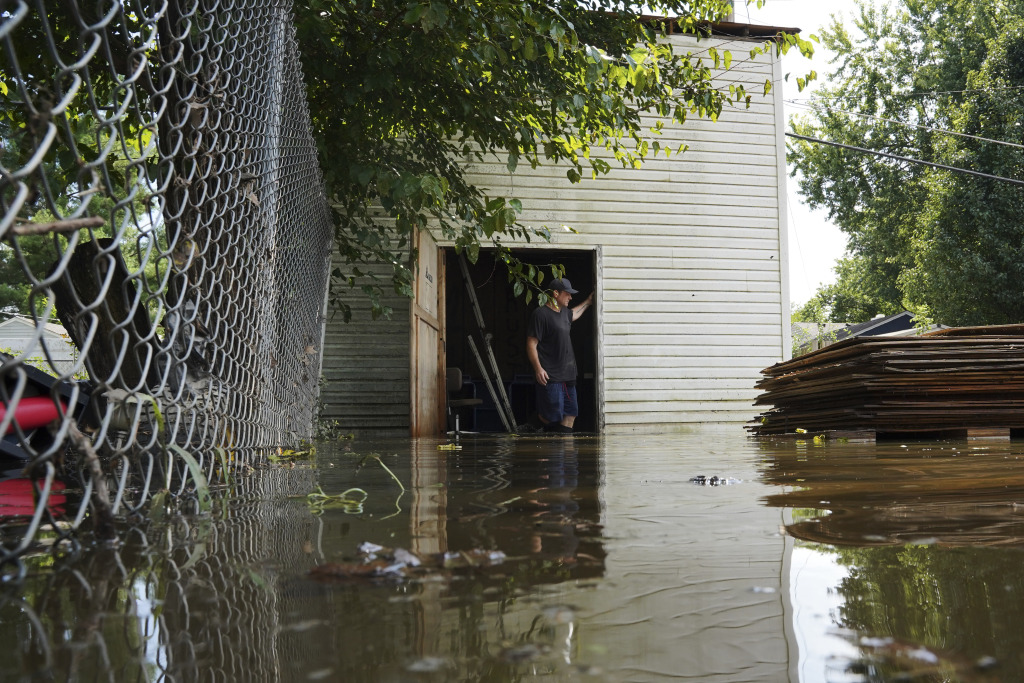
As central Indiana business owners and residents begin assessing the damage from last week’s storms and flooding, many are confronting the same question: What do I do now?
To find out, IBJ spoke with Jacob Houk, president of Indianapolis-based Hays & Sons, a property restoration company, about the first steps to take — from staying safe and documenting damage to contacting insurers and finding a qualified restoration company.
Houk also offered advice about what can be saved, how quickly mold can become a concern and what to watch for when hiring contractors after a widespread disaster.
The interview has been edited for length.
With the flood waters receding, many property owners are just learning what kind of damage they’re facing. What do you recommend they do first?
Safety first. Especially if your building is full of water, there are electrical hazards that you have to be aware of if you have power on. There might be some structural concerns, especially if you’re near a river with running water. And then unfortunately, when you have flooding like this, it’s just dirty water. So there’s bacteria, there are contaminants, there is sewage. … And so making sure it’s safe is always Step 1.

And pretty quickly you can usually figure out if the place is safe to enter. … And then if you’re a business owner or homeowner, it might be as simple as getting some rain boots and gloves and things that kind of protect your skin — you definitely don’t want to just walk in with sandals, for example, and get yourself exposed to [the contaminated water].
After that, documentation is critical. … And oftentimes video is better than photos — down to potentially even walking the office space and talking into the video, saying things like: This is our conference room and the floor’s wet. That’s because typically by the time an insurance adjuster might show up, you’ve probably already gone through some of that initial restoration and demo phase. And so what they’re seeing might be very different than what you’re seeing right now.
So then who should a business owner call first? Do they call their insurance company? Do they call you? What do they do first?
I would highly recommend calling your insurance company first. We see it both ways, and I’m certainly no insurance expert, but when you deal with flood water, there can be some coverage complications. And so having that conversation upfront to learn: Do I have insurance coverage? And if I do, what is it? … So I think understanding what your financial responsibility will be is a great first step.
The very next phone call should be to a professional restoration company.
When an emergency happens like this, how long does it take a company like yours to respond, to get to people?
In a normal scenario, we get a phone call and we’re out within an hour. A typical drying process is three to five days. And then as part of that drying process, if things need to be removed and then put back in, that can take a couple weeks, a couple of months, depending on the severity.
The challenge with this kind of scenario is, there are literally hundreds, if not thousands of buildings that are damaged. There are only so many qualified restoration companies. And again, normally in the scenario, we’re one hour to start working. Right now it might be three, four, five days. And as I think about previous larger natural disasters, sometimes it’s even a couple of weeks.
So the rain happens for a few hours. But it takes weeks, if not months, to recover.
I would think some people would walk into a flooded space and think, “Nothing here is savable. And then other people would walk in and think, “This is going to be OK. It just needs to dry out.” I assume reality is somewhere in between.
It’s definitely somewhere in between. And there’s real science behind the drying process. … So if something is saturated at a certain level, then typically it is kind of beyond repair and it does just need to be removed.
Typically mold can start to grow within a 72-hour window after flooding. So usually if you’ve had to wait that long for restoration work to start, there are some other concerns you’ve got to deal with.
Another unique aspect of the flooding that we’re seeing here is, again, this is contaminated water. So pretty much anything that’s sitting in this water most likely needs to be thrown away, unfortunately. And especially if it’s a scenario where it’s taken a couple of days to get access to your business or your home, that stuff is just sitting in this contaminated water. And at that point, then unfortunately it just needs to go.
Do you recommend that people start going through things or try to save things without you there?
Certainly if the water damage is an area where you have important documentation. Obviously, even if it’s got contaminated water, if it’s business documents or on the personal side, birth certificates, things like that, that’s just stuff that you want to keep.
But I also think it’s a natural human reaction to want to just do something. And there’s nothing wrong with that. I mean, I think it’s totally fine if you want to start moving stuff outside. I go back to the safety piece: Just make sure that you’ve got your skin properly covered and that there are no electrical concerns.
But sometimes when you’re trying to save a few dollars by trying to save some stuff, the next thing you know you got a bigger issue on your hands.
Companies from outside the area could come in to provide restoration services. I assume some of them legitimate, and I assume others are not. Is that right?
Yeah. You do need to be careful. If you are working with somebody that’s not local, I would certainly at least take a few minutes, do some Google research, look up the reviews. You can even find some basic business corporation information online pretty quickly.
But there’s a low barrier to entry in our business, so there could also definitely be folks who are just trying to take advantage of a situation.
When you say a qualified restoration company, how does someone know whether the company that they’ve called is qualified?
There’s an organization called the IICRC [the Institute of Inspection, Cleaning and Restoration Certification] that is the governing agency over the restoration industry. So they’re the ones that provide all the standards on how to properly restore water damage, how to properly restore mold damage, and that’s how we then train our folks.
So at Hays & Sons, all of our team members are IICRC certified. And that’s something that typically a restoration company will tout on their website. … And I think it’s fair to ask them when you’re calling and talking to whatever company you’re talking to: Are the folks going to come out to my house IICRC- certified?
What is one thing that people really think they can save, but it turns out they can’t?
This is going to sound kind of funny, but it’s carpet.
I think it’s because once it’s dried, it looks normal. So you just think that it’s probably fine. But there are all kinds of wear and tear that’s occurred to the carpet — in addition to just contaminants and other stuff like that. … Typically it just has to go.
Please enable JavaScript to view this content.
Jacob Houk is a fine, young man.
Had a toilet overflow and flood 1/3rd of my house. Insurance company had Hays & Sons come out to do the work. $20k-$30k claim.
I give them a solid B.
What do you do now? Move your residence or business to somewhere that doesn’t flood.