
Subscriber Benefit
As a subscriber you can listen to articles at work, in the car, or while you work out. Subscribe Now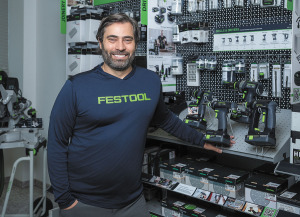
Clint Chapman was working as a marketing executive at Rhode Island-based toy maker Hasbro Inc. five years ago when a corporate headhunter pitched him on a job opportunity at Festool USA.
The century-old German maker of power tools has had a U.S. presence since 2000, but the brand isn’t widely known here. In fact, Chapman—who has done several home remodeling projects and considers himself a “tool guy”—had never heard of Festool when the headhunter told him about the job.
“I felt kind of weird about that,” Chapman recalled.
But the more he considered it, the more he was drawn to the idea of working at a company like Festool. Chapman, 47, has worked in marketing, brand management and product development his entire career. At Hasbro, he led campaigns for some of that company’s best-known toy lines: Transformers, Nerf and Star Wars.
Working for Festool would offer a whole new type of challenge.
 “It was kind of a marketer’s dream,” Chapman said. “It was, ‘OK. I see clearly, [it’s a] really great product line, high customer loyalty. It’s just, I need to help get the word out of what this brand is.’”
As a bonus: The job was in Lebanon, giving the Noblesville native a chance to return home to Indiana after 20 years spent living around the country, including in Rhode Island, California and Georgia.
“It was this really interesting opportunity that really just so happened to be in the perfect location,” Chapman said of his current job.
Festool has about 90 employees in Lebanon, where the company’s U.S. corporate headquarters and U.S. repair facilities are located. All of the company’s tools are made in Germany and the Czech Republic.
Chapman sat down with IBJ recently to talk about how Festool got a foothold in the United States, how its marketing has changed since he took the helm at the company’s U.S. operations, and the similarities between marketing toys and marketing high-end power tools.
This interview has been edited for length and clarity.
What is Festool’s niche? What’s the company best known for?
Being a German company, they’re highly engineering-focused. Festool actually invented the first handheld circular saw, the first track saw, the first orbital sander. So a lot of these things that we take for granted now that you see in a lot of the other brands actually originated from this small, little, family-owned company in Germany. But the big focus for the organization has really been around that idea of innovation, really trying to be forward-thinking within, especially, the woodworking trades and then also high quality. … We know these tools are more of an investment for people into their careers. And so we don’t want to make things that are disposable.
You said that Festool’s U.S. repair operations are in Lebanon. So if a U.S. customer needs his or her tool fixed, that tool comes to Lebanon for service?
Yes. Everything comes to our facility. If a tool comes in, we try to have it repaired and sent back within 48 hours. A lot of those we actually do in 24 hours. I’d say it’s more than 80% [of cases], if a tool comes in today, we will repair it today and get it back out tomorrow. … If we’re going to support professional craftspeople and tradespeople, they can’t be without their tools.
How did the company first gain a foothold in the U.S.?
In the U.S., we had a lot of people that are not professionals, that are hobbyists, but they’re very serious about woodworking—people that are building furniture at home. Before we came here, there was a dealer in southern California that knew about our product and essentially saw that there was a real need for these more premium woodworking tools, and so he started bringing them over. And where we really started with our footing are these high-end hobbyists. … And so that’s where it really started, with some of these people that are really passionate about doing this kind of work. But they weren’t finding the tools that they needed here, and they had heard about Festool over in Germany but were unable to get it. And so we originally started just exporting into the U.S. Eventually, in 2000, we set up a place in Santa Barbara, California, and sort of started from there. And by 2007, we had moved to Lebanon—much, much better for shipping around North America.
OK, so if your first U.S. customers were hobbyists, what’s the split now between hobbyists and professional tradespeople?
It’s still probably about 50/50. In terms of a real direct push into [attracting] professionals, we’ve only really done that over the last few years. Especially on our cordless [tools], that’s where you’re going to see most of your professionals coming in with a brand. And up until now, our cordless has been a very small portion of our business. … And so that is something, as we look forward to next year, we’ll be doing a big drive with some new products that we’re going to be really pushing more heavily into cordless and the professional market.
What about in Germany? Is it a 50/50 split or something different?
Very different. For them, it is almost entirely professional. And actually, what’s interesting is, while we’re shifting and trying to make sure we’re supporting the professionals, they’re now finding an opportunity with hobbyists. It is strange, because [it’s the] same company—for the most part, same products—but very different environments.
You described Festool USA as “not a marketing powerhouse” for its first 20 years in this market. Now you, a marketing professional, are in charge. What’s changed in the five years since you joined the company?
When I came in, most of our spending was on printed catalogs and trade shows, which was good early on, because that’s where people were going to trade shows and learning about tools. Obviously, in a post-COVID world, that changed a lot. And I think everyone realized the need to sort of digitize our marketing efforts and make sure that we’re reaching customers that we can’t reach easily through some of these trade shows or print publications. And so that has been a big transformation for us, of really understanding, ‘Where are our customers, and how do we reach them?’ And it’s definitely different than what the first 20 years was.
Do you still have a print catalog?
So we used to give these full-color [catalogs] out to anyone and everyone. Now our authorized dealers will have this so they can actually go through [it] with their customers and look through everything. And so it’s more of a sales resource than just [a catalog that hobbyists keep on] the coffee table.
Are there similarities between marketing high-end tools and marketing toys?
I worked on Star Wars and a few of these brands that have appeal, clearly, not just to kids but to adults as well. People my age that grew up with things like Star Wars and still collect, and so there’s still some of that spark of that same type of passion, whether you’re a fan of Star Wars or Marvel or whether you’re a huge fan of these specific woodworking tools. … It’s something really interesting and fun but also really challenging. When you work in something where people are invested in the brand, they have a passion about it, you have to be really, really careful there what you do, because you clearly don’t want to upset the people that have made you what you are. And so I think it’s been beneficial that I’ve been able to work on that side. It also helps me have a thicker skin, because you’re never going to make everybody happy, and so that definitely translated well. Plus, these [Festool products] are also just really cool toys to get to build stuff with. It is a hybrid of both work and play. People do this for a hobby and for a profession, usually not because they’re forced into it. It’s because they have a passion for it. And so that’s really fun and exciting to be around.
You grew up in Indiana but then left for 20 years and lived all over the country. What did you gain from that experience?
The biggest thing that I got out of being gone is, I really love being here. We loved the places that we lived when we were there, and we tried to take advantage of it, but this is home—and it definitely feels great to be able to raise my kids here.•
Editor’s note: This story has been updated to clarify that Santa Barbara, California, is the city where Festool USA had its initial U.S. operations.
Please enable JavaScript to view this content.
Editor's note: You can comment on IBJ stories by signing in to your IBJ account. If you have not registered, please sign up for a free account now. Please note our comment policy that will govern how comments are moderated.