
Subscriber Benefit
As a subscriber you can listen to articles at work, in the car, or while you work out. Subscribe Now
A consortium of academic institutions, businesses and research organizations led by Indiana University has been named a finalist in the National Science Foundation’s Regional Innovation Engines competition, putting them in the running for up to $160 million in funding.
The Indiana Musculoskeletal Health Partnership for the Advancement of Care & Treatment, or IMPACT, consortium seeks to build on the university’s musculoskeletal health research leadership by increasing connection and collaboration; focusing on workforce development opportunities starting in K-12 schools; and using artificial intelligence and machine learning to streamline research and development.
Musculoskeletal health refers to the functioning of the body’s muscles, bones, joints, tendons, ligaments and connective tissues, and disorders of this system are among the world’s leading causes of disabilities.
“Musculoskeletal health is critically important to how we move, work and play,” Melissa Kacena, the consortium’s primary investigator and the director of the IU School of Medicine’s Indiana Center for Musculoskeletal Health, said in a written statement.
“We are harnessing biomedical engineering, data-driven discovery and artificial intelligence to develop innovations that will keep people healthier, from smarter implants to wearable devices. Together with Indiana’s orthopedic industry leaders, we are addressing research and workforce gaps that will drive this progress forward.”
The goal of the National Science Foundation’s Engines program is to grow regional innovation ecosystems, awarding up to $160 million toward these efforts.
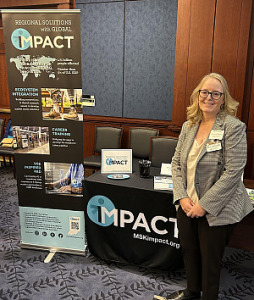
The consortium expects to generate more than $580 million in economic impact for the state, according to the university.
In addition to Kacena, the consortium’s leadership team includes Jim Lancaster, of Warsaw-based medical device company ZimmerBiomet, as interim CEO; associate professor Jill Fehrenbacher of the IU School of Medicine as chief learning officer; and associate professor Amrou Awaysheh of the Kelley School of Business as chief technology and innovation officer.
The consortium comprises more than 100 partners, including Eli Lilly and Co., Zimmer Biomet, BioCrossroads, OrthoWorx, Purdue University, Indiana University Health, the University of Notre Dame, the city of Warsaw, Ball State University, gener8tor, Parkview Health and more.
The Indianapolis-based IU Launch Accelerator for Biosciences, or IU LAB, would be the operational hub of the proposed Indiana Musculoskeletal Innovation Engine, offering infrastructure, co-location and shared services.
“By combining the expertise of Indiana’s leading research universities with the state’s booming orthopedic and musculoskeletal industry, there is no better place than Indiana to create a hub that will drive groundbreaking advancements in musculoskeletal innovation,” IU Vice President for Research Russell J. Mumper said in a written statement. “IU and its partners have made significant progress already in identifying the state’s greatest opportunities in this area, and we are excited to build on this momentum.”
According to the National Science Foundation, or NSF, the Engines program, in its second iteration, received nearly 300 letters of intent. From teams that submitted preliminary proposals, 71 advanced to the next round. Of those that submitted full proposals, only 29 advanced. Now, only 15 will advance to the next stage of the competition.
Winners are expected to be announced in early 2026.
“Securing America’s place at the forefront of science and technology requires growing innovation capacity everywhere so that we can, in turn, aggressively accelerate the pace of development of key technologies,” Brian Stone, NSF acting director, said in a written statement. “The NSF Engines finalists have consistently communicated their strong vision for placing their regions on the map as the national and world leaders in key technologies, demonstrating their commitment to advancing U.S. research, innovation and workforce development.”
Other finalists are based in Chicago; Cleveland; Kansas City, Missouri; Huntsville, Alabama; Morgantown, West Virginia; Corvallis, Oregon; Ames, Iowa; Charlotte, North Carolina; Rochester, New York; Princeton, New Jersey; Concord and Portsmouth, New Hampshire; Storrs, Connecticut; and Fairbanks, Alaska.
Please enable JavaScript to view this content.
Editor's note: You can comment on IBJ stories by signing in to your IBJ account. If you have not registered, please sign up for a free account now. Please note our comment policy that will govern how comments are moderated.