
Subscriber Benefit
As a subscriber you can listen to articles at work, in the car, or while you work out. Subscribe Now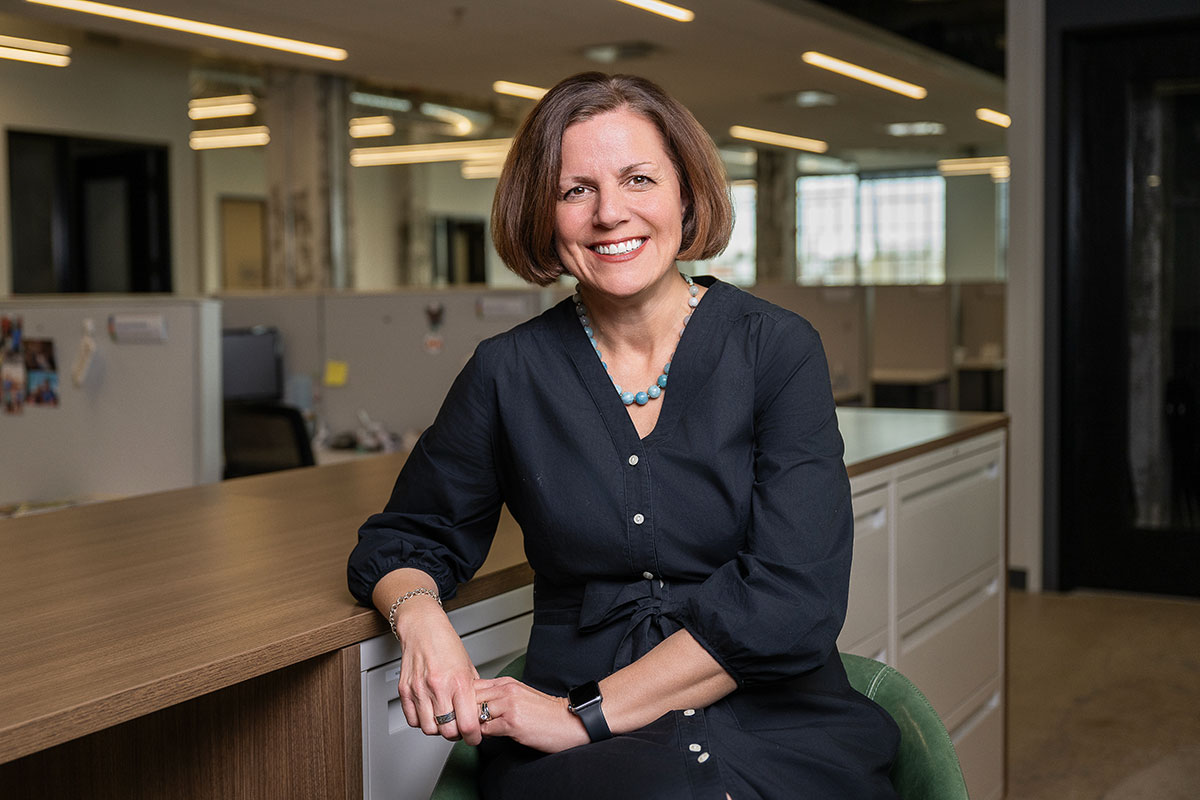
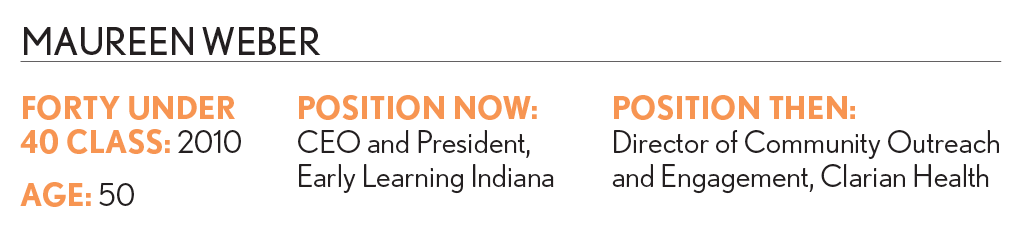
When IBJ recognized Maureen Weber as a Forty Under 40 honoree in 2010, she had just finished reorganizing the Indiana Department of Education and had taken a job as director of community outreach and engagement at Clarian Health, now Indiana University Health.
She was 35, an attorney and had served in three state agencies.
“I have such a penchant for public service,” she told IBJ then, “and have always looked for ways to flex the muscles I built in law school but in a way that allows me to serve my community.”
Fifteen years later, Weber is still impacting the community and public service—now as president and CEO of Early Learning Indiana. She said she took the job because she “saw the opportunity that we had to transform the lives of young children, especially vulnerable ones.”
The organization focuses on helping children learn in their earliest years by operating early learning centers, helping families find quality child care, improving the quality of child care and advocating for greater access to early educational opportunities for all Indiana families.
IBJ talked with Weber about the work Early Learning Indiana is doing today, including the Early Years Initiative, which has received $60 million from the Lilly Endowment to help organizations meet the developmental needs of infants and toddlers.
The Early Learning Initiative is one of the programs that has your organization in the news right now. What is it, and what is the goal?
The Early Years initiative was really an unprecedented opportunity to focus on the years between birth and 3 years old. Lilly Endowment granted Early Learning Indiana significant dollars, and then we held a competitive opportunity for community organizations all around the state of Indiana to invest in the earliest years of life.
All told, we distributed more than $55 million toward this effort and really focused on four things: on building the availability of quality child care, on strengthening families through parenting programs and other kinds of initiatives, on early detection and making sure that we were intervening just as soon as we could in helping to get a child on the right track, and lastly, in early literacy, initiatives that really tie to some of the work that’s happening in K-12 around [the] science of reading and the focus of making sure that all of our third-graders are ready for everything that comes next.
Did you approach Lilly Endowment about the initiative? Did they approach you?
We had been having ongoing conversations about the importance of the earliest years and the need to do something for this group in particular. There’s been a lot of focus in recent years on pre-kindergarten, and appropriately so, but we know that the years before a child turns 3 are the most important from a foundational sort of architecture-building standpoint.
Why is that birth to 3 years period so important?
It’s the period of life where neural pathways are being formed. And I say it’s not rocket science, but it is, in fact, brain science. Your brain, over time, kind of prunes away things that you don’t need anymore. And so it’s really important that that initial infrastructure, that initial wiring, gets done just as solidly as possible.
It’s not that we can’t course-correct over time, but a brain’s ability to change decreases as we get older. We become more capable of complex thought, but any shortcomings in that initial wiring then are harder and more costly to overcome. So we spend a lot of time and money in the later years trying to make up for deficiencies that were formed before a child was even 3.
What are the challenges that lead to the problems that your initiative is trying to solve?
What we know is that children are learning at such a rapid pace that it’s really critical that we make sure that they are in the most wonderful places with responsive relationships and nurturing, caring adults. The good news is, it’s relatively straightforward what children need to be able to form that solid foundation. It is about having materials-rich environments where there are lots of things to learn and with those responsive adults that are caring for the needs.
With those handful of ingredients, we can ensure that children are set on the right path. But we know that in too many cases, for too many hours of the day, children don’t have access to those things. So both through the Early Years Initiative and through the rest of our work and ensuring that early care and education environments are high-quality, we’re focused on that issue.
How is this program manifested?
We’ve allocated all of those dollars, and they are being put into initiatives carried out by community organizations in almost all 92 counties across the state. We have served already thousands of infants and toddlers. Some of these are construction, works in progress. By the time we’re done, we will have created thousands of new, high-quality early care and education seats serving infants and toddlers, and we will have literally thousands of families participating in in-home visiting and other efforts that have a proven track record to change the way that children learn.
Wherever children are, that’s where we want to be meeting them. So it’s in their child care setting, in the home and in community settings as well. And we have grantees who are working in all three of those areas. They have a couple [of] more years to complete their work, and we’ll continue to monitor the progress and report out on what change we were able to effect for very young Hoosiers.
One of the things your organization did during the pandemic was a program called Come Back Stronger. What were you doing in that program?
For better or worse, we were able to identify the need during COVID because we were living it. Among other things, we operate now a dozen early learning centers in Marion County and in Tippecanoe County on behalf of Purdue University. And so we serve families of police, fire, a lot of health care on behalf of IU Health and others. We’re located in both state and federal government buildings.
And so these were the truest essential workers. These are folks who really never left the workforce during COVID—that’s who we were serving. And so we stayed open. From day one all the way through, we continued our operations. From that, we learned what other providers all across the state needed. We understood that they had extra, incremental expenses. …
Again, in collaboration with Lilly Endowment, we were able to craft a response to what the needs were all across the state for early care and education. In total, they invested $25 million that came at really a crucial time before the federal and other support started kicking in down the road. I think those Come Back Stronger dollars were just essential.
Do you feel like it made an impact?
It absolutely did. It provided really critical support that enabled providers to stay open and keep operating in a safe and effective way.
When you look back at the time when you were a Forty Under 40, do you think you could have projected where you would be today?
Definitely not. I think that there is a through-line, though. I like to think about the things that are making things harder for Hoosiers, for families. For me, the opportunity to focus on education in one respect or another has always seemed like time well spent and making sure that people are living up to the best that their life can offer.
From that standpoint, maybe I would have
predicted that I would be doing something in this vein. But definitely, the path my career has taken has been unexpected.
What lesson do you think that gives to younger leaders as they’re thinking about what they’re going to do with their careers?
I think one thing that I always think about is actually a life lesson from Jeb Bartlett—America’s favorite TV president [from the “West Wing”]—which is: See the whole board. We can become really myopic and focused on whatever’s in front of us. And especially for young people, I think they see the next step in the career ladder, and it has their focus and attention. I try to keep my aperture as wide as possible to see the art of possibility around me—and that has served me really well to have an interesting and dynamic career.
What other advice would you have for a young leader?
You know, I used to think that there were really right and wrong choices that I would make in my career. And it took me quite some time to learn that there’s just a door that you walk through and that leads to other doors and so on.
So I guess I would say: Don’t be afraid of that. There are endless opportunities if you say yes to the things that are in front of you.
Finally I want to ask: Where do you think you might be 10 years from now?
Oh, goodness, I don’t know. I hope I’m tackling an interesting challenge. I want to make sure that I am contributing to my highest and best use, whatever that is. I hope that I will continue to stay open and in the meantime make sure that we are doing everything that we can to truly make the most of the opportunity we have for young learners.•
—Lesley Weidenbener
Check out more Forty Under 40 honorees.
Please enable JavaScript to view this content.
What about the gifted kids that can read by kindergarten? Most of these kids get overlooked or seen as problems. Because THEY ARE BORED! Everyone talks about getting kids to read. How about challenging the kids who already know how to read. Who get it, the 1st time it is presented. Sometimes, I wish I didn’t constantly try to challenge him. They wouldn’t advance to the next year because of his grades. Well, he already knew the subject. He acted out because he was tired of hearing the same subject over and over again. But you RARELY hear about that. Fortunately their is a gifted school but it always has a waiting list. It’s one of the few schools that is high on the listed or what ever its called now. And the only IPS school that has a blue ribbon of achievement. So why don’t they send money on this school instead of wasting money on schools that fail to teach? Because it’s not being talked about in the political circles like the other schools. As usual, the gifted kids get the left overs. People assume they don’t need help. But what about the 2 E kids?