
Subscriber Benefit
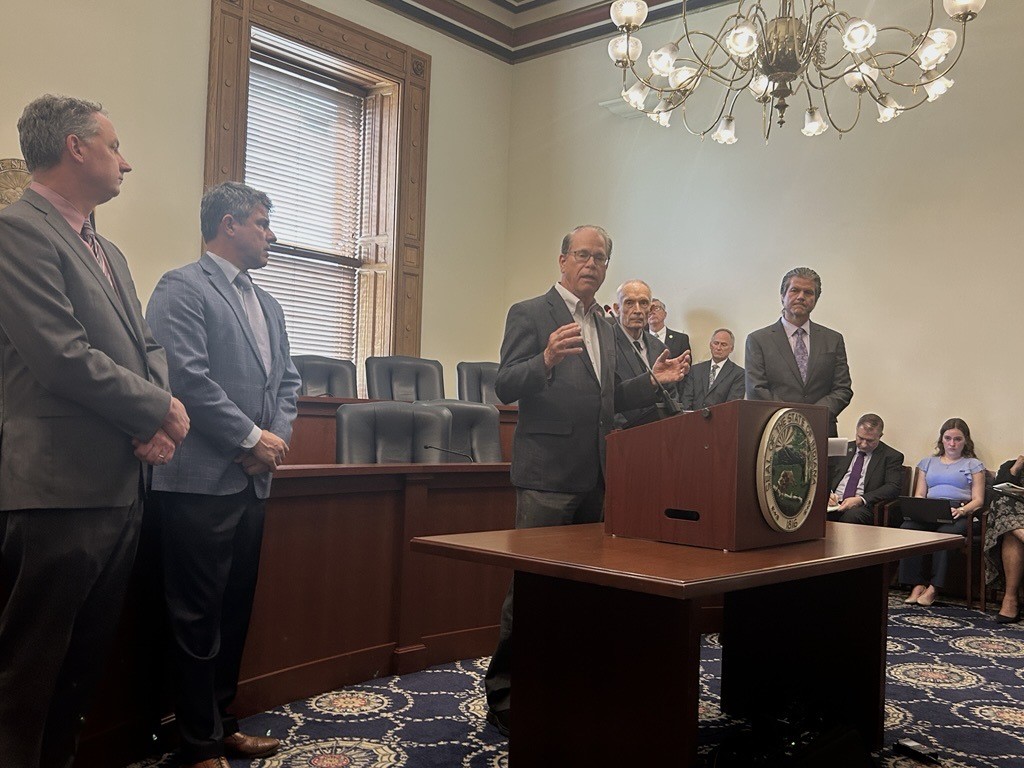
As a subscriber you can listen to articles at work, in the car, or while you work out. Subscribe NowGov. Mike Braun and top legislative leaders announced Wednesday they plan to triple the state’s cigarette tax to nearly $3 per pack and increase taxes on other tobacco products, raising about $810 million in additional revenue over the next two years.
The announcement comes a week after a new revenue forecast projected the state would have $2 billion less over the next two fiscal years than they expected when they wrote the spending plans that passed the House and Senate earlier this session.
Indiana’s current cigarette tax is 99.5 cents per pack, which is the 39th lowest tax rate among the states and hasn’t been increased since 2007. The proposal will raise that by $2.
To further close the gap between projected revenue and earlier version of the budget, leaders also said Wednesday they would reduce planned spending for public health, higher education and government agencies.
“We’re reducing government spending while funding our most critical priorities and providing tax relief for Hoosiers,” said House Speaker Todd Huston, pointing to continuing income tax cuts. “We’re in a good position to weather some potentially lean times because of our commitment to financial responsibility.”
Senate Pro Tem Rodric Bray said that similar to projected local government budget decreases under a property tax measure already signed into law, state government will also operate under a slim budget.
“We have asked local governments … to spend within their means and tighten their belts,” said the Martinsville Republican. “We’re doing exactly the same thing here.”
Long-sought universal school choice vouchers will become reality in the second budget year at a cost of roughly $93 million.
Currently, Indiana’s vouchers are available to Hoosier earning 400% of the amount required for a student to qualify for the free or reduced-price lunch program, or roughly $220,000. An estimated 3.5% of families don’t qualify under the current eligibility guidelines.
Without the voucher expansion, K-12 will get $861 million dollars over the next two years, or a 2% increase annually when excluding curricular materials.
Braun tied projected final woes to national economic uncertainty of the previous four years, though much of the market volatility has occurred since President Donald Trump took office in January.
“Sooner or later, those chickens come home to roost,” he said.
Braun said he was “the loudest voice” on the federal deficit during his term in Congress, which overlapped with Trump’s first term and President Joe Biden.
Budget details
Sen. Ryan Mishler, R-Mishawaka, said the cigarette tax increase will offset increases to Medicaid.
Tax increases are considered one of the most effective ways to curb cigarette use, which does contribute to the state’s overall poor health metrics and Medicaid expenses.
Bray called it “a really good policy” to discourage smoking, even if the expected tax revenue decreases over time.
“That’s a good thing, because we think it means we have fewer smokers,” Bray said.
Additionally, three agencies—the Department of Correction, the Department of Child Services and the Family and Social Services Administration—will have a combined augmentation fund pool of $300 million to cover unexpected expenses. Outside of K-12 funding, which makes up 47% of the budget, those three agencies get the largest amount of state dollars.
“It just gives flexibility during challenging times,” said Mishler, noting that the fund will be distributed at the governor’s discretion.
The Indiana Economic Development Corp. had its budget reduced between 25-30%, coming on the heels of news from Indiana Legislative Insight that the Governor’s Office plans a major audit of the agency.
Most agencies and departments—including the offices of statewide elected officials and the Commission for Higher Education—also saw a 5% reduction in their appropriation.
But a two-year-old program to supplement local public health departments took a 60% cut, with funding falling from $100 million each year to $40 million.
Bray noted that much of those funds—roughly 45%—distributed to counties and some municipalities last year hadn’t been spent.
“I think they’re still trying to build up and roll out their programs,” said Bray, emphasizing a desire to continue funding the program into the future.
Democratic pushback
Details of the final budget compromise were revealed to Democrats at the same press conference and leaders of the respective caucuses said more time would be needed to analyze the full document.
“As this budget is digested over the next 24 hours, we’re going to have much more to consider. We’ve got to weigh just how public education and the needs of our children are being met. We have to weigh if Medicaid needs … and the elderly, the working Hoosiers, (and) everyday people, if those are being met,” said Sen. David Niezgodski of South Bend.
Sen. Andrea Hunley, a former principal, criticized the voucher expansion for benefitting the “wealthiest families in the state,” noting that impoverished families wouldn’t see as much promised relief under the earlier property tax plan.
“Families with home values that are assessed at under $150,000 actually are going to see an increase in their property tax bills,” the Indianapolis Democrat said. “Then at the same time, we’re going to be giving greater breaks to our wealthiest families. … It’s just not a prudent time to look at voucher expansion.”
Hunley also questioned the commitment to reducing Medicaid expenses when Republicans cut public health funding.
“We know that everyone’s got to make sacrifices this session but, again, it’s going to be on the back of the Hoosiers that need the support the most,” Hunley said.
Rep. Greg Porter pointed to an event last week with Trump cabinet official Robert F. Kennedy Jr. and Dr. Mehmet Oz, who leads the Centers for Medicare and Medicaid Services. Both appeared alongside Braun to announce a flurry of health-related executive orders.
“Now we’re down to $40 million [annually]. Is that making Indiana healthy again?” Porter asked, borrowing a phrase coined by the trio. “I think it’s making us extremely vulnerable when it comes to health care.”
Though Porter praised the inclusion of the cigarette tax increase and the IEDC scrutiny, the Indianapolis Democrat said he didn’t support the spending plan until he learned more about K-12 funding and other provisions.
“I don’t think it’s a budget, at this point, that we can completely embrace.”
The Indiana Capital Chronicle is an independent, not-for-profit news organization that covers state government, policy and elections.
Please enable JavaScript to view this content.
If finalized, this is a huge win for improved health of Hoosiers and for perseverance of the advocates who have been pushing legislators to support such rational measures for years. Congratulations to all those who have fought so hard for so long. It is sad, however, that it took a financial reason and not a health reason to finally get the this bill across the finish line.
In the same bill, they also cut the funding given to county health departments ($75 million this year) from the $150 that had been planned, first to $100, now down to $40 million. But hey, they still found the money for the rich to get school vouchers!
So it’s good news that they’re trying to reduce smoking with a tax increase, but they have a long way to go to prove they actually care about the health of Hoosiers.
Rational? How about adding a few bucks tax to anything with sugar in it if we’re going down this “tax the unhealthy” route
Exactly Gregg!
Now 16% of the population will pay over $800 Million for the remaining 84% of the population.
A 30-40% tax rate on a commercial product probably sets a new record.
Marijuana would include 60-80% of the population paying tax, and at half the tax rate of this new cig tax.
At least the Chamber and anti smokers will be happy.
I’m actually okay with taxing and regulating unhealthy products like sugar/candy, soda, cigarettes, alcohol, and weed. I honestly think it would be a good thing if cities and/or counties could implement sugar/soda/candy taxes that fund things like trails and public parks.
This won’t make a dent in the gap.
In response to Kevin P.,
The $2/pack is the national average for state sales tax on cigarettes. It is not a new high. It is far from it. The Indiana tax rate is low which is why the smoking rate is above the national avaerage. See this link to the cigarette sales tax by state from NPR )https://npr.brightspotcdn.com/21/c0/f6c70d504795bd8527bcb883ce20/tobacco-tax-map-2024.pdf). There are several other maps by other organizations out there with the same information.
How about a tax of vaping products?
Hope about FISCAL RESPONSIBILITY?? Not a smoker but on taxes on EVERYTHING we do is way outta hand. Disgusted with our local and state government “representatives” – DO THE HARD WORK!!!
Fiscal responsibility? How about stop cutting taxes so low that we aren’t now dependent on sin taxes like tobacco and the lottery to run the state.
Remember when we were told the lottery wouldn’t be part of the budget and it would only be spent on education?
The issue isn’t that we spend too much, it’s that we don’t collect enough. Our roads are awful. Our kids are poorly educated and we don’t send enough of them to higher education to get high paying jobs. We steal money from the old to pay for our hospitals. Our legislators should have the courage to tell us this.
+1 Joe
Here’s what Senator Ron Alting of Lafayette had to say about it:
“They’re waving a flag, saying we’re the ones cutting your taxes … when what they’re doing is shifting everything on to the local government and saying, ‘You be the bad guys. You add the taxes needed to run a city or run a school’”
No Hoosier is safe from bad decisions made by our state government until our legislators go home for the year.
https://www.basedinlafayette.com/p/sen-alting-on-sb1-statehouse-just
Kudos to those objective commenters above. No tax should be imposed on a single part of the population. This means an additional $730 EXTRA a year on about 800-900,000 residents, or $1,095 total. This last minute, cowardly effort to ‘fill the shortfall’ because of poorly reviewed legislation wipes out any ‘presumptive property tax reduction’. A shell game. Booze, licensing fees etc etc etc should have been included……not just tobacco. Irresponsible and disproportionately punitive. It’s simply prohibition by taxation. On top of everything else, it is likely revenues on the cash cow which is tobacco will likely go DOWN. End result: A lot of poorer people, grumpier people on withdrawal and less tax money. The State had a ‘golden goose’ but decided to eat it for dinner.
Nobody is ever happy with a final budget. The end result is a compromise. Good work by our state legislators.
Nope. They did even worse than usual which is saying something.
Smart, prudent legislators would have waited to pass property tax cuts until after they had seen it the budget forecast would have afforded them the opportunity.
Our legislators rammed through property tax cuts just days before the forecast, like they knew bad financial news was coming and the optics would be bad to pass a tax cut they couldn’t pay for.
So we’re going to take funding from some essential services, but we’re still going to pay for wealthy people to send their kids to private schools? Let’s be clear, the expansion of the voucher program is to eliminate currently existing income limits for recipients. You’re giving $100 million to people who don’t need it. How does that make sense at all?
No good private school would take vouchers and accept state over reach
Frankie, Roncalli and Heritage Christian are two of the biggest recipients of voucher dollars. I don’t believe the state has any say over those schools.
This is Trump math. If you increase the tax by $2 (I’m not opposing), then I would say a large portion of smokers will cut back or quit. Therefore, there isn’t $810million to collect.
Just like the tariff. If production comes state side (I think this is great), the calculation of tariff collection is significantly reduced.
Neither example is calculated correctly.
Not quite. Google “inelastic demand”.
So many stable geniuses. I can’t keep up.
Seriously? You couldn’t find the political will to do this when the health care community asked for it to curb smoking, but now that you need the money, you are going after it this way?