
Subscriber Benefit
As a subscriber you can listen to articles at work, in the car, or while you work out. Subscribe Now
The “classic” company Christmas party—centered on dinner, a speech from the boss and lots of alcohol—long ago went the way of indoor smoking and three-piece suits. It’s been replaced by gatherings that are less focused on a particular holiday, less alcohol-intensive and less intimidating to event-averse Generation Z employees.

“Companies want people to feel appreciated, but they also want an experience that represents their brand and culture,” said Courtney Shafer, director of catering and event management for the Marriott IndyPlace complex.
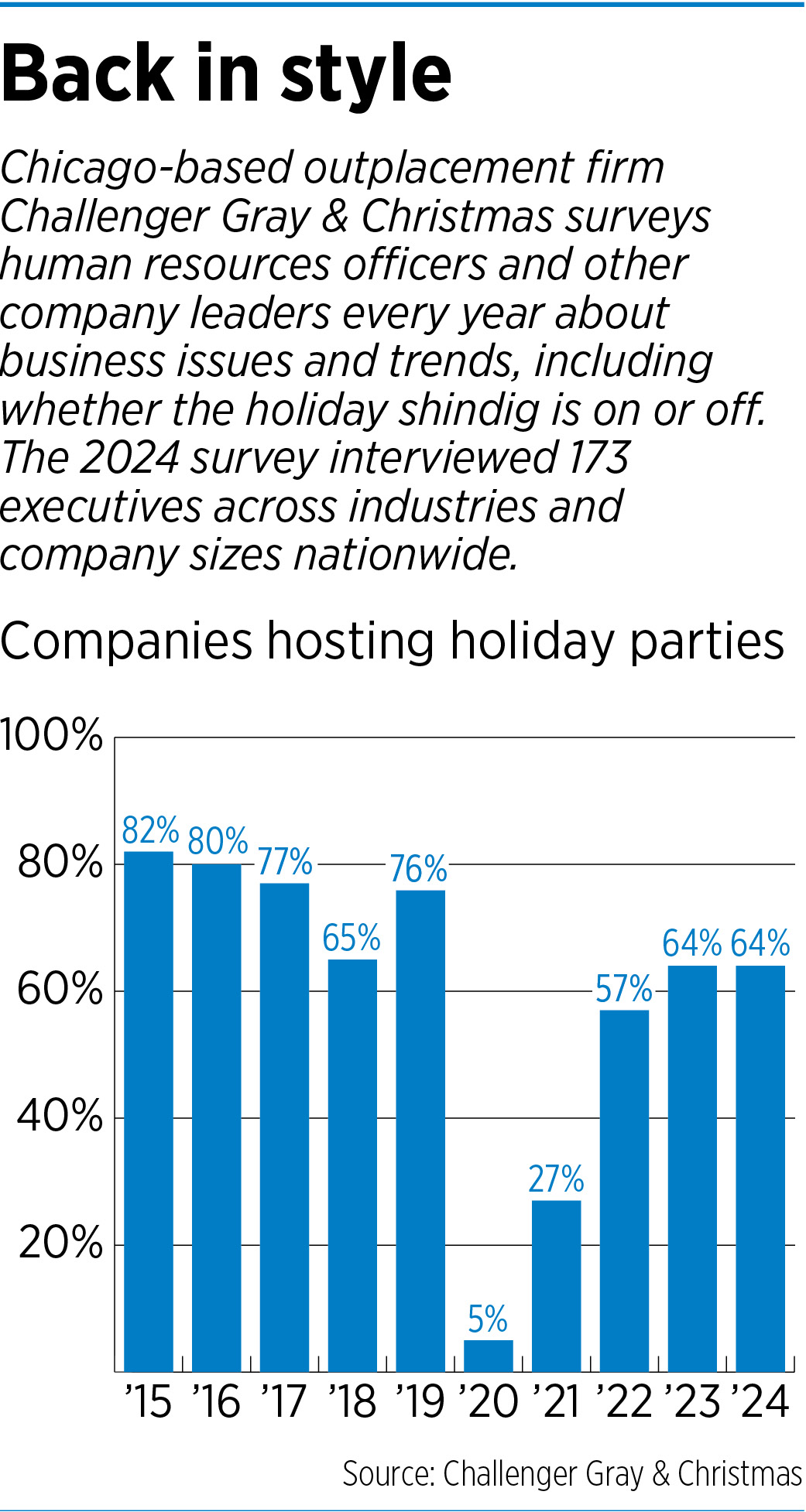
Firms that plan to host a holiday shindig must also contend with inflationary pressures driving up the cost of everything from food to rental spaces, along with the lingering social impact of the pandemic. Which perhaps helps explain a 2024 survey by Chicago-based outplacement firm Challenger Gray & Christmas that found only 64% of American companies planned to host in-person holiday parties last year. That was up from the first post-pandemic years but still down from 76% in 2019.
One change COVID seems to have accelerated is the decline of alcohol consumption. Gen Z workers in particular tend to opt for alcohol-free versions of the old standards.
“You still might see cocktails, but it’s a lot more balanced,” Shafer said. “We’ll have a mixologist creating mocktails alongside regular signature drinks, so everyone feels included.”

The shift has fundamentally changed how event planners, caterers and venues think about the holiday season.
“The goal used to be to reward employees with a fun night out,” said Miro Diamanté, senior director of development and experience at Accent Indy. “Now it’s about connection. People are asking how to celebrate in a way that brings everyone together, not just the extroverts.”
The new workforce
COVID also reshaped who attends corporate holiday parties. Younger employees, many of whom spent two years working remotely, are less inclined to spend their off-hours socializing with colleagues. As a result, many firms are turning their events into more casual, family-oriented affairs.
“We’re seeing more afternoon events, family-friendly celebrations and smaller group parties spread out over several weeks,” said Renee Carstens, co-owner of event designer Atmospheres Indy. “People are more conscious of mental health, child care and even transportation. That’s changed the tone of everything.”
Carstens said clients increasingly ask for décor that’s festive without being tied to a particular holiday.
“It’s more about creating an atmosphere that feels seasonal but inclusive,” she said. “You’ll see winter palettes, metallics, natural textures, and less red and green. Everything is more neutral and elegant.”
The menus are changing, too.
“Buffet-style dinners have given way to grazing stations,” Diamanté said. “It’s more conversational. … The goal is to make it feel relaxed but still special.”

BizBash Deputy Editor Sarah Kloepple, who tracks national event trends, said the change reflects broader shifts in workplace culture.
“Companies want to show they’re modern and values-driven,” Kloepple said. “That might mean choosing local vendors, adding sustainability elements or including experiences like live art, karaoke or food trucks instead of the same ballroom dinner year after year.”
According to Kloepple, the “experience economy” has reshaped expectations nationwide.
“It’s less about excess and more about authenticity,” she said. “Even the largest corporations want moments that feel personal.”
Distinctive venues are now in high demand. The Fountain Square Theatre Building, which hosts two duckpin bowling alleys along with other quirky amenities, is tightly booked this December.
“People say, ‘We come back because it’s so different,’” said Loren Balingit, sales and events manager. “‘We get this entertainment built in with our food, and we like the food, and you have a full bar,’ and they have a good time.”
Crane Bay Event Center, one of downtown’s largest private venues, is operated by Crystal Signature Events and can accommodate as many as 1,800 guests when its adjacent parking area is tented.

“Without the tent, our max is about 1,200 to 1,500, depending on whether it’s a flow event or everyone’s seated at once,” said Amanda Van Der Moere, director of sales for Crystal Signature Events.
Van Der Moere said Crane Bay’s corporate holiday bookings include law firms, nonprofits and major companies like Finish Line. The venue’s size and flexibility allow for custom configurations. The staff can segment the facility for smaller events, and in the past have gone as small as a 40-person luncheon.
As with others in her field, she’s seen a shift toward more interactive, casual events.
Clients are “looking for creative ways to get employees on their feet and networking,” Van Der Moere said.
 Market pressures, pricing
Companies, event planners and venues are not just responding to shifting tastes. They’re also grappling with inflation. Rising food costs and cautious corporate budgets are shaping every party decision, from theme to timing.
“It definitely has made a difference in prices and profitability,” Shafer said.
For large events booked far in advance, contracting around a food-and-beverage minimum rather than fixed menu prices helps manage fluctuations.
“Our big events definitely contract a year in advance at least, because there’s only so many places in town where you can fit 1,200 people for a dinner party,” Shafer said. “They commit to a food-and-beverage minimum, and the prices are going to fluctuate year to year, and they’re aware of that.”
Caterers also walk a tightrope between cost control and quality.
“We haven’t raised prices,” said Brian Poonpanij, president and co-owner of Kahn’s Catering. “We do our best to evaluate our pricing and publish our pricing once per year on our website.”
With large clients sometimes booking years out, such predictability matters.
“The last thing you would want is to procure catering services in a venue, and then suddenly prices go up dramatically,” Poonpanij said. “Chef-driven menu adjustments help us absorb those supply blips without surprising clients.”
Van Der Moere said the same pressures apply at Crane Bay.
“There definitely have been a few clients who’ve been affected by inflation,” she said. “We’ve seen a few cancellations, especially from government-funded events. People are cautious with their spending.”
But even with inflation-inspired price sensitivity, she said, business remains strong.
“We try to keep our prices in line as best as we can, but we’ve definitely seen a [spike] in beef prices and some random items here and there,” Van Der Moere said. “Expenses for us are a little higher, that’s for sure.”
Nonetheless, she said, large-scale events still make financial sense for companies that want to celebrate together.
“When you’ve got hundreds or even a thousand employees, it’s not like you can split into five small events,” she said.
Beyond December
One way companies are managing costs—and stress—is by moving their celebrations outside of December, effectively turning their holiday parties into holiday “after parties.”
“We call them ‘appreciation parties’ now,” Poonpanij said. “It’s not unusual to do them in mid-January or even February. Companies realized that employees are less stressed, venues are more available, and it still sends the same message.”
“There used to be a sense that if it wasn’t in December, it didn’t count,” Shafer said. “Now the calendar is wide open. January has become just as busy for us.”
Van Der Moere confirmed the trend.
“I’ve definitely seen more people delay until January,” she said. “It extends the holiday season for us, which is nice, but it also gives clients more breathing room. December is already packed with family and school events.”
The strategy, she said, also benefits the bottom line.
“Sometimes clients position it as a kickoff party for the new year or a celebration of the previous year’s accomplishments,” Van Der Moere said. “It spreads out business for venues like ours, but it also helps clients save.”
Entertainment trends have also evolved.
“We used to do a lot of DJs and dance floors,” Carstens said. “Now you’ll see live musicians, photo booths or interactive art installations. It’s about participation rather than performance.”
That evolution mirrors a workplace still finding its balance after years of remote and hybrid arrangements.
“People don’t see each other as often, so when they do, they want it to matter,” Diamanté said. “The best events are the ones that remind you why you like working together in the first place.”
Kloepple said the same holds true nationally.
“We’re seeing companies put more effort into quality over quantity—fewer parties, but better ones,” she said. “It’s not that the corporate holiday party is dying. It’s just growing up.”
And in Indianapolis, planners said that growth has brought a welcome dose of creativity.
“We’ve always been known as a convention city,” Carstens said. “But local companies are just as inventive as national ones. They’re doing immersive events, interactive themes, family parties—you name it. The days of the open bar and shrimp bowl are over.”•
Please enable JavaScript to view this content.
Editor's note: You can comment on IBJ stories by signing in to your IBJ account. If you have not registered, please sign up for a free account now. Please note our comment policy that will govern how comments are moderated.