
Subscriber Benefit
As a subscriber you can listen to articles at work, in the car, or while you work out. Subscribe Now
An idea started buzzing around in Kelly Cole’s head a few years ago as she watched a bee hive in action.
She was finishing her doctorate at Purdue University in cyber forensics and contemplating a career analyzing intrusion detection systems. Cole also was a mom of three boys, soon to move from California’s Bay Area back to West Lafayette.
Cole watched bees in the hive, on display at a natural history museum, all fanning their wings and got an idea for a tech startup that had nothing to do with cybersecurity: an energy company where cars, the drivers inside each doing their own thing, all contribute to the electrical grid, like bees all helping the hive.
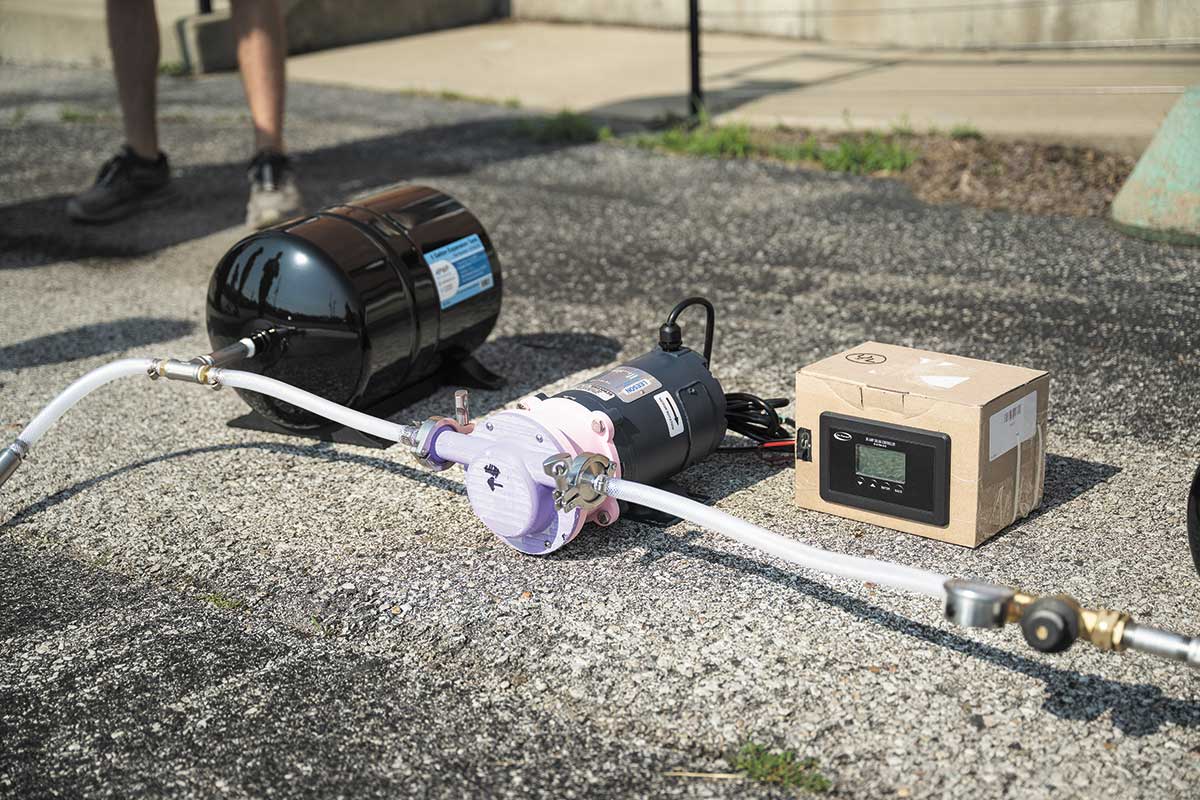
The resulting company, Energy Road of West Lafayette, is developing a closed-loop energy hydraulic system called Volty. The speed-hump-like device is placed over a public road or entry to a parking garage. It compresses when driven over by traffic to spin a turbine, generating electricity. West Lafayette-based Blichmann Engineering, which specializes in brewing equipment, worked with Energy Road to develop Volty.
Cole and her husband, Rhys Thomas Dale, built the prototype in their garage, Dale is also an Energy Road founder and the company’s chief technology officer.
IBJ talked with Cole about her career change and Energy Road’s Volty system.
The conversation has been edited for length and clarity.
What is Energy Road?
We’re developing a roadway electric generator powered by vehicle traffic for cities and organizations looking to lower costs and provide reliable, clean energy. It resembles a speed hump that compresses when driven over to power a turbine, generating the electricity.
One thing people always ask is if the electrical flow is steady enough to feed to the grid because the grid needs it to be steady. And the answer to that is yes; we meter the flow to the motor so that Volty generates continuous electricity, and because of that, it can run on its own for 15 minutes without a passing car to keep a steady, constant flow of electricity.
How much power can it produce?
A single Volty unit on a small scale across one road with two lanes is estimated to generate 267 kilowatts a day from 10,000 vehicles, enough for 10 homes, delivering $42 a day in energy value at 16 cents per kilowatt.
Is the Energy Road Volty system in use?
We have a pilot with the city of West Lafayette to power the pedestrian lights on Kalberer Road.
The company changed its name from ColeTech to Energy Road and your product from Energy Hump to Volty. What was behind that?
We did a [marketing consultation] with Techstars [business accelerator], and we just finished another … with Gener8tor Skills Accelerator, and we changed the name to Energy Road and Volty. Everyone loves it.
Where did you get the idea for this company?
I was looking at bees at the California Academy of the Sciences museum in San Francisco, and I noticed how each bee’s repetitive movement (wing flapping to help regulate hive temperature, for example) helps the entire hive. Then I just started wondering if we could produce energy that way as we drive around in our cars every day. I initially envisioned it on a highway, just using cars going over, like a hump that turned a turbine. And then I talked to Rhys, because he was right there with me, and I was like, “Can we do this thing that I’m thinking of?” And he designed it.
You earned a PhD in cyber forensics from Purdue University in 2023. What made you decide to focus on a renewable energy project?
Right when I got my PhD, I was like, “I don’t know if this is going to be meaningful enough for me to sit there in a cubicle [working on] cyber defense, so I guess that’s why I probably thought of [the idea for Energy Road].
I just finished the dissertation, and then I was working on a research article from the dissertation. While I was working on that, I just came up with this idea out of nowhere, really. And then Rhys is like, “Yeah, we could probably do that.” My dad is a bridge construction engineer, and I asked him as well, and he’s like, “That might actually work.” So once the “energy humps” are on the road, I won’t look so crazy.
Whom do you foresee as Volty’s first potential customers?
We were going to start with cities and then not limit ourselves—also, California cities where there’s lots of traffic.
Our electricity bill was really high [in California], and then [utilities] were turning our power off a lot when we were living in California. So [that’s] probably another reason why we thought of it while we were living there in California.
How much will a Volty system cost?
The estimated price is $18,000 for a small-sized Volty for a parking garage or two-lane road and $150,000 for a large-sized utility application across 10 lanes of traffic in California. We will probably get the cost down, so it’s just an estimate. We make money from direct sales or leases. We also offer a revenue share.
How does this contrast with other renewable energies, like wind or solar?
Ours compares more closely with kinetic energy tiles, the piezoelectric [generators] and other roadway generators. But they dig up the road, and ours [lies] across the road. All the components are off the shelf, so that brings down the cost.
Solar is lowering in cost but takes acres … where these just go onto existing infrastructure.
One point worth clarifying is the misconception that Volty’s energy isn’t clean. In fact, Volty generates clean electricity by harvesting braking energy that would otherwise be wasted from vehicles already required to slow down in places like parking garages, pedestrian zones, off-ramps and toll areas. It’s not creating additional emissions; it’s capturing energy that’s already being lost.
Growing up, were you more interested in computers or nature?
Both of those. But I went straight into the computer area, and then I guess that’s not what I wanted to do in the end. I wanted something more meaningful that would help society a little bit more, and then I would feel better about my contribution.
How many hours a week are you dedicating to Energy Road?
For summer, so in the mornings, I work on the project, and then in the afternoons, I take [my children] to the pool and play. They get the afternoon.
I was transitioning from being a mom to, “What am I going to do next?” And I didn’t think sitting behind a cubicle was going to be all that helpful, so I just wanted a project that was meaningful.
Energy Road is still a new startup, but what have you learned or enjoyed most about this project so far?
Just seeing the idea come to life has been cool, just to get one out there on the road.•
—Daniel Lee
Please enable JavaScript to view this content.
Every busy interstate off-ramp and toll booth location should get one of these.
How can I invest in this business?
[email protected]