
Subscriber Benefit
As a subscriber you can listen to articles at work, in the car, or while you work out. Subscribe Now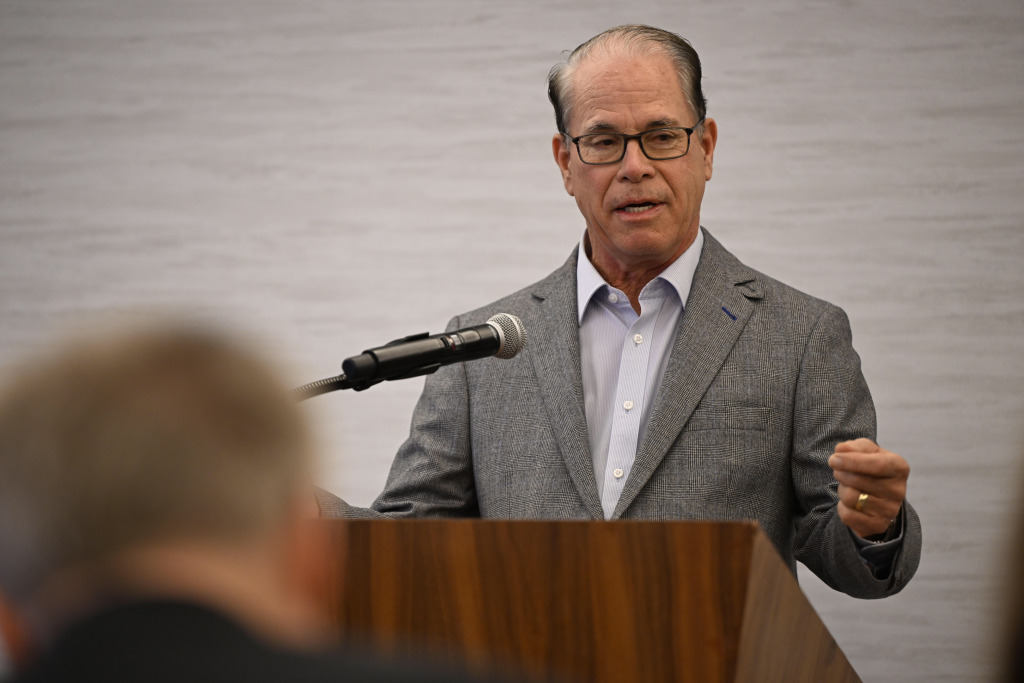
Indiana Gov. Mike Braun on Wednesday announced the creation of a task force to plan for how the state will meet growing demand for energy.
It was part of an executive orders he signed last week and uploaded Wednesday.
“Indiana’s economy is growing, and we need new solutions to meet this accelerating energy demand reliably and affordably,” he said in a news release. “My new Strategic Energy Growth Task Force will take an all-of-the-above approach to meet the electricity demands of our growing economy in the short-run, and plan for Indiana to become an energy export state and national leader in nuclear energy for the long-run.”
Braun said that’ll be done “all with a focus on reliability and affordability for Hoosiers.”
The “state energy growth” plan—which will include 5-year and 20-year outlooks—is supposed to focus on a range of priorities and objectives:
- Maintaining the “all-of-the-above” take on energy sources and maintaining existing coal-powered plants.
- Developing the energy sector to meet current and future power needs, and to make Indiana an energy-exporting state.
- Fostering technological “collaboration and innovation” between the state and private sector. Braun hopes to go nuclear.
- Ensuring energy is affordable and reliable.
Braun’s order gives the task force a to-do list.
It must engage utility companies and others to align their strategic plans toward meeting the state’s energy growth targets. And it has to work with grid operators to focus on grid connection, transmission, dispatchable energy sources and more.
It will also work with the Indiana Economic Development Corp. to identify prospective big industrial power users and build support for “strategic clean energy industrial hubs.” It’ll consider ways to “encourage” those big grid additions to help pay for new electricity generation and transmission.
The task force was directed to analyze what’s driven electricity prices higher over the last 20 years and “propose actionable recommendations.” Additionally, it must “streamline” agency permitting procedures—“while safeguarding the (state’s) abundant natural resources.”
An initial task force report is due to Braun by the end of the year, and a state energy growth plan is due May 29, 2026.
The group’s membership includes Energy and Natural Resources Secretary Suzanne Jaworowski, Commerce Secretary David Adams, Office of Energy Development Executive Director Jon Ford, Department of Environmental Management Commissioner Clint Woods, Department of Natural Resources Director Alan Morrison, Utility Regulatory Commission Chair Jim Huston, Finance Authority Public Finance Director Dan Huge, or their representatives. Other executive branch experts may join.
The order also invited participation from legislative branch utility leaders, grid and transmission representatives, and other industry stakeholders.
The Indiana Capital Chronicle is an independent, nonprofit news organization that covers state government, policy and elections.
Please enable JavaScript to view this content.
Good luck trying to get a nuclear power plant built anywhere in this state. Nobody’s going to want that in their community even though I think that’s the best option for generating electricity and getting rid of these coal-fired plants and other types of electricity generators.
Transport and storage of the resulting nuclear waste is always the hardest part. No one has good answers for that yet, only band aids and pie in the sky dreams. The problem is no state wants to be a nuclear waste repository. While Nuclear power could eventually be a great option, the support infrastructure is not in place.