
Subscriber Benefit
As a subscriber you can listen to articles at work, in the car, or while you work out. Subscribe NowSoon after launching Taylor Advising in 2019, Marla Taylor realized her days as a solo entrepreneur were numbered.
Like many founders, Taylor felt torn between her perfectionist streak—which made her less than eager to let go of certain tasks—and the potential for growth associated with hiring an employee or two.
“I think the tipping point was probably when I wasn’t getting much sleep, trying to manage everything on my own,” Taylor said. “I realized I was spreading myself really thin as we got more and more clients, and that happened pretty quickly, within the first year of opening.
“Just being able to admit to myself that if I could bring somebody else on, it was a risk worth taking.”
By building a team of 12, Taylor Advising found a payoff in clients such as the Coalition for Homelessness Intervention and Prevention and Big Brothers Big Sisters of Central Indiana. The company describes itself as a specialist in working with organizations focused on social good.
“When I started Taylor Advising, I never would have imagined we would be the size we are today, getting to be at the tables we’re at today,” Taylor said, “or having a hand in some of the big issues we’re getting a chance to help our city address.”
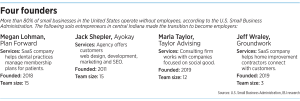
More than 80% of small businesses in the United States operate without employees, according to the U.S. Small Business Administration, and many entrepreneurs thrive by staying solo. For Taylor and others, it’s not a sustainable path. But deciding when and how to grow the team can be challenging.

Jeb Banner, an Indianapolis-based founder or co-founder of about a dozen startups, said the factors in deciding whether to hire aren’t overly complicated.
“You add employees because you can’t do it all yourself,” Banner said. “It’s such an obvious answer, but either you don’t have the technical ability, or there’s too much work.”
Of course, team-building presents challenges, including what roles to fill, what candidates to choose and how hiring makes financial sense.
Banner’s career includes the co-founding of board-management software firm Boardable and online marketing firm SmallBox.
He’s a fan of the Entrepreneurial Operating System created by Michigan-based entrepreneur Gino Wickman. The system details two archetypal roles for every company: the visionary, known for passion and creativity, and the integrator, who’s detail-oriented and an expert at resolving conflict.
“When you’re starting off, you have to play both of those roles,” Banner said. “But I found, the sooner you get the other person in place, the more we’re all doing what we’re best at.”
Jack Shepler, founder of marketing and web design agency Ayokay, said he was influenced to hire his company’s first full-time employee after reading “The E-Myth Revisited: Why Most Small Businesses Don’t Work and What to Do About It,” by California-based author Michael Gerber.
The E-Myth system details three personalities you’ll find in companies: entrepreneur, manager and technician.
“Most small businesses start because the technician says, ‘I can do this myself,’” Shepler said.

Shared responsibility
Shepler, who now leads a team of 15, said he’s most comfortable in the role of entrepreneur who delegates tasks.
“When you’re a solopreneur and you move toward getting a team, it’s hard to not want to do the thing,” he said. “You have to learn how to trust people, which can be hard. I’m used to doing things a certain way. I like things to come out perfect. … It’s figuring out how to stay involved but not micromanage.”
Taylor, whose consulting company helped to draft the Indianapolis Metropolitan Police Department’s Strategic Plan for 2026 to 2031, said she doesn’t expect employees to approach every task the way she would.
“We try to give space for other people to let their talent shine and complement the way that you do it,” Taylor said. “Our work has gotten better and better with every person who’s joined our team.”

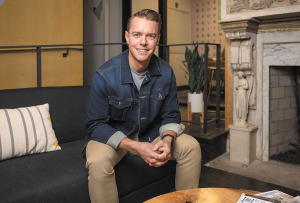
Max Yoder co-founded Indianapolis-based company Lessonly in 2012. The tech firm, which sold sales training and coaching software and services, employed 275 people when California-based Seismic acquired it in 2021.
Yoder said employees respond positively to delegation.
“When people feel trusted, they don’t just work at their baseline,” Yoder said. “They want to show they appreciate that trust. So I think they throttle it up.”
The Goshen native mentioned the hiring of Mitch Causey, who served as marketing leader at Lessonly, as a time for him to let go of control.
“Mitch came in, and he put out some marketing materials,” Yoder said. “This was the first time that I hadn’t made the marketing materials. They were not the marketing materials I would have made. And what I felt in my body was, ‘Oh, that must mean that it’s not going to work.’ But I kept my mouth shut, and it totally worked. It was this great realization for me that there’s probably 6,000 versions of a marketing material that would work.
“There’s a big world out here of what works. I don’t have a monopoly on it.”
 Talent search
Yoder, now a board member for Indianapolis-based dog food company Kibbies, said hiring for a startup differs from hiring for an established corporation.
Startups are works in progress, Yoder said, with no shortage of unknowns. A founder can help potential hires by sharing an accurate depiction of the business.
“If somebody comes into the business, and they think we have it all figured out, or at least largely figured out, they’re going to be pretty disappointed,” Yoder said. “It’s not really how this works. The job is to figure it out. When I wanted somebody to join, I did a lot of flagging of reality for the parts that were the most challenging, so when they came in, they weren’t feeling like it was a bait-and-switch sort of thing.”
Jeff Wraley founded Zionsville-based Groundwork in 2019 as a software-as-a-service, or SaaS, platform to help home improvement contractors connect with customers. This year, Wraley and his staff of two launched ProjectStory, a Groundwork spinoff that allows homeowners to submit videos of potential fix-it projects for quotes by contractors.
Wraley said adaptability and a sense of adventure are important traits in otential hires.
“You need to identify the folks who are up for a journey when you’re in the early stages,” Wraley said. “Evidenced by our adjustments to go after the ProjectStory concept and launch this spring, it was ‘All right, guys; here we go. This is what we’re doing now.’ You have to be transparent with the team.”
In the case of Taylor Advising, a job candidate’s chances are helped if Taylor knows the person or has witnessed their work.
“I know I can trust not only their talent and skills, but also that they have the same values I have,” Taylor said. “They believe in the bigger picture I see, and we share the company’s culture. I’ve taken careful steps to know that’s true before I’ve ever hired anyone onto my team.”
Buyer beware
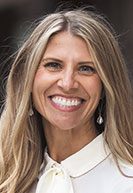
Megan Lohman said mentors advised her that a founder is a company’s salesperson until $1 million in revenue is reached.
Nevertheless, Lohman said, she hired sales staff early in the lifespan of Plan Forward, the SaaS platform she founded that helps dental practices manage membership plans for patients.
Focusing on the role was difficult to resist, she said.
“You need sales. That is the lifeblood of the company,” Lohman said. “You feel like you’re bogged down with running the company and you think, ‘If I could just hire a salesperson to fill the funnel, it would make everything else easier.’ But a salesperson is one of the most expensive and difficult hires.”
Lohman said early missteps in sales taught her “what not to hire.”
To correct course, Lohman said, she “had to do what nobody else could replicate and kind of offload everything else.”
Founded in 2018, Plan Forward presently has a team of 15 that works in the sector of direct primary care—a health care model in which patients pay monthly or annual fees to have access to concierge medical professionals.
At Groundwork, Wraley hired employees to address customer onboarding and customer success, or “pain point” solutions.
Wraley said he steers clear of speculative hires, or situations in which a company owner wagers on growth in contrast to hiring based on needs.
“When you’re an early-stage company, dangerous hires are ones where you’re reaching for growth goals and you might not know exactly how you’re going to get there,” Wraley said. “You have a good sense, but how long does that growth channel and that role make sense to do the thing that you think is going to happen? Those speculative hires are the gambles, for sure.”
Piece by piece
Ayokay founder Shepler said he helps his company’s bottom line by working with a fractional chief financial officer. Fractional executives serve part time for perhaps two to three companies.
“A true CFO at a company is going to want more than $250,000,” Shepler said. “That doesn’t make sense at a 14-person company. So he splits his time, and he’s just super sharp. I’m a creative guy, not a finance guy. Before the CFO, I largely was making decisions based on if I felt like the bank account was growing or shrinking.”
Lohman considers fractional staffing a major trend among small businesses.
“You can get a lot of mileage out of fractional,” the Plan Forward founder said. “We add full-time as our revenue can support more full-time headcount. Until then, you use fractional resources as much as possible. It leverages your cash and your burn rate.”
Serial entrepreneur Banner said fractional executives are appealing to CEOs because of the smaller financial burden.
“They usually piece together two to three fractional roles, and you get senior-level talent without having to spend the full salary price,” Banner said. “It’s also a ‘try before you buy,’ because in my experience, a lot of those fractional people become full time as the business grows. The fit is there.”
Fractional hires should not be subjected to overzealous work demands, Banner cautioned.
“I think there are ways you can abuse that, where somebody is hired fractionally and treated full time in terms of the ‘always-on’ culture,” he said. “As a fractional employee, I think it’s important to set boundaries, reset them and communicate them. I try to be conscious of that.”
Banner’s latest startup is Bounce.fm, a software platform to help music creators organize workflows and collaborate with fellow artists online. Banner hired Bounce’s first employee in August. Subscriptions for the public are expected to be offered by the end of the year, he said.
In the meantime, Banner endorses any solo entrepreneur’s notion to build a team.
“The biggest thing you gain is somebody who’s waking up every day like you are, if you hire the right person and give them the right reasons to be excited about the business,” Banner said. “I can do a certain amount of things alone, but every time I’ve succeeded in anything I’ve done, it’s been with other people.”•
Please enable JavaScript to view this content.
Thank you this was exactly the article I needed as a solopreneur who is exploring growth!