
Subscriber Benefit
As a subscriber you can listen to articles at work, in the car, or while you work out. Subscribe Now
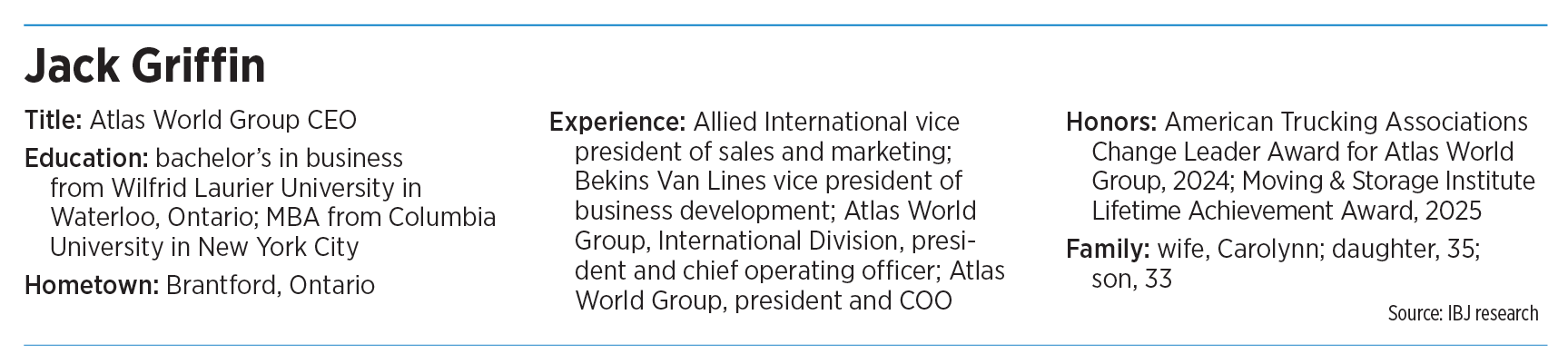
Atlas World Group CEO Jack Griffin speaks candidly about what he believes the impact tariffs imposed by President Donald Trump will have. On his company, on Americans and on other countries.
Griffin is a Canadian-turned-Evansville resident born in the same town as Wayne Gretzky (“I taught him how to play hockey, and I went into the moving business,” he jokes). The CEO of major moving and storage conglomerate Atlas World Group doesn’t sugarcoat his opinion: “The American people will suffer,” he said, as will America’s neighbors to the north and south. “It’s just stupid.”
He also takes issue with Trump’s targeting of diversity, equity and inclusion initiatives and immigration.
The 30-year industry veteran earned a lifetime achievement award from the Moving & Storage Institute this year and has committed to leading the company for two more years before he retires.
This interview has been edited for clarity and brevity.
What’s the shortest, easiest explanation for what all Atlas does?
We don’t own any trucks. We sell through independent agents. There are 250 of them in the States and probably about 100 of them in Canada. And so the company that I work for, we are a bank, we are a tech company, and we are a marketing company.
We’re not a legal co-op, but the agents actually own the company that I work for. The board of directors that I chair has 15 agent-owners, and my staff holds them in compliance, and yet they actually own the company that I work for.
We manage a network. If you wanted to buy a new Ford, or a Porsche, whatever type of car you like, you would go to a Ford or a Porsche dealer. If you want to move with Atlas, or you use us for logistics, like moving medical equipment, you would actually go to an Atlas agent.
Can you tell me a bit about the technology you’re investing in?
It’s not sexy, and it’s not glamorous. It’s not software; we’re not Google, LinkedIn or Meta. But we still use technology as a differentiator. If you don’t, you get pretty quickly commoditized. A couple of guys in a truck show up and then grab your grandmother’s armoire. They put it in a truck, and they drive it from Indianapolis to Fort Myers, Florida. And there’s your move.
But the key is, [our agents] are contractually tied to us. And what that means is that we offer a technological ecosystem. A platform where, when they book a move, they go into their computer and they upload it, it goes into our system, and then we take over.
We spend a disproportionate amount of money on technology, because I really believe it’s a differentiator. I mean, you could do this process manually, but you would be incredibly inefficient, and you wouldn’t make any money doing it. Technology is a very important topic for our company.
We probably followed a lot of the gig economy, like Uber, DoorDash, Grubhub and Lyft. They pioneered dynamic pricing.
We do about 60% of our annual revenue in a 90- to 120-day window. People move when their kids are out of school. It’s a big V curve. We have more business than we know what to do with for about 90 days out of the year, and for the other nine months, we’re trying to fill our trucks. It’s a really weird business.
If you move during what we call peak season, you will pay more because there’s a limited capacity. We run out of capacity.
Is Atlas impacted by the tariffs, or the threat of tariffs, right now?
It’s horrible. Without talking politics, we have a big Canadian company. We have a big U.S. company.
A lot of the big Canadian banks, they have a U.S. presence. So we call that cross-border business, because you can drive from the U.S. to Canada and vice versa. That business is going to be completely eliminated through the tariffs.
Already, the Canadian companies are saying, “OK, well, if that’s your attitude in Washington,” and they’re pointing at one person, and you can imagine who that is. They’re saying, “OK, screw you guys. We’re not going to vacation in the States. We’re not going to make any investment in the States.”
You know, two of the Canadian banks are two of the biggest banks in the United States right now—BMO, Bank of Montreal, and TD, which stands for Toronto Dominion. They’ve acquired U.S. banks and have a significant footprint.
So it’s incredibly unhealthy. It’s unhealthy for the automotive industry. GM and Ford are our accounts. That’s going to grind to a halt on moving people until the tariffs are resolved.
I’m really not objective. I went to Columbia University in New York and did my MBA there. Like some of the better schools in the country, we believe in open markets. These tariffs are the opposite. … They’re trying to bring jobs back to the United States. That ship has sailed. It’s just never going to happen.
The supply chains are so integrated. The American people will suffer. So will the Canadian people, and so will the Mexican people. It’s just stupid. It’s just the dumbest thing. Just when we thought we were going to get some kind of recovery. We are not happy with the policies coming out of this administration so far.
Diversity, equity and inclusion are important at Atlas, and something that you’re not planning to let up on. Can you talk a little bit about that?
Regardless of whether the Democrats are in power or the Republicans are in power, I’m kind of a stubborn Irish guy. We don’t take our direction from the White House.
Now, we have government contracts. We move a lot of the military. We move a lot of the Department of State. So if the contract gets revised where they don’t want to see any of our DEI programs on our website, or something like that, fine. We’ll soften the language there or whatever.
But about six, seven years ago, I appointed a CDO, a chief diversity officer, and we’re not abandoning that. Like I said, we don’t take direction from the White House. We run our company the way we want to run it.
I think this administration is conflating diversity, equity and inclusion with tokenism. The company that we run is based on a meritocracy. Whoever’s educated, whoever’s experienced, who’s deserving, who has the work ethic, they’ll get the job.
I was asked that question a few weeks ago. We have a midmanagement group, and these are all of our best and brightest in our up-and-comers, about 20 of them, and they asked me to come over and address them in our auditorium in their different building. And the first question was this young man. He said, “Given what the White House is doing in the new administration on diversity, equity, inclusion, what’s going to happen here?” I said, “Well, as long as I’m running this company, we’re going to create a safe place for my employees to work.” We’re in a battle to get the best people. I don’t care what religion or no religion, or who you’re married to or who you love. What I care is you do your damn job.
As long as I run this company and I’m given free rein, I believe it is the right thing to do. I’m not doing it because it’s trendy or because Hollywood says I should do it. And you know what? People want to work here; we have a very low turnover rate. We have a reputation of being a compassionate and kind and receptive, inclusive place, and I want my employees to feel safe.
We don’t tolerate any type of injustice, racism, homophobia or antisemitism. If there’s an incident of that, they won’t work here anymore.
In that same vein, would it be accurate to say that the bulk of your workforce is made up of immigrants?
Probably 90% of the guys that work on the trucks, that do the packing, the loading, all the literal heavy lifting are Hispanic, Mexican or from Latin America. For sure, and they’re the hardest workers. You know, there are no white people who want to work that hard.
Probably the vast majority of the people who do the literal heavy lifting in what we do in the moving business are immigrants. They’re legal. They might live in Tijuana but work in San Diego, but they’re legal. You know, they’re on green cards, or they’re on visas or whatever. There’s no, there’s nothing under the table.
This administration—if [the immigrants it’s targeting are] bad people, good, go get the bad people. Get the drug lords or the gang members. They don’t belong here. But you’ve got people who want to work hard and pay taxes and Social Security. We’ll take them all day long.•
—Taylor Wooten
Please enable JavaScript to view this content.
Why is this in our IBJ. We don’t care to hear this political nonsense.
What about it makes you upset and uncomfortable?
How about becasue tariffs will impact Indianapolis Business.
I’d work for this guy.
+1
Love him reaffirming his commitment to diversity, equity and inclusion work. The business case has not changed, this work continues to be good for people and business.
Such a B.S article. He/Atlas is not committed to DEI, if he was mandated to hire 25% black and 40% White workers, we wouldn’t do it. He states 90% of the work force his hispanic. While I agree ALL companies should be based/built on meritocracy, Atlas certainly cannot claim itself to be purposely diverse….what a joke.
Griffin emphasizes that Atlas hires and promotes based purely on merit. That’s completely consistent with what the Trump administration is calling for and inconsistent with what DIE has become at most corporations, a de facto quota system. He then explains that about 90% of the laborers on Atlas trucks are Hispanic — many of them immigrants — because they’re the hardest workers, and he follows that up by adding what some would consider a racist comment, stating that Whites aren’t willing to do such hard work. A more honest statement would be that most non-immigrants are unwilling to work for the wages Atlas pays. And what does his CDO do? Hire almost exclusively Hispanics, apparently? When the fact is that most corporate DIE programs would require that Atlas have a representative proportion of all races and genders as laborers. How many women does he have doing heavy labor? So, either Griffin doesn’t understand DIE, or he’s just a phony, doing exactly the opposite what he claims.
His definition of DEI is about the most anti-DEI statement I’ve ever read. No version of DEI includes the word “meritocracy”. He’s also quite racist for a DEI diehard, he says NO white person wants to work hard. Get that everyone, no white person anywhere in the world. Since only Hispanics work hard, I dare him to include Black in that statement the next time he’s spews his old-timey racist views in public.
A real stand up guy. Hires based on merit(as every good CEO should), but thinks he is a DEI champion.
Tool.