
Subscriber Benefit
As a subscriber you can listen to articles at work, in the car, or while you work out. Subscribe Now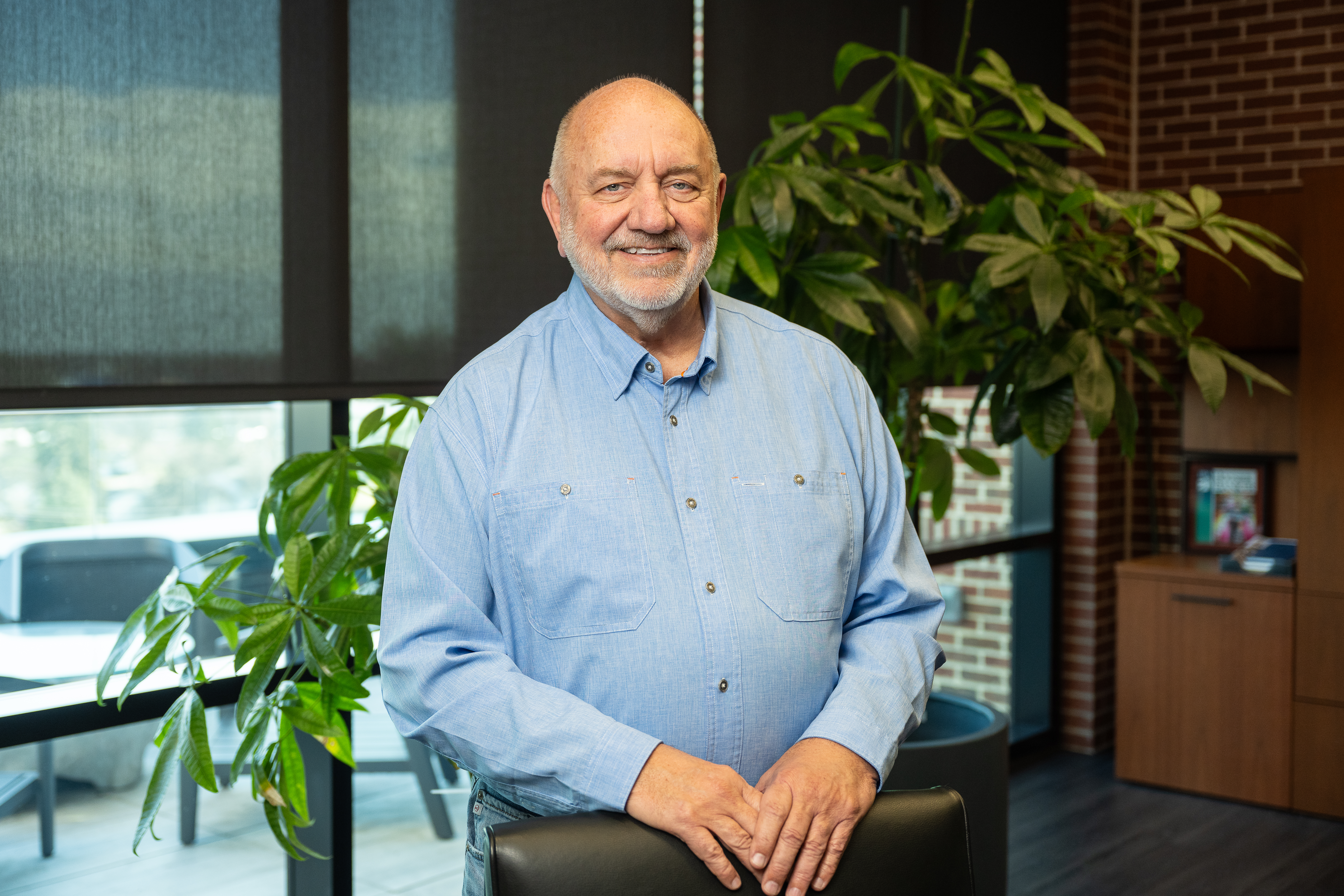
Before he was 10 years old, David Becker had a job delivering The Indianapolis Times newspaper in the Eagledale neighborhood. When he soon discovered that the more customers he had on his route, the more money he could earn to buy model cars, Becker traded in his Schwinn with the banana seat and high handlebars for a 10-speed so he could distribute additional papers quicker.
Equipped with that level of energy and knowledge as well as sage advice from his grandfather—“Just remember, no matter what happens, they can’t eat you”—an entrepreneur was born.
In the years since, Becker has gone on to found five companies, including Fishers-based First Internet Bank, which now is closing in on $6 billion in assets and employs more than 300. He helped start and seed TechPoint, the initiative to grow central Indiana’s technology sector, is a former chair of the Central Indiana Community Foundation and a board member of the Central Indiana Corporate Partnership, and is helping build a high school apprenticeship program.
In recognition of his work and community service, Becker is the recipient of IBJ’s second annual Mickey Maurer Entrepreneur of the Year Award.
“David has an unbelievable sense of entrepreneurship and common sense,” Fishers Mayor Scott Fadness said. “He can sit down with a Wall Street private equity firm, or he can sit down with a startup company, listen to a pitch and get to the substance of the project or the venture very quickly and decide whether there’s meat there or not. I don’t know where a person gets that skill set, but David has it, and it’s fun to watch.”
Becker’s skill set began taking shape in Speedway. When he was in seventh grade, his father, who grew up on a cattle ranch in the North Dakota Badlands, and his mother, who spent her early years on a tobacco farm in Kentucky, moved the family from just a bit north of the Indianapolis Motor Speedway’s West 30th Street gate to Monrovia.
“My brother and sister were both like, ‘My God, what did we do to make our parents mad?’” Becker said. “But I loved that I graduated from the Monrovia High School. I think there were 72 or 74 in our graduating class. It was a typical rural Indiana school: Four of us went from high school straight to college, two of us got out, and the rest either got jobs at Lilly, Allison Transmission or just stayed on the farm.”
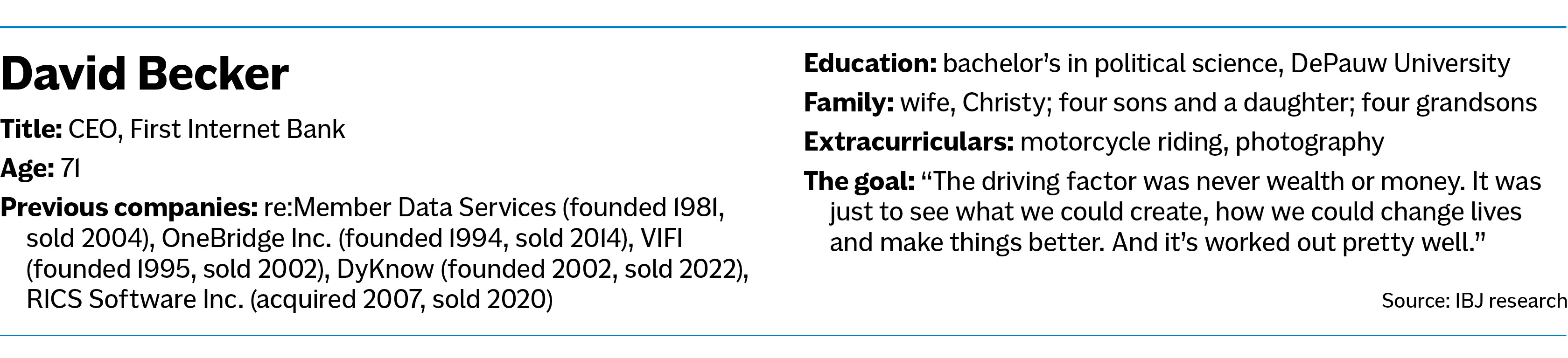
Becker chose DePauw University and majored in political science. His coursework included one computer class that went terribly after he knocked a machine off a desk. It sounded like a bomb went off, he recalled, and he had to pay his fraternity brothers to finish his programs so he could get through the class.
“I swore I’d never have anything to do with computers in my life,” he said. “And here I am.”
Getting started
After graduating, Becker, who had thought about going to law school, decided instead to work in finance with General Electric Credit Corp. That led to a job with the Indiana Credit Union League, a trade association for credit unions.
Then, in 1979, he saw an opportunity when deregulation came along. Credit unions could do whatever they wanted, Becker said, but they didn’t have any tools to do it. He wrote a business plan laying out how the trade association could provide data services for credit unions. When it took too long to decide what to do, Becker decided to do it himself. He bought the software he needed and set up his own data center, called re:Member Data Services Inc.
Becker started re:Member, known as RDS, with a credit card and a $10,000 loan from his father. That seed money came from a life insurance payment after his mother died of cancer. At the time, he thought that if he could ever get to $1 million a year in sales, that would be a home run. He reached that target in 18 months. (In 2004, Becker sold the company for $24 million.)
Over the next two decades, Becker built on that success. In 1995, he founded OneBridge Inc. to provide online, real-time processing for credit cards, debit cards and ATMs. The next year, he founded Virtual Financial Services, or VIFI, a provider of internet services for financial institutions and corporations. (He sold OneBridge for an undisclosed amount in 2013 and VIFI for $52 million in 2001.)
The big idea came in 1996. Becker realized that a bank could put together the software components of all three of his companies and operate nationwide. But not with bricks and mortar; the bank could do it electronically. He approached Bud Melton, then-president of First Indiana Bank, and made a presentation to the board. Becker said everyone in the room under age 40 bought into the idea. Everyone over 40 said, essentially, “Not in my lifetime.”
“Bud explained to me that it couldn’t be done, which is absolutely the best thing you can say to an entrepreneur,” Becker said. “So I’m standing at the elevator with my sales manager, and he says, ‘What are you gonna do now?’ And I said, ‘I’m gonna go start a bank.’”
Regulators required Becker to raise $15 million in initial capital—three times what a traditional bank needed, he said—and keep a 14-to-1 capital-to-risk ratio, which is about double what’s required from brick-and-mortar banks. It took three years to get a charter, but on Feb. 22, 1999, Becker launched First Internet Bank, the first FDIC-insured bank to operate completely online, from a flip phone.
Now, if you wanted to, you could bank wherever you were. In fact, you could bank naked—which is how the bank advertised itself in USA Today and elsewhere.
“I’ve been questioned many times: ‘How do you come up with this stuff kind of outside the box?’” Becker said. “And I said, ‘Nobody ever told me there was a box.’ My parents gave me a lot of flexibility and a lot of leeway as a child. They said, ‘Hey, you’re smart enough, you can figure it out, and if you get in trouble, don’t call us. If you’re smart enough to get in there, you can get out. So, I’ve been pretty independent.”
Give them rope
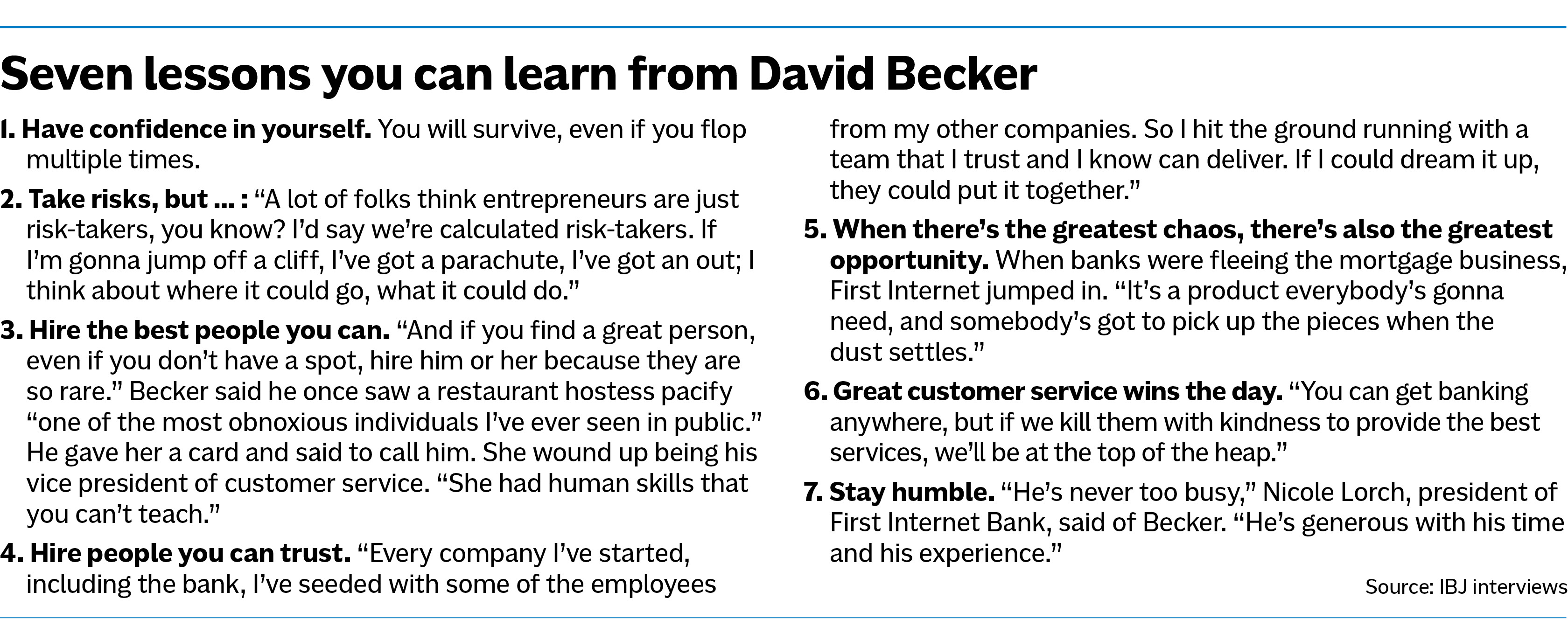
Becker credits some of his success to hiring good people and letting them handle the day-to-day operations running his companies. One of his favorite lines is, “I’ll give you all the rope you want. You can swing or you can hang.”
Mark Brown has worked with, for or in proximity to Becker for 20 years, ever since Brown was an auditor with the firm Crowe, and Becker’s RDS was one of his first clients. In 2006, Becker bought a company called RICS Software, and Brown, who had already worked as chief financial officer at VIFI and OneBridge, joined RICS as chief financial officer. (Becker’s son Jason was CEO.) When RICS was sold for an undisclosed amount in 2020, Brown was unsure about what to do next.
Becker offered him a job at the bank in a new line of business called fintech partnerships (a combination of “financial” and “technology”), which provides banking services and compliance oversight for fintech companies, enabling them to offer financial products and services without needing to be licensed banks.
Brown, who had no banking experience, was doubtful. But Becker told him: “‘We need somebody who’s not a banker to be around here.’ And he also said this: ‘I need somebody around here who will tell me no. I don’t have a lot of people who’ll do that.’”
After what Brown describes as “a rocky start,” fintech is now running “fairly well,” and Brown is first vice president of finance for fintech and special projects.
Nicole Lorch, president of First Internet Bank, started as VIFI’s director of marketing 29 years ago, straight out of DePauw University. After VIFI was sold, Becker hired her for the same position at First Internet Bank. He remembers calling her and saying, “‘Hey, if I remember right, you did a summer internship with a bank once upon a time, didn’t you?’” She had. “And I said, ‘Well, that’s more banking experience than I’ve got. Why don’t you come over and help me?’”
“David is an incredible blend of entrepreneur and leader, and I don’t often see both of those qualities embodied in one person,” Lorch said. “You think about a visionary, but then you hear about how difficult they could be to work for. And you hear about entrepreneurs that are constantly on to the next thing and there’s constant motion there.
“But David has a remarkable patience to him and a quiet charisma that draws people into him,” she said. “We’re very fortunate to have someone like that in central Indiana.”•
Check out more of IBJ’s ranking of Indy’s fastest-growing companies.
Please enable JavaScript to view this content.
Editor's note: You can comment on IBJ stories by signing in to your IBJ account. If you have not registered, please sign up for a free account now. Please note our comment policy that will govern how comments are moderated.