
Subscriber Benefit
As a subscriber you can listen to articles at work, in the car, or while you work out. Subscribe Now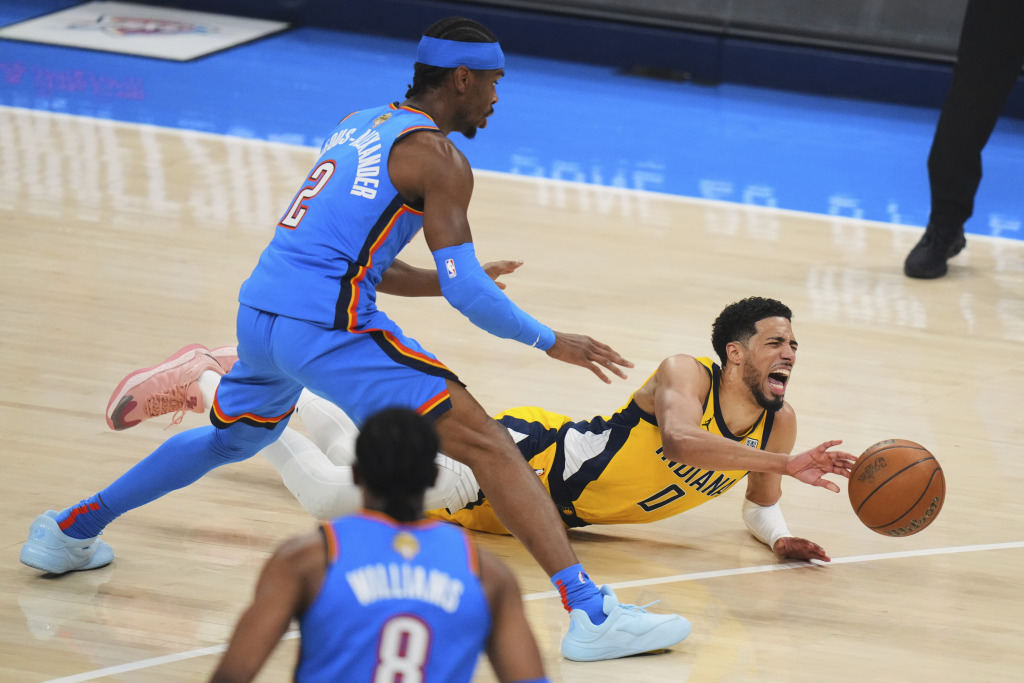
The NBA had already convened a panel of experts to study Achilles tendon injuries even before Indiana Pacers star Tyrese Haliburton ruptured his in Game 7 of the NBA Finals, Commissioner Adam Silver said Wednesday night.
The league had seven known Achilles injuries this season—Pacers forwards James Wiseman and Isaiah Jackson, New Orleans guard Dejounte Murray and Miami guard Dru Smith had them in the regular season, and Boston’s Jayson Tatum, Milwaukee’s Damian Lillard and Haliburton were hurt in the playoffs.
Silver, speaking to ESPN as part of its NBA draft coverage, said there weren’t any in the NBA in the previous season.
“We had already convened a panel of experts before Tyrese’s most recent Achilles rupture,” Silver said on the telecast. “We had seven this year. We had zero last year under the exact same circumstances. The most we’ve ever had in a season (before) is four.”
The injuries led to a question that has come up more and more in recent years: Is the NBA season too long? Silver doesn’t believe that is the case, and wonders if the way young players train and how hard NBA players train in the offseason is putting too much strain on bodies.
“When we look back at the last 10 years, the majority of the Achilles injuries have happened before the All-Star break,” Silver said. “So, it’s not clear it’s the number of games. And as you know, modern NBA players, even when they’re not playing games sometimes in the summer, they’re working harder than they are during the season when they’re playing three games a week.”
Haliburton got hurt in the first quarter of Game 7, one where Indiana went on to lose to Oklahoma City. A day later, after having surgery, Haliburton said he doesn’t regret the choice to play through a strained calf—which some suspect could have played a role in the Achilles injury.
Silver said the league is even using artificial intelligence in its search for clues about why the injury happened so often this season.
“I’m hopeful that by looking at more data, by looking at patterns, this is one area where A.I.—people are talking about how that’s going to transform so many areas—the ability with A.I. to ingest all video of every game a player’s played in to see if you can detect some pattern that we didn’t realize that leads to an Achilles injury,” Silver said. “We’re taking it very seriously.”
What experts say
Durant and Haliburton entered their respective NBA Finals elimination games with strained right calves. Each wound up leaving early with torn right Achilles tendons.
Durant, a perennial All-Star and the league’s 2014 MVP, missed the whole next season as he recovered from the injury and now Haliburton, the Indiana Pacers’ two-time All-Star, could face a similar fate. Predictable? Perhaps. Both knew the risks when they opted to chase a championship, and both wound up paying the price when their tendons gave out on pro basketball’s biggest stage.
“There’s no question you’re at a higher risk of worsening an injury or another injury occurring because maybe your gait is off a little bit or the muscle firing isn’t as good,” said Dr. Kevin Farmer, an orthopedic surgeon and chief of sports medicine at the University of Florida. “To Tyrese’s credit, maybe he wasn’t as healthy as he wanted to be, but he was willing to go out there and try to perform to win that championship for the team.
“He made a decision to take that risk, and I think there should be some credit there for trying.”
Haliburton’s injury reflects a new trend, though, one that has seen younger players become more susceptible to Achilles injuries that were traditionally more prevalent in athletes in their mid- to late-30s and early-40s.
Haliburton, 25, Boston Celtics All-Star Tatum, 27, and Milwaukee Bucks All-Star Lillard, 34, all suffered Achilles injuries in the playoffs and each is expected to miss most if not all of next season.
Farmer and Dr. James Borchers, president and CEO of the U.S. Council for Athletes Health and a longtime team physician for Ohio State football, have studied the changes. They attribute the increase in Achilles injuries to many factors from low-cut shoes to longer seasons to Fluoroquinolone, a class of antibiotics both acknowledge has been tied to ruptured tendons.
Neither has examined Haliburton, Tatum or Lillard.
But they believe the biggest factor may be younger athletes shedding the multi-sport label to specialize in a single sport year-round, creating more wear and tear on specific body parts, such as elbows and Achilles tendons, that are prone to break down based on workload.
“Athletes that are doing a a lot impact—so certainly jumping and putting a lot of stress across tendons—and those tendons over time can develop into micro damage and lead to weakening in the tendon,” Borchers said. “I think there’s a lot more activity that increases the risk of these types of injuries and it’s the wear and tear. It’s very rare we’re going to look at an otherwise healthy tendon rupture just rupture because of an acute event.”
It’s not conjecture, either.
Multiple studies from Farmer’s medical team at Florida have researched whether today’s overuse injuries in baseball occur because players are throwing harder for longer periods. Farmer said he considers the Achilles tendon in basketball to be comparable to the elbow in baseball.
“Instead of athletes getting (Achilles injuries) in their 30s or 40s because of wear and tear, we’re seeing it now early on because of the excessive stress they’ve developed their whole lives,” Farmer said. “I really think we’re going to find out at some point that the way we’ve changed (youth sports), the risk, is why we’re seeing these younger athletes injured.”
The image of Haliburton crashing to the ground and agonizingly slapping the court in frustration may wind up as the most indelible image out of this year’s NBA Finals. But he’s already said he doesn’t regret playing, and, like Durant, he doesn’t intend to let that moment become the defining moment of his career.
Instead, he plans to follow the example of Durant and others in the ever-expanding world of players who have overcome serious injuries to continue playing elite ball.
The good news for Haliburton: Medical technology is helping athletes make quicker, more thorough recoveries.
While a standard timetable for a return from Achilles injuries remains about 12 months, some NFL players have made it back in as few as nine and in 2023, former New York Jets quarterback Aaron Rodgers tried to do the unthinkable by returning for a playoff run less than four months after tearing his Achilles. Rodgers might have tried it—had the Jets been in the playoff hunt.
Nobody expects Haliburton, Tatum or Lillard to push it that quickly, especially in a sport where running and jumping are so essential. Even Indiana Pacers coach Rick Carlisle has said he doesn’t expect Haliburton to play next season.
Durant didn’t return from his June 2019 injury until December 2020.
And at least Haliburton and Tatum have one big advantage—age is on their side.
“The intensity and attention to rehabilitation is fantastic and you’re also talking about world-class athletes who sometimes recover differently from average individuals,” Borchers said. “We’ve seen some really amazing individuals come back from these injuries and with the expertise in rehab and recovery and the work they’re putting in, it’s pretty amazing to see them come back sooner than what the textbook might say. And there’s a big difference between (age) 25 and 39 or 40.”
Please enable JavaScript to view this content.
82 games is simply too much for these athletes. I’m probably in the minority but don’t have a problem with “load management” given the length of season and amount of dollars at stake with players.
82 games + In Season Tournament + Olympics.
82 games? The Pacers and Thunder both played 105 games this season.
I understand the money in the NBA Playoffs, but maybe they should reconsider the old system: 3 games first round, 5 games second round, 7 games conference and league finals, with more recovery time between each series.
The best season the NBA has had in a long time was the approximately 58 game season in the late 90s due to the players strike. Every game essentially meant something. 82 games is simply too many. Same for the NHL and MLB The NFL has 17 games. Any guess why football is so popular?