
Subscriber Benefit
As a subscriber you can listen to articles at work, in the car, or while you work out. Subscribe Now
Two Indiana University surgeons’ wishes to preserve a girl’s flowing hair during brain surgery motivated them to develop comb-like device that could help cranial surgery patients avoid having their heads shaved.
The invention and potential commercialization of the disposable handheld device show how innovation often comes from on-the-job problem solving, often facilitated by co-worker conversations and tinkering.

Dr. Jignesh Tailor, assistant professor of neurological surgery at the IU School of Medicine, and former IU fellow Dr. Steven Wakeman, who now practices in Florida, were operating on a young female patient with epilepsy. The diagnostic procedure involved implanting electrodes in the brain to find the source of her seizers.
“We were doing this implantation, and she had lovely hair,” Tailor said. “Especially with girls, I do ask whether they want to keep their hair. Most of them say yes—of course they do.”
Yet, avoiding having to shave a patient’s head is not simple.
The procedure involves drilling a hole in the skull. Tailor said preserving hair was a tricky task: an assistant would have to use tools such as forceps and manually hold the hair, often individual strands, to avoid them getting caught in the small whirling drill bit.
Working in pediatric neurosurgery at Riley Hospital for Children at IU Health, Tailor and Wakeman decided there had to be a better way.
The pair brainstormed. Wakeman, who has an engineering background, 3D-printed an early version of the device in the room where he was living at the time.
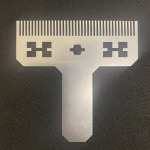
The comb-like device is designed to secure hair to the scalp and keep it away from the surgical incision area, while creating a gap for drilling into the skull.
Tailor, working with the IU Innovation and Commercialization Office, filed a U.S. patent application for the tool’s design. His goal is to have it eventually used by surgeons across the country.
“It’s not complicated,” Tailor said. “But it makes it just a lot easier to do because it gets all the hair out of the way, away from the drill.”
From there, the commercialization process gets more complicated.
Such devices need a process for sterilization before they can be used in the operating room.
Working with the IU’s commercialization team, Tailor took the approach of filing a patent application and then approaching a manufacturing company to produce a prototype device.
A surgical instrument maker produced the prototype, which Tailor said he is evaluating. For example, the prototype is metal. He is evaluating whether the device is soft enough to contour to the head but not too soft so that it doesn’t properly hold the hair in place.
“This innovative tool is easy to use, streamlines surgical procedures, and enhances patients’ emotional well-being by eliminating the need to shave their hair,” said Lakshmi Sastry-Dent, director of technology commercialization for the IU Innovation and Commercialization Office. “Currently patent pending, Dr. Tailor plans to evaluate the tool in upcoming surgeries.”
The device eventually could be used for a variety of surgeries, including those for epilepsy or tumor biopsies.
The prototype is in early testing. Tailor considers the device a side project to his primary work of surgery and leading a laboratory to study brain tumor development and treatments.
But he said he does love the idea of a patient leaving the hospital after complex surgery with a full head of hair when possible.
“If they don’t look any different, they walk out feeling OK,” he said. “It’s important to take every opportunity we can as physicians to innovate … otherwise the field doesn’t move forward.”
Please enable JavaScript to view this content.
This is the best article I’ve read today. Kudos to these doctors who obviosuly care very much about their patients….not just their physical health, but their emotional/mental health as well. How wonderful!