
Subscriber Benefit
As a subscriber you can listen to articles at work, in the car, or while you work out. Subscribe Now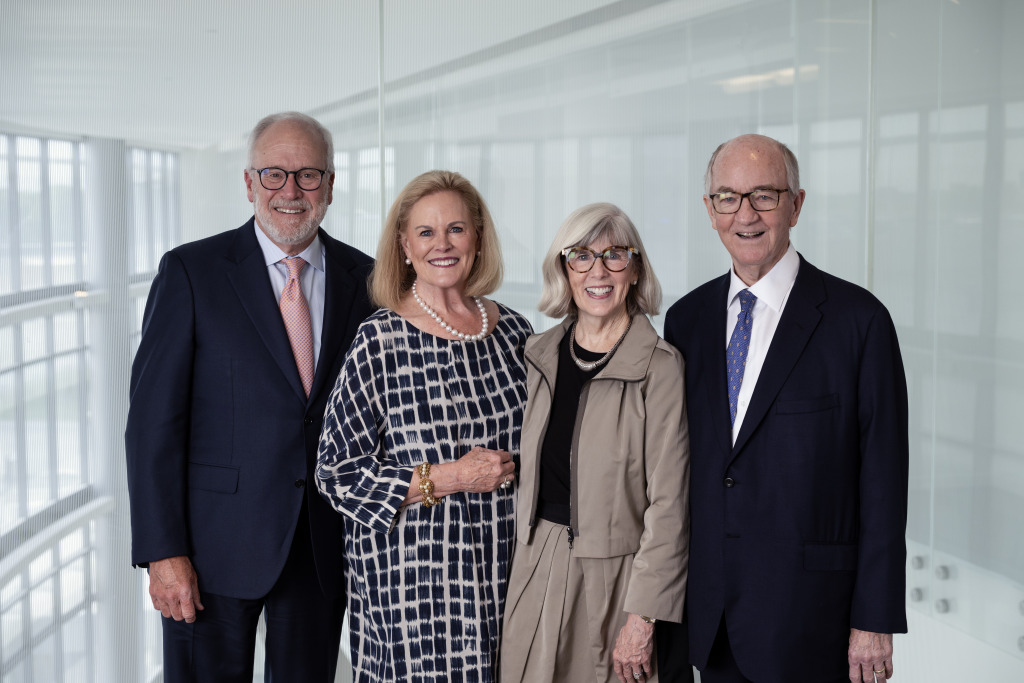
Former Eli Lilly and Co. CEOs Randall Tobias and John Lechleiter, with their wives Deborah and Sarah, respectively, have partnered to commit a combined $20 million gift to create the Tobias-Lechleiter Institute for Clinical Innovation at Indiana University Health.
What’s more, IU Health said it is matching the gift, providing a total of $40 million. The donation was announced Tuesday.
The Lechleiter and Tobias families are each giving an estate gift of $10 million, which together becomes the largest to be received by the IU Heath Foundation, which is the philanthropic arm of Indianapolis-based health system IU Health.
The Tobias-Lechleiter Institute will focus on getting more Hoosiers enrolled in clinical trials and advancing medical research at IU Health and the IU School of Medicine. The resources and impact from the gift at the new institute are to be shared by the two institutions.
“It’s really a gift that’s intended to benefit both organizations, and that’s a huge win for us as we look at what collaboration and partnership looks like across the board,” said Crystal Miller, president of the IU Health Foundation. “It really means for us we can help make people healthier faster.”
Miller said to have a major gift coming from two high-profile former CEOs from the same company and their spouses—all friends who often socialize together—was rare.
Tobias served as CEO of Indianapolis-based drugmaker Lilly from 1993 through 1998. Lechleiter, who spent his career at Lilly, served as CEO from 2008 through 2016.
“I can’t imagine anybody else we would have teamed up with,” Tobias said.
In fact, Tobias said the two families first discussed the gift while relaxing on the porch of his lake house.
The Tobias family was already planning to make a gift, and Randall asked John if he’d like to join—also mentioning the plan for IU Health to match the gift.
“I said, ‘You sort of had me at hello,’” John Lechleiter remembered telling Tobias.
“Both of us, the Tobiases and the Lechleiters, from experience at Lilly, understand the importance of clinical trials,” Lechleiter said. “We want Indiana to be well represented in clinical trials.”
Tobias said the impact from boosting clinical trials and research at IU Health and the IU School of Medicine would have a global impact.
Miller of the IU Health Foundation said the $20 million gift match from IU Health will start being used right away.
“I’ve worked with so many people who have left estate gifts, and they’ve never gotten a chance to see the true impact of their dollars,” she said. “So this is a way that we want to be able to engage with our donors.”
IU Health said the institute will serve as a hub for groundbreaking disease detection and treatment in Indianapolis and across the state. The institute’s work will begin immediately, IU Health said.
The Tobias-Lechleiter Institute for Clinical Innovation has multiple goals. Among the specific aims, the institute wants to increase the number of Hoosiers participating in medical studies to 75,000 patients each year to provide access to groundbreaking care, medications and interventions.
Another goal is to enroll 300,000 patients in the Indiana Biobank initiative over the next five years to serve as the foundation for transformative research by understanding genomic risk factors.
In addition, IU Health said the Tobias-Lechleiter Institute will work to provide clinicians and researchers with access to leading-edge resources, to accelerate the speed and impact of medical research and to help attract and retain top medical talent.
“Thanks to this commitment, our patients will get early access to life-saving treatments and The Institute for Clinical Innovation will become a destination for leading-edge health care,” IU Health President and CEO Dennis Murphy said in a written statement.
Together, IU Health and the IU School of Medicine have a massive reach, with more than 4.6 million annual care encounters involving more than 1.2 million patients. IU Health said its large patient demographics closely reflect national demographics, making this data valuable to the broader life sciences community.
“The thing that is particularly appealing about this is the IU Health match,” Lechleiter said. “We’ll get this work underway immediately and will be here to watch it be shaped and to grow.”
Please enable JavaScript to view this content.
What an exciting moment for Indiana. The new Institute for Clinical Innovation is such a meaningful investment in our state’s health!
With a goal to enroll 75,000 Hoosiers a year in clinical studies and 300,000 in the Indiana Biobank, this could open the door to groundbreaking care and research that starts right here, with us.
May I offer one critical recommendation though?
To reach these bold enrollment goals, we must prioritize how we communicate with people. Over and over, I’ve seen clinical research success derailed by one big assumption: that people fully understand what’s being asked of them.
And it’s not just an issue for people with low literacy. Everyone benefits when we take protocol-heavy, expert-driven content and turn it into clear, accessible communication that supports understanding, earns trust, preserves dignity, and encourages meaningful engagement.
That’s why I encourage the Institute to invest in health literacy and clear, inclusive communication best practices by:
🔹 Simplifying information and confirming understanding with every participant
🔹 Making participation easier to navigate from start to finish
If we want more Hoosiers to say “yes” to research, we have to make the ask clear, inclusive, and human. (And I’d be happy to help! 😊)
Lori Hall RN
CEO | Patiently Speaking LLC
http://www.Patiently-Speaking.com
Hoosier + Lilly Retiree