
Subscriber Benefit
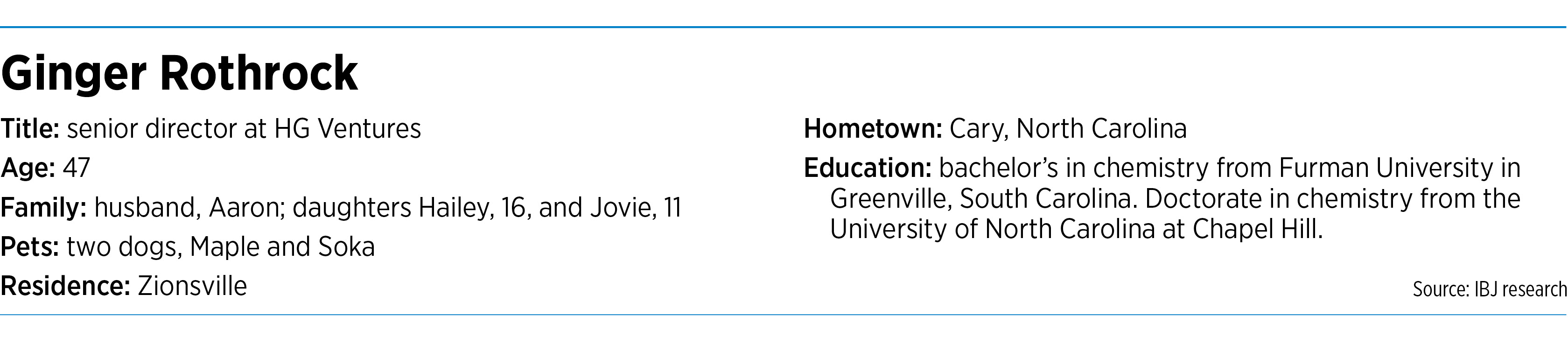
As a subscriber you can listen to articles at work, in the car, or while you work out. Subscribe NowIn retrospect, it seems inevitable that Ginger Rothrock, 47, would make her way to a place like HG Ventures.
The Indianapolis-based enterprise, which launched in 2018, is the venture and innovation arm of The Heritage Group. HG Ventures invests in early- to growth-stage companies that are developing materials and systems used in transportation, infrastructure, environmental services and specialty chemicals—the same industries in which The Heritage Group’s 30-plus operating companies do business.
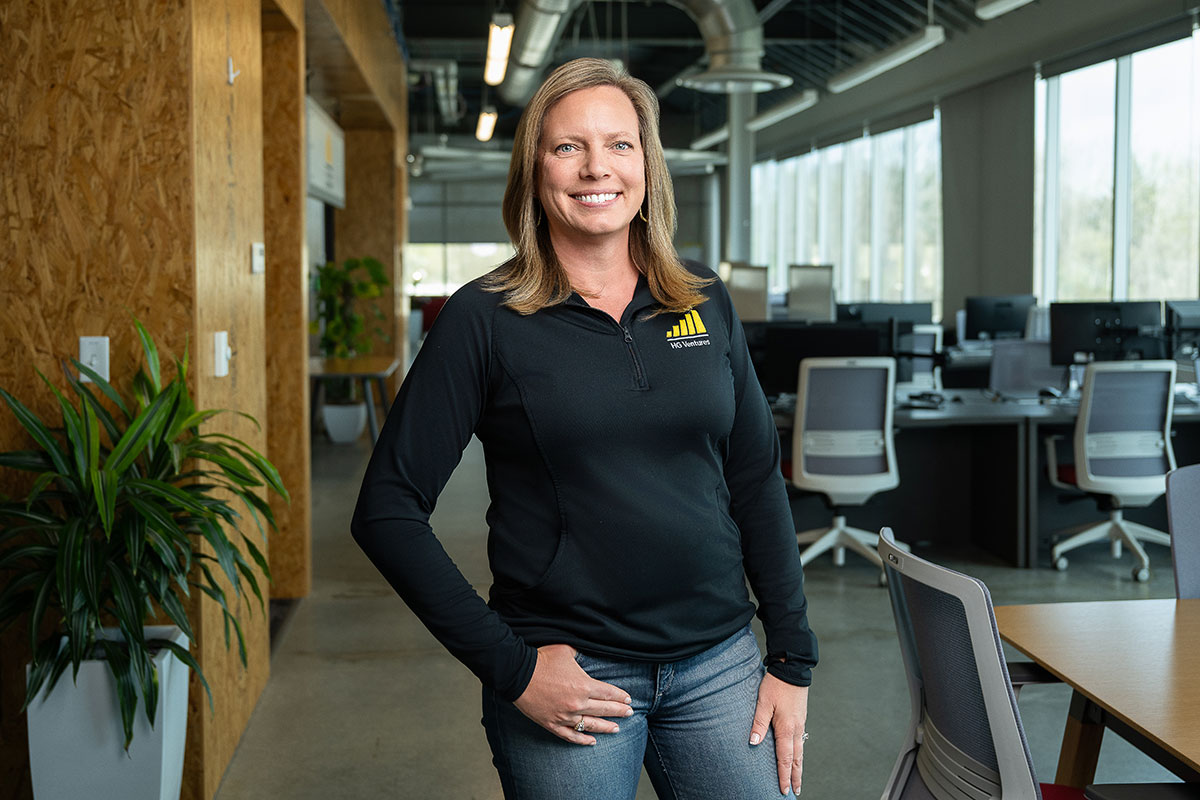
Rothrock’s personal resume includes both entrepreneurship and academic training in chemistry—a perfect combination for what she’s now doing as senior director of HG Ventures.
In 2005, she co-founded Liquidia Technologies—a North Carolina-based nanotechnology company built on research she had been involved with while earning her doctorate in chemistry at the University of North Carolina at Chapel Hill. That company, which now operates as Liquidia Corp., is a biopharmaceutical company developing treatments for rare types of cardiopulmonary disease. (Rothrock is no longer connected with Liquidia, which is currently a publicly traded company with about 170 employees, though she does hold a small number of shares in the company.)
Then, from 2011 to 2018, she held a variety of roles at RTI International, an independent scientific research institute in North Carolina’s Research Triangle Park. She moved here from North Carolina seven years ago, hired by The Heritage Group to help get HG Ventures up and running.
Rothrock sat down recently with IBJ to talk about her background and how it meshes with HG Ventures’ goals. This interview has been edited for length and clarity.
Which came first for you—wanting to study chemistry or wanting to be an entrepreneur?
I come from a family of entrepreneurs—my dad, both grandparents, uncles—so I grew up in the “eat what you kill” kind of life. When the business was going well, we were doing well as a family—and when it wasn’t, we were eating Spam and staying home a lot.
What was your father’s business?
My dad was involved in the brick industry. So I spent much of my childhood in the brick plant, which his office was near, and that community. I’ve always loved construction and physical things.
Coming from an entrepreneurial family, how did you end up studying chemistry? The two things don’t seem like an obvious fit.
My dad was an engineer—that’s what I knew. But then in the ’90s, visiting colleges with engineering, it seemed, I’d say, less innovative. I like the creation side of science more than, say, the scale-up and running of a plant, and found that chemistry was the right place to do more of the front end of innovation at the time. Engineering is more interesting and innovative nowadays, but at the time, the chemistry folks were doing more of what I called more interesting and innovative things. Engineering was all about designing a plant, running a plant, versus tinkering, which is more my interest area.
Has your chemistry training been useful as an entrepreneur?
When you’re in the lab, you fail all the time. You get very used to trying new things, failing, trying again. Sometimes things catch on fire. I think that training as a scientist teaches you just to continually improve whatever it may be—continually test, reassess, start over until you get it right, and then you move on to the next thing.
To date, how many startups has HG Ventures invested in?
We have about 30 active companies in the HG Ventures portfolio. Generally, our first investments are $1 million to $10 million. We’ll do up to $20 million in any company.
So if your initial investment into a company is $10 million, they could potentially get another $10 million if things go well?
Yeah, on average. We’ve had some more, some less.
How does HG Ventures identify which companies to invest in? What are you looking for when you’re making a decision?
First and foremost, we screen for companies that align with The Heritage Group, which includes [industries such as] circular economy and waste, road construction, materials, chemicals and fuels mostly, and things adjacent to that. So we really focus on, where can we as a corporate venture arm help a startup? So that tends to make the universe smaller. Then we look for everything a traditional venture capitalist would look for: team, market that’s got venture return, a solid product within that.
What’s the play here? Is HG Ventures looking to get in, get out, and make a profit just like any other investor?
We’re financially motivated. So we are looking for a financial return. But our thesis is, can we pick really good companies? Because we have so much knowledge and expertise in the markets in which we work, we hope to pick the best companies up front. Then once they’re in our portfolio, we can bring physical assets, knowledge, expertise, go-to-market routes that can then help those companies move faster and hopefully exit for more.
You mentioned that HG Ventures’ portfolio companies have had some successes: Equipment management platform Gauge was acquired by Kansas City, Missouri-based XBE last month; and Zionsville-based 120Water announced in January 2024 a $43 million investment led by New Jersey-based Edison Partners. is HG Ventures pleased with its performance so far?
We’re actually doing quite well so far. The [investment] thesis is holding, even in this tough market.
On an entirely different note: You recently mentioned on LinkedIn that you have completed mental health first aid training. What prompted you to take that course?
I was attracted to it because, being in HG Ventures, I have all these things to offer entrepreneurs. I can talk to them about their business and market and give them product help, but success as an entrepreneur is also about the people. … And as a venture capitalist or scientist, we don’t get training around mental health challenges, by any stretch. It’s very challenging to be an entrepreneur. I was an entrepreneur. I’ve mentored lots of entrepreneurs. You know, the highs are high and the lows are low. Mental health first aid training is a way that helps you recognize when there may be a challenge, a mental health challenge, and guide a person to the right resources. It’s just like regular first aid training. I’m not a doctor. I’m not going to go stitch up your wound. But I can recognize there’s a problem, you know, and kind of stop the bleeding. … It’s just another tool in the toolkit that we can use to help our entrepreneurs.
What was the biggest “Aha!” moment you got out of that training?
I think the biggest “Aha!” was to address any potential problem head-on. If you see something, as quickly as you can pull the person aside and just say, “Are you OK?” And give the person space to talk, and you never know what will come out.•
Please enable JavaScript to view this content.
Editor's note: You can comment on IBJ stories by signing in to your IBJ account. If you have not registered, please sign up for a free account now. Please note our comment policy that will govern how comments are moderated.