
Subscriber Benefit
As a subscriber you can listen to articles at work, in the car, or while you work out. Subscribe Now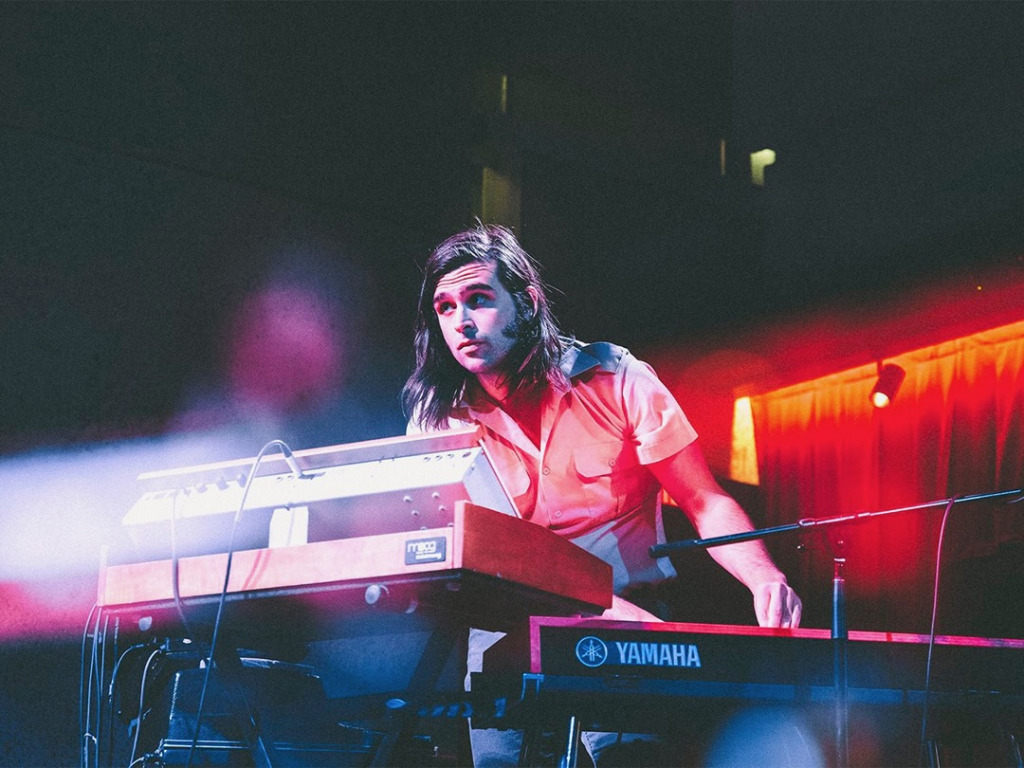
Mathieu David Gagnon says he intentionally avoided listening to other music when making “8 Tableaux,” a 2024 album by his Canadian ensemble Flore Laurentienne.
Gagnon looked to abstract painter Jean-Paul Riopelle (1923-2002) as the inspiration for “8 Tableaux,” and visuals guided the compositions and synthesizer-focused recordings.
He credits the Montreal Museum of Fine Arts for providing books filled with images of Riopelle’s work for research purposes.
“I really wanted to be in the painter state of mind,” Gagnon told IBJ during an online interview.
On March 26, Flore Laurentienne will perform at Tube Factory art space, 1125 Cruft St. The show is part of a U.S. tour that includes performances at the Andy Warhol Museum in Pittsburgh and the Big Ears Festival in Knoxville, Tennessee.
For the tour, Flore Laurentienne features Gagnon on keyboards plus a string quartet and a percussionist. Gagnon describes the sound as “electronic chamber music.”
How did Riopelle’s work, which includes 1950s pieces in which a palette knife was used to apply paint to canvas, translate to music?
Gagnon said different paintings sparked different approaches. In the case of Riopelle’s 1953 painting “Blue Night (La Nuit Bleue),” Gagnon said a song titled “La Nuit Bleue” is “literally a left-to-right transcription of the painting in music.”
The “Blue Night” painting is suggestive of the abstract expressionist work of U.S. painter Jackson Pollock (1912-1956). While Pollock gained fame for his “drip technique” above a horizontal surface, Canadian Riopelle painted on a conventional canvas at an easel.
Musician Gagnon said looking at Riopelle’s paintings changed his perspective regarding structure.
“In my old work, I didn’t use a lot of randomness in my music,” said Gagnon, who lives in Quebec. “But those paintings really inspired me to use randomness in the choice of notes and the rhythm. I think it brings my music to another level of life.”
Gagnon said the instrumentals of “8 Tableaux” can be perceived as having no beginning, middle or end. This interpretation also was influenced by Riopelle.
“When you look at the painting, there’s no beginning or there’s no ending,” he said. “It’s like a screenshot of where the painter was at and when he chose to stop. He can go on and on. In music, time is your canvas.”
Gagnon said his synthesizers fit well with a string quartet’s two violins, viola and cello.
“Like the synths, the string quartet can’t be ‘right’ on the notes,” he said. “There’s always fluctuation from the pitch. One thing I really dig about synthesizers is that you can play in natural temperament. When you play piano, it’s equal temperament. The synthesizers give me the quarter-tone between the notes.”
Among his synthesizers, a Minimoog is the one Gagnon said he can’t live without.
“I am a huge fan of progressive music,” said Gagnon, referring to Minimoog masters such as Rick Wakeman of Yes and Geddy Lee of Rush. “But a real Minimoog is very expensive. I bought tons of monophonic synths, hoping they would sound like a Minimoog. They never did. One day I found a Minimoog and I sold all of the other ones. That was about seven years ago. It never fails me.”
Flore Laurentienne
- When: 7 p.m. March 26
- Where: Tube Factory art space, 1125 Cruft St.
- Admission: $10
- Info: Visit bigcar.org.
Please enable JavaScript to view this content.
Editor's note: You can comment on IBJ stories by signing in to your IBJ account. If you have not registered, please sign up for a free account now. Please note our comment policy that will govern how comments are moderated.