
Subscriber Benefit
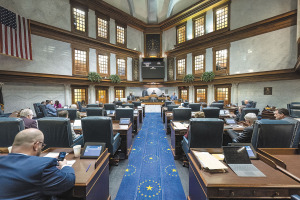
As a subscriber you can listen to articles at work, in the car, or while you work out. Subscribe NowAs the Indiana House and Senate look for a compromise on a final two-year budget plan, we’re siding with the Senate in its vote not to expand the state’s private school voucher plan to higher-income families.
The budget approved by the House eliminates all eligibility requirements for state-funded vouchers used to pay tuition at participating private schools.
Originally, Indiana’s voucher program was created to ensure that lower-income families had an opportunity to send their children to non-public schools. But over the years, lawmakers have expanded the program so that, today, students are eligible for vouchers as long their family earns equal to or less than 400% of the federal benchmark for free or reduced-price school lunches.
For example, a child in a family of four earning up to $230,880 is eligible for a voucher this school year.
Gov. Mike Braun campaigned on a promise to eliminate the limit and make private school vouchers universally available. “Everything I do on this issue will always be based on one simple idea,” Braun said during his State of the State address. “Parents are in charge of their own kids’ education.”
But Senate Appropriations Chair Ryan Mishler, R-Mishawaka, stripped that expansion out of the budget in the name of saving money.
“That’s $170 million that we’d have to add in to cover those students that we just didn’t have,” Mishler said.
We think that’s smart in a year in which lawmakers aren’t (at least at this writing) expecting much new revenue, Medicaid is already eating up a big chunk of the budget, and lawmakers have other priorities, including boosting education funding overall.
We also think it’s not appropriate to expand school vouchers to higher-income families at the same time the state has waitlists for services needed by children with disabilities and aging Hoosiers. The proposed state budget won’t eliminate those backlogs.
In addition, lawmakers are looking to scale back the number of families eligible for subsidized child care. For example, families of four making roughly $41,000 to $48,500 annually will no longer have access to the program. It will be reserved for those making less.
With all that in mind, we think lawmakers and the governor should postpone any additional expansion in the voucher program—at least until other priorities are fully funded.
Between the time IBJ sent this week’s issue to the printer and when you’re reading this editorial, the Legislature was expected to receive an updated fiscal forecast. With any luck, lawmakers will learn that income, sales and corporate taxes are projected to bring in more than they thought when they wrote the first versions of the two-year budget.
But even if that’s the case, we believe lawmakers should put that additional funding toward eliminating waiting lists and providing child care to families that need it. That’s more than just a service for kids; it puts more adults into the workforce at a time when Indiana’s unemployment rate is low.
If there’s enough money left after that to consider universal vouchers, then that’s another conversation.•
__________
To comment, write to [email protected].
Please enable JavaScript to view this content.
Editor's note: You can comment on IBJ stories by signing in to your IBJ account. If you have not registered, please sign up for a free account now. Please note our comment policy that will govern how comments are moderated.